




Compounded skincare prescription: what it is and why it works
TL;DR:
- Compounded skincare prescriptions are custom topical formulas created by licensed pharmacies to meet individual skin needs. They offer personalized adjustments in ingredients, concentrations, and bases, improving treatment outcomes, especially for sensitive and complex skin conditions. Their flexibility allows for better adherence and measurable benefits, making them a promising future approach in skincare.
A compounded skincare prescription is defined as a topical treatment formulated by a licensed compounding pharmacy, under a prescriber’s direction, to meet a patient’s specific skin needs. Unlike mass-market products, which carry fixed ingredient concentrations, a compounded prescription adjusts active ingredients, strengths, and delivery vehicles to match individual skin type, diagnosis, and tolerance. This is the clinical standard for patients whose skin does not respond to retail options. At Them-ethod, we work with this model because personalised dermatology produces measurably better outcomes than one-size-fits-all skincare.
What is a compounded skincare prescription and how does it work?
A compounded skincare prescription is a custom topical formulation created specifically for one patient, not produced in bulk for general sale. The industry term is “compounded dermatological formulation,” and it sits within the broader category of pharmaceutical compounding, which has been practised in clinical settings for decades. Compounded medications often modify FDA-approved drugs into custom bases suited to the patient’s needs. This means a clinician can take a proven active ingredient and reformulate it into a gel, cream, or serum that works with a patient’s specific barrier status.
The process begins with a prescriber, typically a dermatologist or aesthetic clinician, assessing the patient’s skin concerns, sensitivities, and treatment history. That assessment informs a prescription, which is sent to a compounding pharmacy. The pharmacy then prepares the formulation using pharmaceutical-grade ingredients, precise measurements, and quality-controlled processes. The result is a product that exists nowhere on a retail shelf.
Custom skincare prescriptions differ from standard topicals in one fundamental way: every variable is adjustable. Concentration, vehicle, pH, and excipient selection are all chosen for that patient, not for the average consumer. This is what separates compounded skincare from even the most premium retail ranges.

How are compounded skincare prescriptions formulated and customised?
Formulation begins with selecting the right active ingredients for the diagnosed skin concern. A prescriber might choose tretinoin for cell turnover, hydroquinone for pigmentation, azelaic acid for rosacea, or niacinamide for barrier support. These actives are then combined or adjusted in concentrations that suit the patient’s tolerance, not the concentration that suits a mass-market safety margin.
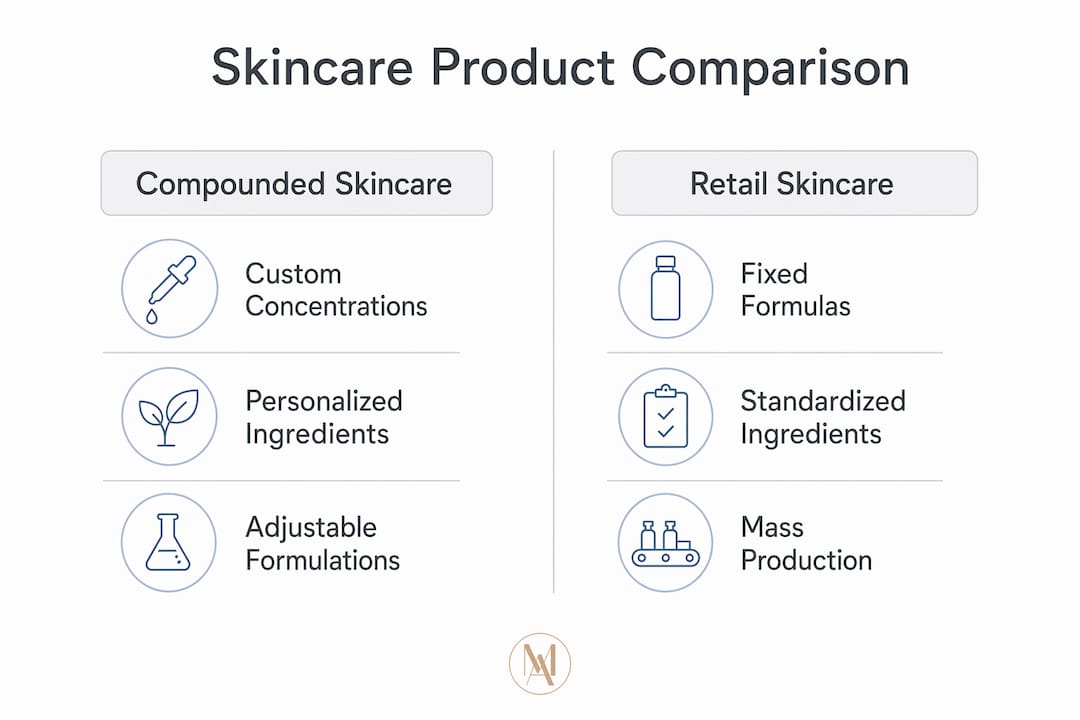
The vehicle, meaning the base in which the active sits, is equally important. Customised vehicles and bases match skin type, diagnosis, and tolerability, improving the overall treatment experience. A patient with dry, reactive skin needs a different base than someone with oily, acne-prone skin. Getting this wrong causes stinging, barrier disruption, and treatment abandonment.
Key formulation considerations include:
- Active ingredient selection: Choosing agents with the strongest evidence for the specific condition, such as tretinoin for photoageing or kojic acid for melasma.
- Vehicle and pH calibration: Matching the base texture and acidity to the patient’s barrier status and skin type.
- Excipient review: Removing preservatives, fragrances, and alcohols to reduce triggers for contact dermatitis and inflammation.
- Concentration titration: Starting at a lower strength and increasing as tolerance builds, rather than applying a fixed commercial dose.
One of the most clinically valuable tools in compounding is the dynamic titration model. Clinicians adjust ingredient strength over time based on patient tolerance, which removes the trial-and-error cycle that causes so many patients to abandon treatment. The formula evolves with the patient’s skin, rather than the patient adapting to the formula.
Pro Tip: Ask your prescriber to specify the vehicle type in your compounded prescription. A water-in-oil emulsion suits dry or compromised skin, while a gel base suits oily or acne-prone skin. This single variable significantly affects both comfort and absorption.
What are the clinical benefits of compounded skincare?
The clinical evidence for compounded dermatological formulations is specific and measurable. A topical compounded formula improved melasma in 65% of patients after 8 weeks, with results comparable to traditional triple-combination creams but with fewer adverse events. That outcome matters because it shows compounding does not sacrifice efficacy for tolerability. It delivers both.
“Compounded skincare prescriptions provide a proactive option to maintain skin barrier health by fine-tuning formulas rather than abandoning treatment due to irritation. Patient adherence improves significantly when regimens are simplified into single formulations combining multiple therapeutic agents.”
The advantages of compounded skincare extend across several clinical areas:
- Acne and post-inflammatory hyperpigmentation: Combining antibacterial, keratolytic, and brightening agents in one formula reduces the number of products applied and the risk of ingredient interactions between separate products.
- Melasma and pigmentation disorders: Slow-release or lower-irritation brightening agents reduce side effects in higher Fitzpatrick skin types, where standard retail brighteners frequently cause rebound hyperpigmentation.
- Rosacea and reactive skin: Removing fragrances and preservatives from the formulation prevents flares that commercial products routinely trigger.
- Hormonal skin changes: Patients with endocrine-related skin concerns benefit from formulas that adjust to changing hormone levels, such as shifting from a lighter base during oily phases to a richer one during dry phases.
Simplifying complex regimens into a single compounded product improves adherence and reduces the risk of applying incompatible actives in the wrong order. Adherence is the single biggest predictor of treatment success in dermatology. A formula that patients actually use consistently outperforms a theoretically superior product that causes discomfort.
How does compounded skincare differ from standard retail products?
Standard retail topicals are formulated for the broadest possible market. This means fixed concentrations, standardised bases, and preservative systems designed for shelf stability rather than skin compatibility. Mass-market topicals with fixed strengths may not address individual skin sensitivities or complex conditions effectively, which leads to poor adherence and treatment discontinuation.
The table below compares the two approaches across the variables that matter most clinically.
| Feature | Compounded prescription | Standard retail topical |
|---|---|---|
| Ingredient concentration | Tailored to patient tolerance | Fixed for mass-market use |
| Vehicle and base | Selected per skin type and diagnosis | Standardised for broad appeal |
| Excipients | Fragrances and preservatives removed as needed | Included for stability and scent |
| Combination actives | Multiple agents in one formula | Usually single active or fixed blend |
| Adjustability | Modified over time as skin changes | Cannot be altered |
| Prescriber oversight | Required | Not required |
The excipient issue is particularly significant for sensitive skin. Commercial products include alcohols, synthetic fragrances, and parabens because these extend shelf life and improve sensory experience for most consumers. For patients with rosacea, eczema, or reactive skin, these same ingredients are common triggers. A compounded formulation removes them entirely, which is not possible with any retail product regardless of price point.
Who benefits most from compounded skincare and how to get it?
Compounded skincare prescriptions are most clinically appropriate for patients whose skin concerns are complex, persistent, or poorly served by retail options. The strongest candidates include:
- Patients with melasma or post-inflammatory hyperpigmentation, particularly those with Fitzpatrick skin types IV to VI, where standard brighteners carry a high risk of irritation.
- Patients with acne that has not responded to over-the-counter treatments, who need specific antibiotic, retinoid, or keratolytic combinations at therapeutic concentrations.
- Patients with rosacea or reactive skin who cannot tolerate the preservatives and fragrances in commercial products.
- Patients experiencing hormonal skin changes, such as those related to pregnancy, perimenopause, or thyroid conditions, where skin behaviour shifts over time.
- Patients seeking a bespoke skincare regimen that consolidates multiple treatment steps into one well-tolerated formula.
Obtaining a compounded prescription follows a clear pathway. First, a consultation with a qualified prescriber, such as a dermatologist, aesthetic clinician, or GP with a dermatology interest, is required. The prescriber assesses the skin, reviews treatment history, and writes a prescription specifying the active ingredients, concentrations, vehicle, and quantity. That prescription goes to a licensed compounding pharmacy, which prepares the formulation under quality-controlled conditions.
Compounded prescriptions require collaboration between healthcare providers and specialised compounding pharmacies to ensure stability, quality, and patient safety. Professional oversight at every stage ensures the formula is stable, correctly dosed, and appropriate for the patient’s current skin status. This is not a process that can be replicated by purchasing individual actives and mixing them at home.
Pro Tip: Before your consultation, document your current skincare routine, any reactions you have experienced, and the specific concerns you want to address. A detailed history helps your prescriber write a more targeted prescription from the first appointment.
Key takeaways
Compounded skincare prescriptions are the most clinically precise option for patients with complex, sensitive, or treatment-resistant skin concerns, because every variable from active concentration to vehicle base is tailored to the individual.
| Point | Details |
|---|---|
| Definition | A compounded prescription is a custom topical made by a licensed pharmacy under a prescriber’s direction. |
| Clinical evidence | Compounded formulas improved melasma in 65% of patients after 8 weeks with fewer adverse events than standard creams. |
| Formulation flexibility | Active concentrations, vehicle type, and excipients are all adjustable to match skin type and tolerance. |
| Adherence advantage | Combining multiple actives into one formula reduces regimen complexity and improves consistent use. |
| Access pathway | A prescriber consultation followed by a licensed compounding pharmacy is the required route to obtain a compounded prescription. |
Why I believe compounding is the future of serious skincare
I have spent years working with clients who arrive having tried every premium retail product available, often spending significant sums, only to find their skin is still reactive, still pigmented, or still breaking out. The pattern is consistent. The products are not failing because they are poor quality. They are failing because they were never designed for that specific person’s skin.
What compounding does, in practice, is remove the compromise. A retail product has to work for thousands of different skin types. A compounded prescription has to work for one. That shift in design intent changes everything, from the concentration of the active to the texture of the base to the absence of the fragrance that was causing the flare all along.
The misconception I encounter most often is that compounding is only for extreme cases. It is not. Compounding is appropriate any time a patient’s skin has a specific need that no available retail product meets precisely. That includes patients with mild but persistent pigmentation, patients who want to consolidate a five-step routine into one well-formulated product, and patients who simply cannot tolerate the preservatives in commercial ranges. For anyone interested in personalising their skincare with clinical precision, compounding deserves serious consideration.
The future of skincare is not a better mass-market formula. It is a formula made for you.
— Jess
Compounded skincare at Them-ethod
Them-ethod works with clinically grounded skincare solutions for patients who need more than retail can offer. For acne-prone skin, the PCA Skin ClearSkin serum delivers targeted treatment with a formulation developed for sensitive and reactive skin types. For pigmentation and uneven tone, the NeoStrata collection applies science-backed actives across a range of skin concerns. Both sit within a wider offering that includes virtual consultations with experienced clinicians, prescription-strength products, and personalised treatment planning. If you are ready to move beyond fixed formulations, a consultation with the Them-ethod team is the right starting point.
FAQ
What is a compounded skincare prescription?
A compounded skincare prescription is a topical formulation prepared by a licensed compounding pharmacy under a prescriber’s direction, with active ingredients, concentrations, and bases tailored to one patient’s specific skin needs.
How does compounded skincare differ from prescription retail products?
Retail prescription products have fixed formulations approved for general use. Compounded prescriptions are made individually, allowing the prescriber to adjust concentrations, remove irritants, and combine actives in ways no commercial product offers.
Who can prescribe compounded skincare?
A qualified prescriber, such as a dermatologist, aesthetic clinician, or GP with dermatology experience, can write a compounded skincare prescription, which is then prepared by a licensed compounding pharmacy.
How long does a compounded skincare prescription take to work?
Clinical studies report measurable improvements in conditions such as acne, rosacea, and pigmentation within 2–3 weeks, with significant melasma improvement seen in 65% of patients after 8 weeks of consistent use.
Can compounded skincare be adjusted over time?
Yes. The dynamic titration model allows prescribers to modify ingredient concentrations as the patient’s skin responds, which avoids the trial-and-error cycle common with fixed retail formulations.