



The role of skin history in treatment: a clinician's guide
A thorough dermatological history directly alters diagnosis, immediate management, and referral decisions before a single lesion is examined. The MSD Manual confirms that history elements such as duration, site of onset, spread pattern, and prior treatment responses frequently determine diagnosis or prompt further testing. Validated tools including the Dermatology Life Quality Index (DLQI) and the ICE (Ideas, Concerns, Expectations) framework add a psychosocial dimension that shapes both management intensity and referral thresholds. Critically, a negative history can be as diagnostically informative as a positive one.
The domains this guide covers:
- Presenting complaint and lesion characteristics
- Medications, topical products, and environmental exposures
- Systemic history and relevant comorbidities
- Psychosocial impact and patient beliefs
- Red flags and referral criteria
Table of Contents
- How skin history shapes every treatment decision
- The essential dermatological history checklist
- How specific history findings change diagnosis and management
- Practical frameworks and mnemonics for efficient consultations
- Medications, topical products, and exposures: when to investigate
- Assessing psychosocial impact and communicating sensitively
- Red flags and referral criteria you must not miss
- How to document the history and plan follow-up effectively
- Key takeaways
- Why the history is where clinical decisions are actually made
- Useful sources for further reading and clinic tools
How skin history shapes every treatment decision
The role of skin history in treatment is not supplementary; it is the primary clinical filter. Before you reach for a prescription pad or refer to secondary care, the history has already narrowed the differential, flagged contraindications, and identified whether the presentation is urgent. The PCDS guidance lists duration, associated symptoms, site of onset and spread, provoking factors, and prior treatment responses as the core items that inform both urgency and likely aetiology. Miss any one of them and you risk treating the wrong condition, prescribing a drug the patient has already failed, or overlooking a systemic disease hiding behind a rash.
The patient skin history significance extends beyond diagnosis. Social history items such as alcohol intake and occupation carry direct therapeutic implications: alcohol use limits methotrexate prescribing, and an occupational exposure history can redirect the entire management plan from topical therapy to workplace intervention. Structured history-taking is also relational. Clinicians who explore personal concerns increase patient trust and treatment adherence, which matters enormously for chronic conditions requiring long-term regimens.
The essential dermatological history checklist
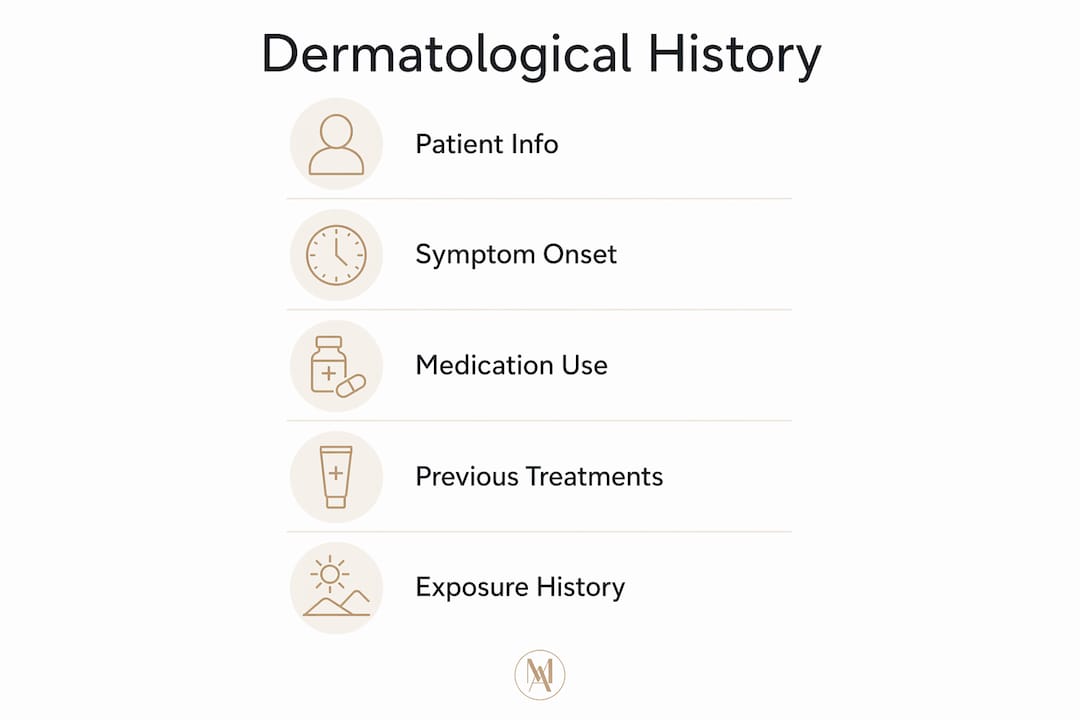
A reproducible, ordered checklist prevents missed clues in time-pressured consultations. The British Journal of Nursing recommends structured transitions from open to semi-open to focused questions to balance thoroughness with efficiency. Work through these domains in every consultation.
Presenting complaint (HOPC)
- Site: “Where did it first appear, and has it spread?”
- Onset and duration: exact date or approximate period; acute versus chronic
- Progression: improving, worsening, or fluctuating; any clear triggers
- Character: itch, pain, burning, or no sensation; severity on a 0–10 scale
- Associated symptoms: fever, joint pain, weight loss, fatigue, oral or genital involvement
- Morphology changes: has the lesion changed colour, size, or surface texture?
Lesion-specific items
- Initial site and direction of spread (centrifugal, dermatomal, follicular)
- Symmetry: bilateral symmetry favours systemic or endogenous causes; asymmetry raises concern for infection or malignancy
- Prior appearance and any documented photographs
Past episodes and treatment responses
- Previous identical or similar episodes; what was diagnosed and by whom
- Treatments used: name, strength, frequency, duration, and outcome
- Adverse effects from prior therapies, including topical steroids
Demographics and epidemiology
- Age and sex: atopic eczema peaks in childhood; psoriasis has bimodal onset; bullous pemphigoid is predominantly elderly
- Ethnicity and Fitzpatrick phototype: post-inflammatory hyperpigmentation is more pronounced in phototypes IV–VI; certain conditions (e.g. discoid lupus) present differently across skin tones
- Residence, recent travel, and country of origin: leishmaniasis, tropical tinea, and endemic mycoses require a travel history
Systemic enquiry
- Diabetes (predisposes to candidiasis, necrobiosis lipoidica, and poor wound healing)
- Hepatitis C (associated with lichen planus and porphyria cutanea tarda)
- Autoimmune disease: thyroid, connective tissue, inflammatory bowel
- Arthralgia or arthritis (psoriatic arthritis, reactive arthritis)
- Unexplained weight loss, night sweats, or lymphadenopathy
Medication and allergy history
- All prescribed medicines including dose and start date; note that long-term use does not exclude drug causation
- OTC products, herbal remedies, vitamins, and supplements
- Topical agents: ask explicitly, “Tell me everything you’ve used on this area” — non-judgemental phrasing yields a more accurate product history
- Documented allergies and the nature of the reaction (true allergy versus intolerance)
Contact, occupational, and social history
- Occupation and specific exposures: wet work, cutting oils, rubber gloves, hairdressing chemicals
- Household contacts with similar symptoms (scabies, tinea capitis, impetigo)
- Animal contacts and hobbies
- Sexual history when relevant (syphilis, HIV-associated dermatoses, genital warts)
- Smoking, alcohol, recreational drug use, and sleep patterns
- Sun exposure history and use of sunbeds
How specific history findings change diagnosis and management
The impact of skin history on care becomes clearest when a single piece of information redirects the entire clinical plan. The table below maps discrete history findings to likely diagnostic categories and the immediate action each should trigger.

| History finding | Likely diagnostic category | Immediate action |
|---|---|---|
| New drug started 2–6 weeks before eruption | Drug eruption (morbilliform, urticarial, or lichenoid) | Stop or substitute offending drug; avoid re-challenge |
| Rash improves at weekends and on holiday | Occupational contact dermatitis | Patch testing; occupational health referral |
| Prior topical steroid use; annular scaly rash | Tinea incognito | Skin scraping for mycology; start antifungal |
| Arthralgia plus psoriasiform plaques | Psoriatic arthritis | Rheumatology referral; avoid systemic steroids |
| Travel to tropics; ulcerated nodule | Cutaneous leishmaniasis | Dermatology referral; tissue biopsy and culture |
| Household contact with itch | Scabies | Treat patient and all household contacts simultaneously |
| Weight loss, night sweats, lymphadenopathy | Lymphoma or systemic malignancy | Urgent 2-week-wait referral; urgent bloods |
Consider a patient presenting with a widespread, itchy morbilliform rash. Without a medication history, the working diagnosis might be viral exanthem. Adding the history that allopurinol was started five weeks earlier shifts the diagnosis to a drug eruption, changes the immediate action to drug cessation, and raises the urgency if systemic features are present. Similarly, a patient with a persistent hand dermatitis who mentions it clears completely during annual leave almost certainly has occupational contact dermatitis, directing management towards patch testing rather than escalating topical steroids.
Prior treatment responses are equally decisive. A patient who has already failed two courses of moderate-potency topical steroids for eczema should prompt consideration of a secondary care referral, a DLQI assessment, and discussion of systemic or biologic options rather than a third identical prescription.
Practical frameworks and mnemonics for efficient consultations
Structured frameworks reduce missed diagnostic clues and improve efficiency in brief consultations. The following tools are ready to use from your next clinic session.
ABCDEFGH for pigmented lesions
- Asymmetry — one half does not mirror the other
- Border — irregular, notched, or poorly defined edge
- Colour — variation within the lesion (brown, black, red, white, or blue)
- Diameter — greater than 6 mm (though melanomas can be smaller)
- Evolution — any change in size, shape, colour, or new symptoms
- Feeling — itch, bleeding, or crusting
- Genetics — personal or family history of melanoma
- Hydration/Health — immunosuppression or chronic sun damage
The three C’s for rashes
- Character: what does it look, feel, and behave like?
- Course: how has it changed over time?
- Context: what else is happening (drugs, travel, contacts, systemic symptoms)?
ICE framework script
ICE integrates naturally into a five-minute consultation without adding significant time:
- “What do you think might be causing this?” (Ideas)
- “Is there anything about it that particularly worries you?” (Concerns)
- “What were you hoping we might be able to do today?” (Expectations)
These three questions frequently surface the patient’s fear of cancer, their belief that the condition is contagious, or their expectation of a specific cream they have read about online. Addressing each directly improves adherence and reduces unnecessary re-attendance.
Timed consultation templates
2-minute rapid assessment (urgent or walk-in): Open with “Tell me about this in your own words” (30 seconds), then move immediately to onset, drug history, systemic symptoms, and red-flag screen.
5–10-minute extended review: Full HOPC, medication and allergy history, social and occupational history, ICE, and a brief DLQI screen. Document a one-line diagnostic impression before examination.
Ready-to-use verbal prompts:
- “When exactly did you first notice it?”
- “Has anything made it better or worse?”
- “Have you used anything on it, including anything from a pharmacy or online?”
- “Are you taking any new medicines, including anything bought without a prescription?”
- “Has anyone else at home or work had something similar?”
For a step-by-step consultation workflow that maps these templates to clinic process, Them-ethod’s structured guide offers practical implementation support.
Medications, topical products, and exposures: when to investigate
Medication history is one of the highest-yield components of any skin assessment. Drug eruptions are common, frequently delayed, and often missed because clinicians assume that a medicine taken for months cannot be the cause. That assumption is incorrect: allopurinol and penicillins, for example, can cause reactions weeks after initiation, and long-term use does not exclude drug causation.

Drug timeline approach: ask for the start date of every medicine and map it against the eruption onset. A latency of 1–3 weeks is typical for morbilliform reactions; fixed drug eruptions can recur within hours of re-exposure. Key drug classes to flag include allopurinol, penicillins, cephalosporins, sulphonamides, beta-blockers, ACE inhibitors, and gliptins.
Topical and OTC products deserve equal scrutiny. Patients commonly apply creams, oils, herbal preparations, or cosmetic products before attending clinic, and these can dramatically alter lesion appearance. Topical steroids cause tinea incognito; certain skin chemistry interactions between personal care products and the skin barrier can provoke or sustain contact reactions. Ask patients to bring containers where practical.
| Offending agent / exposure | Typical latency | First-line investigation |
|---|---|---|
| Allopurinol, sulphonamides | 2–6 weeks | Stop drug; FBC, LFTs, U&Es; dermatology referral if severe |
| Penicillins, cephalosporins | Days to 2 weeks | Stop drug; allergy testing if re-challenge needed |
| Rubber / latex (gloves, condoms) | Minutes to hours | Patch testing (delayed) or prick testing (IgE-mediated) |
| Occupational wet work / cutting oils | Weeks to months | Patch testing; occupational health referral |
| Topical steroid misuse | Variable | Skin scraping for mycology; withdraw steroid gradually |
| Travel to endemic region | Days to weeks | Skin swab or scraping; tissue biopsy if nodular |
When to investigate:
- Swab: suspected bacterial superinfection, impetigo, or infected eczema
- Skin scraping / mycology: any annular, scaly, or asymmetric rash where tinea is possible
- Patch testing: chronic hand dermatitis, facial dermatitis, or any suspected allergic contact dermatitis; refer to a specialist patch testing service
- Biopsy: uncertain diagnosis, suspected malignancy, or failure to respond to first-line treatment
- Blood tests: hepatitis C serology (lichen planus, porphyria cutanea tarda), ANA and dsDNA (lupus), FBC and LFTs before systemic agents, thyroid function in urticaria
Assessing psychosocial impact and communicating sensitively
Chronic skin disease correlates with higher rates of anxiety and depression, and formal assessment with tools such as the DLQI guides when to refer for psychological support. The DLQI is a validated, ten-item questionnaire covering symptoms, daily activities, leisure, work, personal relationships, and treatment burden. Scores range from 0 to 30: a score of 0–1 indicates no effect on quality of life; 2–5 small effect; 6–10 moderate effect; 11–20 very large effect; 21–30 extremely large effect. In NHS practice, a DLQI above 10 is typically one of the thresholds used to support referral for systemic therapy or psychological input.
Integrate psychosocial questions as brief adjuncts rather than a separate lengthy screen. In a busy clinic, a single ICE question or the DLQI can be completed in the waiting room using a pre-visit form, freeing consultation time for clinical decision-making.
Patients commonly believe skin disease is self-inflicted or caused by poor hygiene. Proactively offering reassurance early reduces harmful self-treatment and promotes safer management. Practical communication strategies:
- Name the condition clearly and explain its cause before the patient asks.
- Correct hygiene myths directly: “This is not caused by being unclean.”
- For stigmatised conditions (psoriasis, acne, genital dermatoses), acknowledge the emotional impact before moving to treatment options.
- For sexual history, use normalising language: “I ask everyone these questions as part of a thorough assessment.”
Referral thresholds for mental health support: a DLQI above 10, active suicidal ideation, or significant functional impairment (inability to work, sleep, or maintain relationships) warrants referral to a liaison psychiatry or clinical psychology service, or signposting to the British Association of Dermatologists’ patient support resources.
Pro Tip: Integrate the DLQI as a pre-visit form rather than a verbal screen. Patients score themselves more honestly on paper, and a completed form gives you a baseline to track treatment response at follow-up.
Red flags and referral criteria you must not miss
Certain history and examination findings require urgent action regardless of how benign the lesion appears at first glance. The following red flags should prompt same-day assessment, urgent referral, or emergency admission.
Urgent red flags (same-day or emergency):
- Widespread blistering or skin detachment (suspected Stevens-Johnson syndrome or toxic epidermal necrolysis): admit immediately
- Mucosal involvement (oral, ocular, or genital erosions) alongside a skin eruption
- Rapidly spreading erythema with systemic sepsis features (necrotising fasciitis, staphylococcal scalded skin syndrome)
- Angio-oedema with airway compromise
Two-week-wait suspected cancer pathway (UK):
- Pigmented lesion with any ABCDEFGH feature, particularly evolution or bleeding
- Suspected squamous cell carcinoma: indurated, ulcerated, or rapidly growing keratinising lesion
- Suspected Merkel cell carcinoma: rapidly growing, firm, violaceous nodule in elderly or immunosuppressed patients
- Unexplained lymphadenopathy with skin changes suggesting lymphoma
Expedited dermatology referral (within 2 weeks, non-cancer pathway):
- Widespread or severe psoriasis unresponsive to primary care treatment
- Suspected pemphigus or pemphigoid
- Connective tissue disease (lupus, dermatomyositis)
- Diagnostic uncertainty after two treatment failures
Immediate in-clinic actions:
- Stop the suspected offending drug and document the decision clearly
- Arrange urgent biopsy if malignancy or bullous disease is suspected
- Initiate infection control precautions for suspected scabies or tinea capitis in institutional settings
- Request urgent bloods (FBC, U&Es, LFTs, CRP) if systemic involvement is likely
How to document the history and plan follow-up effectively
Good documentation makes the history useful for every clinician who sees the patient after you. A structured one-line summary at the top of the note saves time and reduces prescribing errors.
One-line summary template: “[Age]/[sex], [duration] history of [morphology] at [site], likely [diagnostic impression], possible [differential], [immediate action taken], review in [timeframe].”
Example: “34F, 6-week history of pruritic morbilliform rash on trunk and arms, likely drug eruption (allopurinol started 5 weeks ago), allopurinol stopped today, review in 2 weeks or sooner if worsening.”
Documentation checklist:
- Allergy status confirmed and coded in the record
- All current medications listed with start dates
- Consent for clinical photography obtained and documented; images stored securely
- Baseline investigations recorded (e.g. FBC, LFTs before methotrexate or acitretin)
- Monitoring plan stated: frequency of bloods, parameters to check, and who is responsible
- Safety-netting advice given and documented: what to do if the condition worsens before review
Follow-up schedule:
- Acute infections or drug eruptions: review in 1–2 weeks
- Moderate eczema or psoriasis starting topical therapy: 4–6 weeks
- Systemic agents (methotrexate, ciclosporin): bloods at 2 weeks, then monthly until stable
- Trigger for earlier review: spreading lesion, systemic symptoms, or failure to improve at 50% of expected timeframe
Pre-visit structured forms improve data consistency and save clinic time. Them-ethod’s client onboarding guide offers a practical template for capturing baseline data including medicines, product use, and prior treatments before the consultation begins.
Key takeaways
A structured dermatological history directly determines diagnosis, guides immediate treatment choices, and identifies red flags that require urgent referral before any examination finding is considered.
| Point | Details |
|---|---|
| History precedes examination | Onset, spread, drug history, and prior treatments narrow the differential before a lesion is touched. |
| Drug causation is always possible | Long-term use does not exclude a drug eruption; map every medicine against the eruption timeline. |
| DLQI guides management intensity | A DLQI score above 10 supports referral for systemic therapy or psychological input in NHS practice. |
| Red flags demand immediate action | Widespread blistering, mucosal involvement, or systemic features require same-day or emergency assessment. |
| Use ABCDEFGH, ICE, and structured mnemonics | These frameworks reduce missed clues and improve consultation efficiency in time-limited settings. |
Why the history is where clinical decisions are actually made
There is a tendency in clinical training to treat history-taking as the preamble to the “real” work of examination and investigation. That framing is worth challenging. In dermatology, the history frequently closes the differential before the patient has removed a single item of clothing. The occupation, the new drug, the holiday that cleared everything, the steroid cream bought online: these details do not emerge from a biopsy or a blood panel. They emerge from asking the right questions in the right order.
What we find consistently, working at the intersection of clinical practice and evidence-based skincare, is that the history also determines whether a patient will actually follow the treatment plan. A clinician who asks about concerns and expectations, who names the condition clearly and corrects the hygiene myth the patient has been carrying for years, achieves something a prescription alone cannot. The DLQI and ICE framework are not bureaucratic add-ons; they are the mechanism by which a consultation becomes therapeutic rather than merely transactional.
The practical lesson is straightforward: invest the first two minutes of every consultation in open questioning, and the remaining time becomes more efficient, not less. The history is not the warm-up. It is the work.
Useful sources for further reading and clinic tools
The following resources support the clinical frameworks, referral pathways, and validated tools described in this guide.
- PCDS: Taking a dermatology history — the Primary Care Dermatology Society’s concise checklist of core history items for rashes and lesions; useful as a printed proforma for GP and primary care settings.
- MSD Manual: Evaluation of the dermatologic patient — comprehensive professional-edition guidance covering all history domains; authoritative reference for medical students and junior clinicians.
- NCBI Bookshelf: The Dermatologic History — detailed chapter on medication history, topical product questioning, and the diagnostic value of a negative history; freely accessible.
- British Journal of Nursing: Dermatological assessment — covers history-taking technique, DLQI, and psychosocial assessment; relevant for nursing and allied health professionals.
- JAAPA 2025: Taking a dermatological history — more than skin — practice-focused article on rapport-building, ICE integration, and the relational dimension of history-taking.
- British Association of Dermatologists (BAD) — patient information leaflets, DLQI scoring sheets, and guidance on the two-week-wait pathway; available at bad.org.uk.
- NHS England two-week-wait referral guidance — defines the suspected cancer pathway criteria for skin lesions; accessible through local integrated care board portals.
- Them-ethod: Best practices for skin consultations — structured consultation approaches including ABCDEFGH application and proforma examples, written for clinicians adapting workflows to include virtual and in-person assessments.
This article provides general clinical information for educational purposes. It does not constitute medical advice. Clinicians should confirm current referral criteria, prescribing thresholds, and local guidelines with their NHS trust, integrated care board, or a qualified specialist for individual patient decisions.