


How to layer skincare products for best results
TL;DR:
- Proper skincare layering from light to heavy enhances product efficacy and maintains skin health. Using products in the wrong order can reduce benefits by up to 50% and damage the skin barrier. Consistency, correct sequencing, and understanding ingredient pH are essential for effective routines and visible long-term results.
Most people own the right products. The problem is the order. Knowing how to layer skincare products correctly is the single most impactful change you can make to an existing routine, yet it is one of the most consistently misunderstood aspects of skincare. Apply things in the wrong sequence and you can reduce product efficacy by up to 50%, regardless of how premium your formulations are. This guide covers everything from foundational principles and step by step skincare layering for both morning and evening routines, to troubleshooting the mistakes that quietly sabotage your results.
Table of Contents
- Key takeaways
- Understanding product types and textures
- Morning and evening layering routines
- Common layering mistakes to avoid
- Signs your routine is working and when to adjust
- My take on skincare layering
- Build your ideal layering routine with Them-ethod
- FAQ
Key takeaways
| Point | Details |
|---|---|
| Thinnest to thickest | Apply products from lightest to heaviest consistency to maximise absorption of each layer. |
| Separate conflicting actives | Vitamin C and retinol require different pH environments and should be used at separate times of day. |
| Sunscreen always last | Mixing sunscreen with moisturiser reduces SPF protection significantly; apply it as a dedicated final step. |
| Introduce actives gradually | Use one new active for four to six weeks before adding another to protect the skin barrier. |
| Consistency drives results | Active ingredients need weeks to show visible change; patience and repetition matter far more than complexity. |
Understanding product types and textures
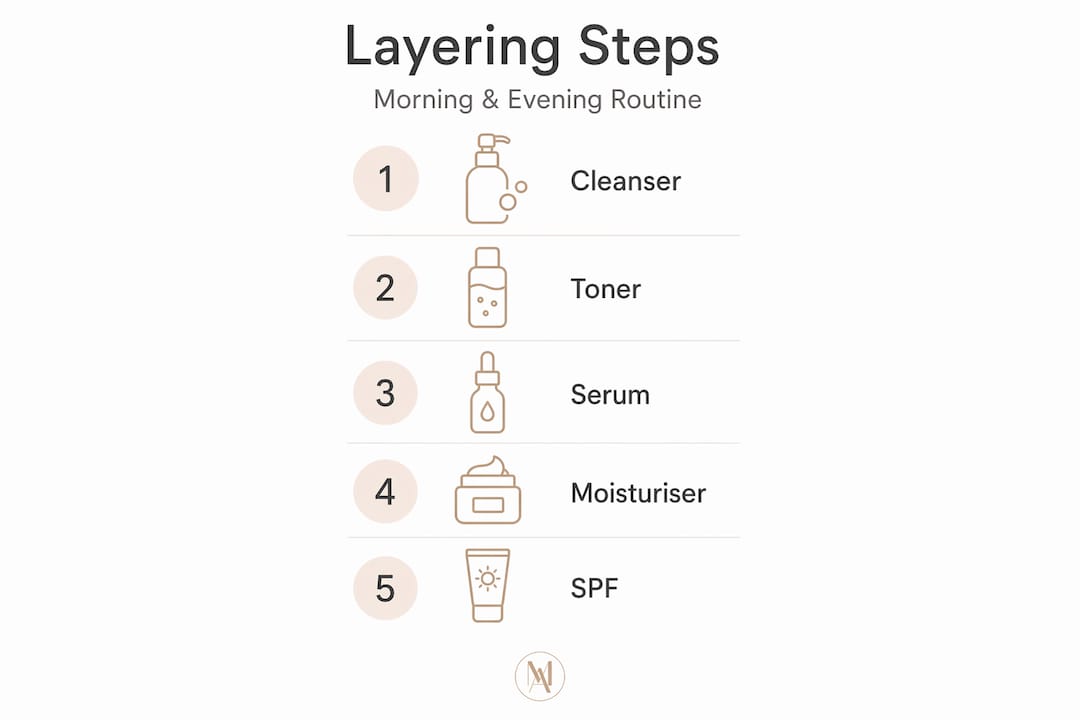
Before you can execute a proper layering sequence, you need to understand what each product in your routine is actually doing. Products broadly fall into five categories: cleansers, toners and essences, treatments (serums and actives), moisturisers, and sunscreen. Each category has a defined functional role, and that role determines where it sits in your routine.
The principle governing sequence is texture and molecular weight. Lighter, water-based products have smaller molecules that need direct contact with the skin to penetrate effectively. Heavier, oil-based or emollient formulas sit on top and create a barrier that prevents anything applied afterwards from absorbing properly. Layering in the wrong direction means your most active, expensive serums may never reach the cells they were formulated to treat.
Product categories and their layering position
| Category | Consistency | Layering position |
|---|---|---|
| Cleanser | N/A (rinse off) | Step 1 (preparation) |
| Toner / Essence | Watery | Step 2 |
| Vitamin C serum | Light, watery | Step 3 (AM) |
| Treatment serums | Light to medium | Step 3 to 4 |
| Eye cream | Light to medium gel or cream | Step 5 |
| Moisturiser | Medium to thick cream | Step 6 |
| Facial oil | Occlusive | Step 7 (before SPF if used) |
| Sunscreen | Varies | Final AM step |
pH compatibility matters just as much as texture. Vitamin C requires a pH of 2.5 to 3.5 to remain stable and active, while retinol functions best at a more neutral pH. Layering them simultaneously without separation does not just reduce their individual benefits. It can deactivate both.
Key preparation habits that make layering more effective include:
- Double cleanse in the evening: an oil-based cleanser first removes makeup and sebum, followed by a water-based cleanser to clear remaining impurities. This creates the clean base that your treatments actually need.
- Clean hands every time: applying products with unwashed hands introduces bacteria and disrupts the skin’s microbiome.
- Allow each product to settle briefly: this is especially relevant before applying treatments over a toner.
Morning and evening layering routines
The order of skincare products differs between AM and PM because your skin’s needs differ. Morning is about protection and preparation. Evening is about repair and treatment. Once you understand that distinction, the logic of each sequence becomes self-evident.
Morning routine: step by step
- Cleanser. A gentle, pH-balanced cleanser removes overnight product residue and surface oils. If your skin is not congested or oily in the morning, a water rinse can suffice.
- Toner or essence. Apply to damp skin to replenish hydration and begin preparing the skin’s surface for active absorption. Hydrating toners with hyaluronic acid or glycerin work well here.
- Vitamin C serum. Apply vitamin C directly after toning, before any other treatment products, to maintain its pH-dependent potency. This is the optimal placement for antioxidant protection against daily UV and environmental exposure.
- Additional treatment serums. If you use niacinamide, growth factors, or peptide serums, apply these after vitamin C. Niacinamide is particularly useful here as it acts as a mediator compatible with most other actives and helps buffer potential irritation.
- Eye cream. Apply with your ring finger using a gentle patting motion around the orbital bone. The eye area requires dedicated formulations due to the thinness of the skin.
- Moisturiser. Lock in your treatment layers and support barrier function. This is where you apply a moisturiser suited to your skin type, whether that is a lightweight gel for oilier skin or a richer cream for dry or mature skin.
- Sunscreen. Always the final step. Mixing sunscreen with moisturiser dilutes its protective film and can reduce SPF efficacy by 30% or more. Apply chemical sunscreen at least 15 minutes before sun exposure; mineral formulas are effective immediately.
Pro Tip: Allow your vitamin C serum 60 seconds to fully absorb before applying the next product. This short wait preserves its stability and prevents pH interference with your next layer.
Evening routine: step by step
- Double cleanse. Essential if you have worn makeup, SPF, or an oil-based product during the day.
- Toner or essence. Same as the morning, to replenish and prepare.
- Exfoliant (as needed, two to three times per week). AHAs and BHAs work at a low pH and should be applied to clean skin before serums. Do not layer exfoliating acids on the same night as retinol. Retinoids and exfoliating acids should be alternated to protect the skin barrier.
- Retinol or retinoid treatment. If not using an exfoliant that evening, this is where retinol belongs. New to retinol? Use the sandwich method: apply a thin layer of moisturiser first, then retinol, then moisturiser again on top. The moisturiser-retinol-moisturiser sequence slows absorption and significantly reduces irritation without compromising the active’s efficacy. You can read more about retinol layering principles to get the most from this ingredient.
- Peptide or barrier-support serum. If you are not using retinol that night, this is an excellent option to support collagen production and strengthen the skin.
- Eye cream. Applied as in the morning routine.
- Rich moisturiser or night cream. The final PM step seals everything in and supports overnight skin repair.
Pro Tip: If you experience stinging when applying actives, it is rarely a sign the product is “working.” It usually signals either the wrong application order or a compromised barrier. Dial back and simplify before adding more.
Common layering mistakes to avoid
Even experienced skincare users make these errors. Some reduce your products’ effectiveness. Others actively damage the skin barrier.
- Applying oil-based products too early. Oils are occlusive by nature. Applying them before lighter serums creates a physical barrier that prevents those serums from penetrating the skin. Facial oils go near the end of your routine, always.
- Mixing vitamin C and retinol in the same step. These two actives need different pH environments to function. Using them together without a time gap or AM/PM split risks deactivating both. A 20 to 30 minute wait time between the two is the minimum if splitting them into separate steps within the same routine.
- Blending sunscreen into moisturiser. It is tempting to save time, but the result is a diluted, uneven SPF film across your skin. This is one of the most common sun protection errors made in daily routines.
- Introducing too many actives simultaneously. Overloading skin with multiple strong actives causes barrier damage marked by stinging, persistent redness, and heightened sensitivity. The guideline is one new active at a time, introduced over a four to six week window.
- Layering too quickly and causing pilling. Product pilling, where your skincare rolls or balls up on the skin, often arises from layering incompatible textures too quickly. Give each layer 30 to 60 seconds to absorb before the next.
A damaged skin barrier cannot absorb active ingredients effectively, no matter how good the formula is. Simplifying your routine and repairing the barrier first will always produce better outcomes than adding more products to an already stressed skin.
Signs your routine is working and when to adjust
Knowing that your layering is correct is not always immediately obvious because skin does not transform overnight. What you are looking for in the short term are qualitative shifts, not dramatic visual changes.
Signs your routine is working well include improved skin texture, consistent hydration without tightness or excess oil, and a visible reduction in redness or sensitivity over the first few weeks. If products are absorbing cleanly without pilling and your skin feels calm after application, your product sequencing is on track.
For active ingredients, the timeline for measurable results is longer. Consistent use of retinol over 12 to 16 weeks is typically needed before visible changes in fine lines and skin texture become apparent. Vitamin C takes four to twelve weeks for noticeable brightening. Patience here is not a virtue. It is the actual mechanism.
Pro Tip: Take a photograph of your skin in the same lighting every four weeks. Progress in skincare is gradual and easy to dismiss day-to-day. A side-by-side comparison across eight weeks often reveals changes you had entirely stopped noticing.
Seasonal adjustments matter too. Skin tends to lose more moisture during winter months, which may mean incorporating a richer moisturiser or hydrating serum. In summer, a lighter texture under SPF often performs better. Routine awareness is not about perfecting a fixed programme. It is about responding to what your skin actually needs at any given time.
If irritation, persistent breakouts, or barrier damage continue despite simplifying your routine, that is the signal to seek professional guidance rather than continue experimenting independently. Building a properly structured routine with clinician input often resolves months of trial and error in a single consultation.
My take on skincare layering
I have spent a lot of time working with clients whose routines read like a clinical trial protocol. Twelve products. Multiple actives. Rigorous morning and evening sequences. And yet their skin was inflamed, reactive, or stubbornly unchanged. The issue was not a lack of effort. It was too much complexity applied in the wrong order.
What I have learned is that a well-layered routine of four or five well-chosen products consistently outperforms a ten-step chaos pile. The science of how to layer skincare products is straightforward once you stop treating your routine as a collection of individual heroes and start thinking about how they interact. Vitamin C does not fail on its own. It fails when retinol is layered directly on top of it at the wrong pH, or when a thick occlusive is applied first and blocks it from reaching the skin entirely.
The other thing I would say is this: most people abandon their actives far too soon. Retinol gets blamed for not working after three weeks. Vitamin C gets labelled ineffective after a month. But the skin’s renewal cycle alone takes 28 days or more, and collagen production changes happen over months. Consistency beats complexity every single time. Simplify your routine, sequence it correctly, and then give it time to actually work.
— Jess
Build your ideal layering routine with Them-ethod
At Them-ethod, we believe the best layering routine starts with the right formulations, not the most formulations. Whether you are structuring a routine from scratch or refining an existing one, the products you choose need to work together, not against each other. Our curated range includes targeted treatments like the PCA Skin Clearskin serum, formulated to sit cleanly within a properly layered routine without disrupting other actives. For those committed to retinol, PCA Retinol Night 0.5% offers a precise, medical-grade concentration designed for correct evening layering. Browse our full NEOSTRATA collection for professional-grade exfoliants and serums selected with layering compatibility in mind.
FAQ
What is the correct order of skincare products?
The correct order runs from thinnest to thickest: cleanser, toner or essence, targeted serums, eye cream, moisturiser, and sunscreen (morning only). Applying products in this sequence optimises ingredient absorption and prevents heavier formulas from blocking lighter actives.
Can you use vitamin C and retinol together?
You can use both, but not at the same time. Vitamin C requires a low pH of 2.5 to 3.5 while retinol needs a more neutral environment. The safest approach is to use vitamin C in the morning and retinol in the evening, or allow a 20 to 30 minute gap between them if using both at night.
How do you apply moisturiser in a layering routine?
Moisturiser is applied after your serums and treatments have absorbed, acting as a sealant for all previous layers. It should always come before sunscreen in the morning. For dry or sensitive skin, a richer cream in the evening supports overnight repair and strengthens barrier function.
What causes skincare products to pill on the skin?
Pilling typically occurs when products with incompatible textures are layered too quickly, or when a silicone-heavy formula is applied over a water-based one. Allowing each layer 30 to 60 seconds to absorb and applying products in the correct consistency order will largely eliminate this problem.
How long before skincare layering shows results?
Hydration improvements can appear within days. However, active ingredients like retinol and vitamin C require consistent use over several weeks to months before visible changes in pigmentation, fine lines, or texture become apparent. Photographs taken every four weeks are the most reliable way to track genuine progress.