


How to identify skin concerns: a clear guide
TL;DR:
- Identifying skin concerns early allows targeted treatment and better skin health.
- Modern tools like AI screening aid initial assessment but require professional validation for accuracy.
Skin concerns are identifiable physical changes to the skin’s appearance, texture, or function that signal an underlying condition requiring targeted care. Knowing how to identify skin concerns accurately is the first step toward choosing treatments that actually work. The British Skin Foundation classifies these concerns by their physical manifestations, from spots and scaling to lumps and redness, giving you a clinical framework to work from. Modern tools, including AI screening and professional consultations, now make skin problem identification more accessible than ever. The key is learning to observe your skin systematically before reaching for any product.
How to identify skin concerns: the common types and their signs
Recognising a skin concern starts with knowing what you are looking at. The British Skin Foundation’s clinical taxonomy categorises conditions by their visible physical signs, which makes it far easier to match what you see on your skin to a named concern.
The most frequently encountered skin concerns include:
- Acne (spots and breakouts): Presents as blackheads, whiteheads, papules, or cysts. Most common on the face, chest, and back. Often linked to excess sebum production and blocked follicles.
- Dryness and dehydration: Signs include flakiness, tightness after cleansing, and a dull, rough texture. Dehydration affects water content; dryness relates to a lack of natural oils.
- Pigmentation: Appears as dark patches, uneven skin tone, or post-inflammatory marks. Melasma, sun damage, and post-acne marks all fall under this category.
- Eczema (atopic dermatitis): Characterised by intense itching, redness, and dry, cracked skin. Genetic factors like the filaggrin gene and environmental triggers such as pet dander or dust mites play a role.
- Psoriasis: Presents as thick, silvery-scaled plaques, typically on the elbows, knees, and scalp. The skin beneath is usually red and inflamed.
- Sensitivity and redness: Persistent flushing, stinging, or reactive skin that flares after product use or temperature changes. Often signals a compromised skin barrier.
- Lumps and lesions: Includes moles, cysts, and actinic keratoses. Any new or changing lesion warrants professional assessment.
The table below maps each concern to its primary physical signs and the skin layer most affected.
| Skin concern | Primary signs | Layer affected |
|---|---|---|
| Acne | Spots, blackheads, cysts | Epidermis, follicle |
| Dryness | Flakiness, tightness, dullness | Stratum corneum |
| Pigmentation | Dark patches, uneven tone | Epidermis, melanocytes |
| Eczema | Itching, redness, cracking | Epidermis, barrier |
| Psoriasis | Thick plaques, scaling | Epidermis |
| Sensitivity | Flushing, stinging, reactivity | Barrier, nerve endings |
| Lumps and lesions | Moles, keratoses, cysts | Dermis, epidermis |
Skin concerns often arise from the interaction of genetics and environment, which is why two people with the same concern can experience it very differently. Recognising the specific signs on your own skin is what makes personalised treatment possible.
What does your skin tell you after cleansing?
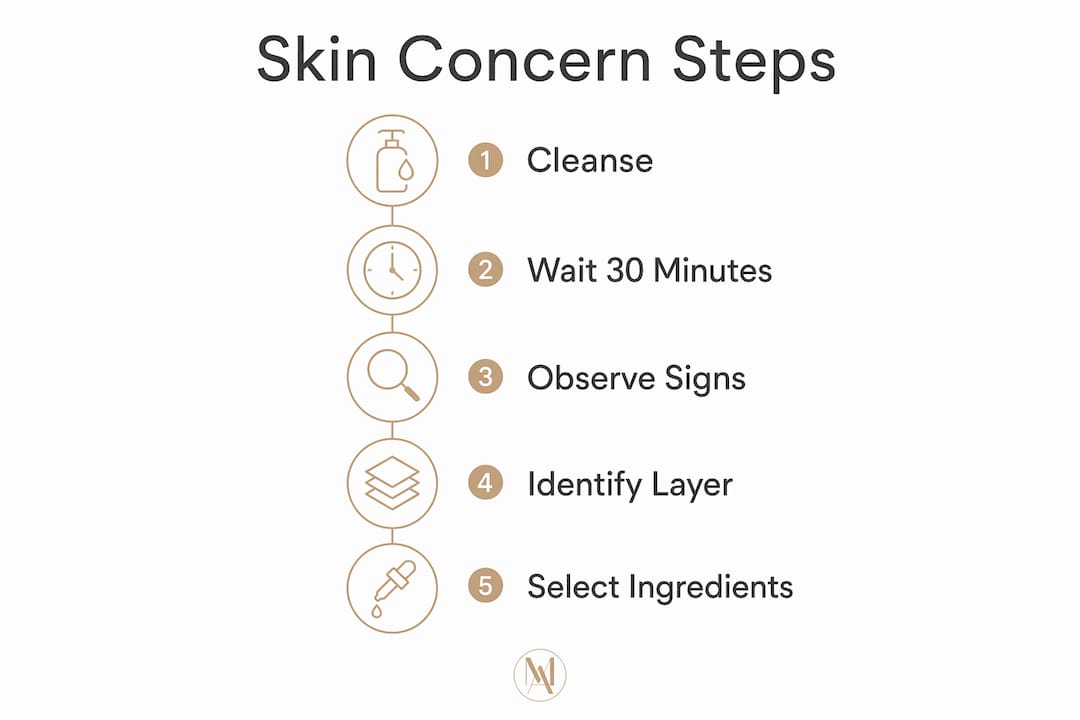
The most reliable way to assess your skin condition is to observe it in its natural state, with no products applied. A 30-minute wait after cleansing reveals your skin’s baseline behaviour without interference from moisturisers, serums, or SPF.
Follow these steps for an accurate self-assessment:
- Cleanse gently with a mild, non-stripping cleanser. Avoid anything with fragrance or active ingredients that could alter your skin’s natural signals.
- Wait 30 minutes without applying anything. Sit in a well-lit room and resist the urge to touch your face.
- Observe the T-zone (forehead, nose, and chin). Visible shine or oiliness here, combined with dryness on the cheeks, points to combination skin.
- Check for tightness or discomfort. Tightness across the cheeks or forehead signals dryness or a compromised barrier.
- Note any redness or stinging. Stinging after cleansing indicates barrier damage, not simply sensitivity. This distinction matters for treatment.
- Look for texture changes. Rough patches, flaking, or visible pores all provide diagnostic clues about your skin’s current condition.
Pro Tip: Photograph your skin under natural light immediately after the 30-minute observation period. Comparing photos week on week gives you an objective record of how your skin changes, which is far more useful than relying on memory alone.
A common mistake is applying products immediately after cleansing, which masks the very signals you need to read. Oiliness tells you sebum production is high. Tightness tells you the stratum corneum is not retaining moisture. Stinging tells you the barrier is already compromised. Each signal points to a different treatment priority.

Which ingredients match your identified skin concern?
Once you have identified your primary concern, the next step is matching it to the right ingredients. The 3-step process of observe, define, and match is the clinical standard for moving from skin assessment to targeted treatment.
Here is how to match common concerns to their most effective ingredients:
- Barrier damage or dryness: Ceramides, panthenol, and squalane repair the stratum corneum and restore moisture retention. These should always come first before introducing any active ingredients.
- Acne and breakouts: Salicylic acid (a beta-hydroxy acid) penetrates the follicle to dissolve excess sebum and dead skin cells. Niacinamide reduces sebum production and calms post-breakout redness.
- Pigmentation and uneven tone: Niacinamide, azelaic acid, and vitamin C inhibit melanin transfer and brighten existing dark marks. Consistent SPF use is non-negotiable alongside these ingredients.
- Sensitivity and redness: Centella asiatica, bisabolol, and allantoin calm inflammation without disrupting the barrier. Avoid fragrance, alcohol, and high-concentration acids until the barrier is restored.
- Ageing and loss of firmness: Retinol stimulates collagen production and accelerates cell turnover. Peptides support the dermis and work well alongside retinol for those with sensitive skin.
Prioritising barrier repair before introducing actives like retinol or vitamin C is not optional. A damaged barrier cannot absorb active ingredients effectively, and layering actives onto compromised skin causes irritation rather than results. This is one of the most common mistakes we see at Them-ethod.
Pro Tip: Address one primary concern at a time. If you have both pigmentation and breakouts, start with the concern causing the most disruption. Once that is stable, introduce ingredients for the secondary concern. Ingredient overload is the fastest route to a reactive, confused skin barrier.
Understanding why medical-grade skincare works for specific concerns comes down to ingredient concentration and formulation. Prescription-strength and clinically validated products deliver actives at levels that produce measurable change, which over-the-counter alternatives often cannot match.
When should you use AI tools or see a dermatologist?
Technology has made initial skin condition evaluation significantly more accessible. AI-powered skin analysis tools can screen for over 62 skin conditions using photographs, delivering assessments in approximately 30 seconds with risk levels and confidence scores. That speed makes them genuinely useful as a first step.
However, the limitations are equally important to understand:
- AI tools are screening tools, not diagnostic tools. Final clinical decisions rest with qualified healthcare professionals.
- AI performs best with clear, well-lit photographs taken at close range. Poor image quality reduces accuracy significantly.
- Conditions with overlapping visual features, such as eczema and psoriasis, require clinical examination and often a patient history to distinguish accurately.
- Any lesion that is new, changing in size or colour, or bleeding requires an in-person dermatology appointment without delay.
“Bringing an AI-generated skin analysis report to your dermatologist improves communication and can streamline diagnosis and treatment planning. The report shows detected visual features and risk scores, giving the clinician a structured starting point for evaluation.”
The most effective approach is to use AI as a preparation tool rather than a final answer. Run a screening, note the flagged concerns and risk scores, then bring that report to your consultation. Early consultation with a dermatologist when AI detects high-risk markers significantly improves treatment outcomes. For context on when a rash or skin change warrants professional attention rather than a wait-and-see approach, resources like Chameleon’s rash guidance offer a useful framework. Professional skin analysis remains the gold standard for accurate, personalised skin condition evaluation.
Key takeaways
Accurate skin concern identification requires systematic observation, symptom recognition, and ingredient matching before any treatment begins.
| Point | Details |
|---|---|
| Observe before you treat | Wait 30 minutes after cleansing to read your skin’s natural signals accurately. |
| Use clinical categories | The British Skin Foundation’s taxonomy maps physical signs to named conditions for reliable identification. |
| Repair the barrier first | Ceramides and panthenol must come before actives like retinol or vitamin C on compromised skin. |
| Match ingredients to concerns | Salicylic acid targets breakouts; niacinamide addresses pigmentation; ceramides restore dryness. |
| Use AI as a starting point | AI screening tools flag concerns and risk levels but require professional confirmation for diagnosis. |
Why I think most people assess their skin in the wrong order
When people come to Them-ethod for guidance, the most common pattern I see is this: they have already bought five products, applied them all at once, and are now dealing with a reactive, irritated skin barrier. They came looking for a solution to pigmentation or breakouts, but the first thing we have to address is the damage caused by skipping the assessment stage entirely.
The 30-minute observation test sounds almost too simple to be useful. It is not. Sitting with your bare, product-free skin for half an hour is genuinely uncomfortable for most people, and that discomfort is informative. If your skin feels tight and raw within minutes of cleansing, your barrier is already struggling. That is not the moment to introduce a vitamin C serum or a retinol.
What I have found, both professionally and personally, is that patience in the assessment phase saves months of frustration later. Identifying one primary concern, addressing it with the right ingredient at the right concentration, and then observing the response gives you real data about your skin. That data is worth far more than any trend-driven routine.
Technology like AI skin screening is genuinely exciting, and I do think it has a place in the process. But it works best when you already have a clear sense of what you are looking for. Use it to validate your observations, not to replace them. Then take that report to a clinician who can interpret it in the context of your full skin history.
The readers who get the best results are not the ones who use the most products. They are the ones who understand their skin well enough to use fewer products, more precisely.
— Jess
Targeted skincare for your identified concerns
Once you know your primary skin concern, choosing the right product becomes straightforward. Them-ethod stocks clinically validated treatments selected for their ingredient integrity and results. For breakout-prone skin, the PCA Clearskin acne serum delivers salicylic acid and soothing agents in a formulation designed to clear active breakouts without stripping the barrier. For those working on pigmentation and uneven texture, the NEOSTRATA collection uses scientifically validated acids and antioxidants to improve skin tone and clarity over time. Both ranges are available with personalised guidance from Them-ethod’s clinical team, so you can be confident you are choosing the right product for your specific concern rather than guessing.
FAQ
What is the fastest way to identify my skin type?
Cleanse your face with a gentle cleanser and wait 30 minutes without applying any products. Oiliness in the T-zone, tightness on the cheeks, or stinging after cleansing each point to a distinct skin type or barrier condition.
How many skin concerns can AI tools detect?
AI skin analysis tools can screen for over 62 skin conditions using photographs, providing results in approximately 30 seconds. They are screening tools only and do not replace a clinical diagnosis from a qualified dermatologist.
Should I treat all my skin concerns at once?
Dermatologists recommend focusing on one key concern at a time, starting with barrier repair if the skin is compromised. Addressing multiple concerns simultaneously with different actives increases the risk of irritation and slows overall progress.
When should a skin concern prompt a dermatologist visit?
Any lesion that is new, changing in size or colour, or bleeding requires prompt professional assessment. Worsening redness, persistent itching, or concerns flagged as high-risk by an AI screening tool are also clear signals to book a consultation.
What ingredients work best for a damaged skin barrier?
Ceramides, panthenol, and squalane are the most clinically supported ingredients for barrier repair. These should be introduced before any active ingredients such as retinol, acids, or vitamin C to allow the skin to respond effectively.