



How to build clinical skincare protocols
TL;DR:
- A clinical skincare protocol involves evidence-based formulation, sequencing, and patient-specific considerations, unlike a simple routine. It requires thorough assessment, pH compatibility, gradual titration, and adaptation for special populations to ensure effective results over eight to twelve weeks. Proper evaluation, patience, and personalized formulations are essential for achieving and maintaining optimal skin health.
There is a meaningful difference between a skincare routine and a clinical protocol. A routine is a habit; a protocol is a pharmacological strategy. Understanding how to build clinical skincare protocols means moving beyond product selection and into the territory of pH compatibility, ingredient sequencing, tolerance thresholds, and evidence-based formulation design. Whether you are a skincare professional constructing treatment plans for clients or an informed enthusiast ready to think more precisely about your own skin, this guide covers the full process: assessment, formulation, layering, troubleshooting, and outcome evaluation.
Key takeaways
| Point | Details |
|---|---|
| Assessment comes first | A thorough skin and lifestyle assessment must precede any protocol design to avoid mismatched treatments. |
| pH and sequencing matter | Incompatible pH combinations can deactivate key actives, making product order a clinical decision. |
| Titration protects the barrier | Gradual escalation of active concentrations reduces irritation and improves long-term patient adherence. |
| Special populations need adapted plans | Pregnancy and sensitive skin require ingredient substitutions governed by current clinical consensus. |
| Outcomes require time and tracking | Most corrective actives show meaningful results only after eight to twelve weeks of consistent use. |
How to build clinical skincare protocols: foundations first
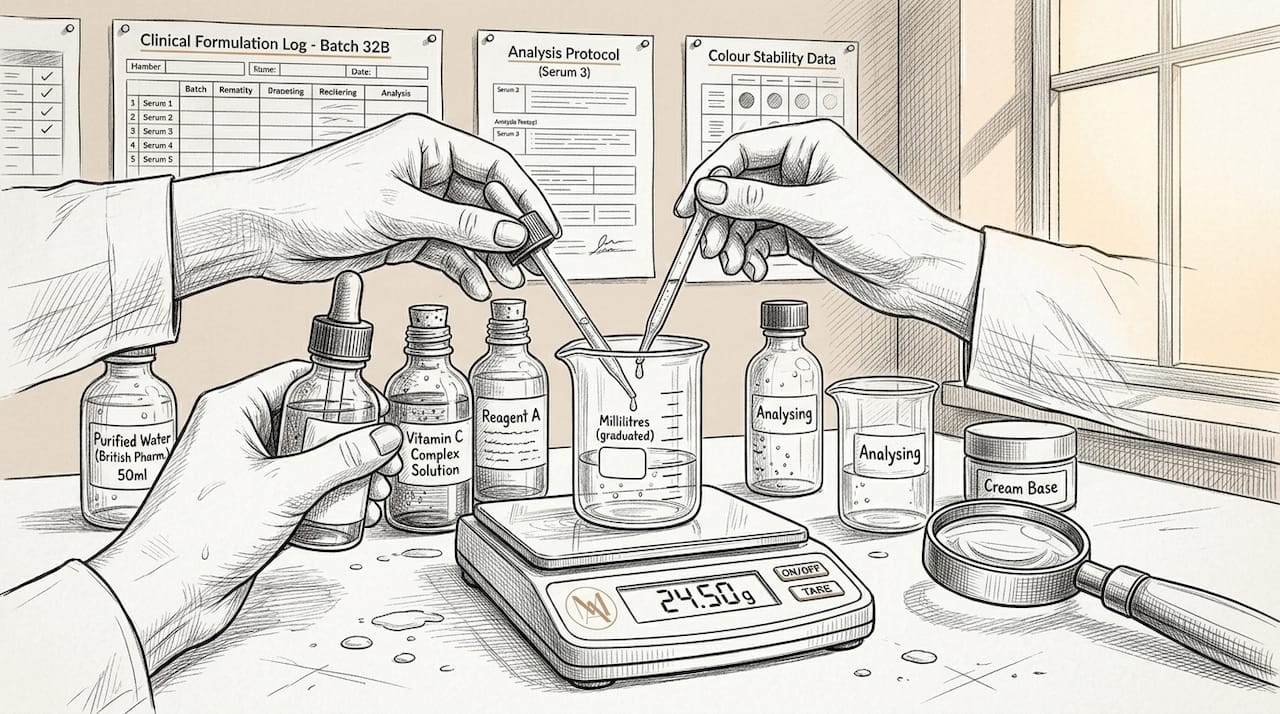
Before selecting a single active ingredient, you need to understand what clinical protocol design actually involves. It is pharmacological design, relying on pH compatibility, molecular weight, and tolerance thresholds. That framing matters because it changes how you approach every decision that follows.
Skin and lifestyle assessment
A thorough assessment is the non-negotiable starting point. Document Fitzpatrick skin type, barrier integrity, existing conditions such as rosacea or post-inflammatory hyperpigmentation, current medication use, hormonal factors, and lifestyle habits including sun exposure and diet. Vehicle and penetration enhancer choices depend directly on skin barrier integrity and Fitzpatrick type. Skipping this step leads to protocols that look correct on paper but fail in practice.
Setting realistic treatment goals is equally critical. A client presenting with melasma, active acne, and dehydration cannot address all three concerns simultaneously without risking sensitisation. Prioritise by clinical urgency and patient tolerance.
Core ingredient categories
Every evidence-based skincare regimen is built on four functional categories: cleansers, targeted serums, barrier support, and photoprotection. The table below summarises the clinical role of each.
| Ingredient category | Primary function | Key considerations |
|---|---|---|
| Gentle cleanser | Removes debris without disrupting microbiome | pH 4.5 to 5.5; avoid sulphates on compromised skin |
| Vitamin C serum (L-ascorbic acid) | Antioxidant protection; collagen stimulation | Requires pH below 3.5 for absorption; unstable in light and air |
| Retinoids (retinol, tretinoin) | Cellular turnover; collagen production | PM use only; titrate from low concentration |
| Barrier moisturiser (ceramides, hyaluronic acid) | Transepidermal water loss prevention | Twice-daily application reduces eczema risk by 50% |
| Broad-spectrum SPF 30+ | Photoprotection; prevents pigmentation recurrence | Physical or chemical; reapply every two hours in direct sun |
Research confirms that simplified four-step protocols are 50% more effective at preventing barrier issues than complex multi-product routines. This is a useful anchor when clients arrive expecting a ten-step plan.
Developing and personalising your protocol
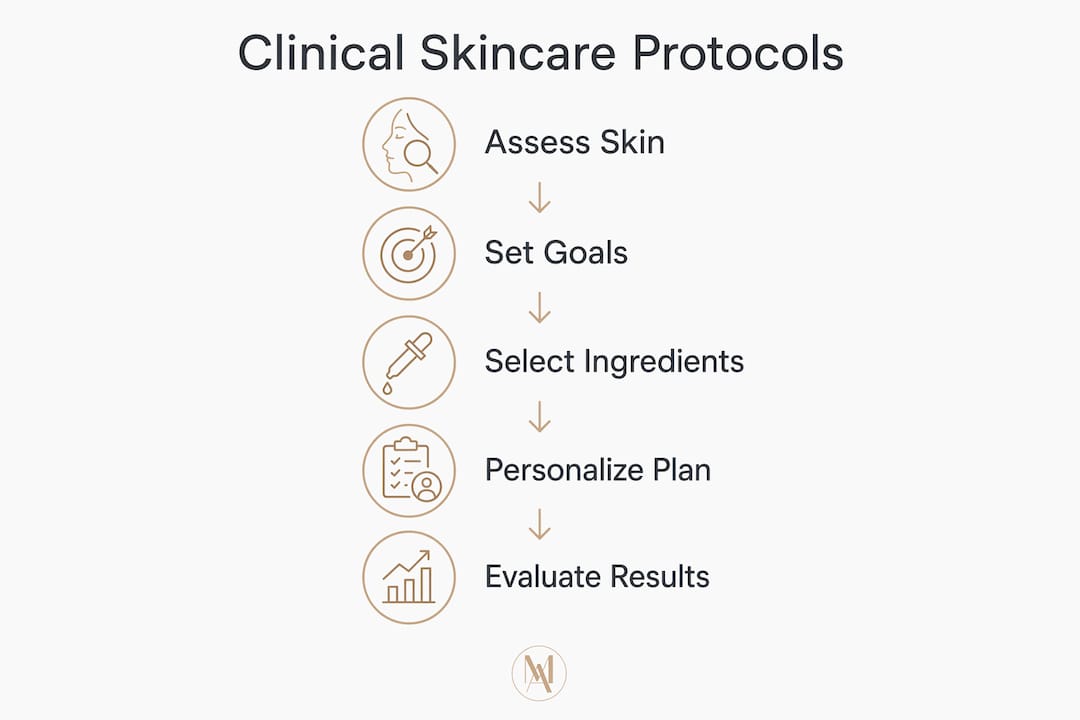
With assessment complete and ingredient categories mapped, the development process follows a logical sequence. Here is how we approach it at Them-ethod.
-
Define the primary concern and select lead actives. One or two lead actives should target the primary concern. For pigmentation, that might be a combination of azelaic acid and niacinamide. For ageing, a retinoid paired with a stabilised vitamin C.
-
Check pH compatibility before layering. Combining incompatible pH deactivates actives. For example, applying niacinamide immediately after a low-pH acid serum can reduce the efficacy of both. Allow a 20 to 30 minute wait, or use them in separate AM and PM phases.
-
Sequence by molecular weight and target skin layer. Apply thinnest-to-thickest. Water-based serums penetrate before occlusives. Vitamin C goes onto clean, slightly damp skin in the morning; retinoids go on dry skin in the evening to reduce irritation risk.
-
Begin with sub-therapeutic concentrations and titrate upward. This is the most underused principle in protocol design. Starting a client on 0.025% tretinoin three nights per week before escalating to nightly use is not timidity. It is dynamic titration, the approach that protects long-term barrier health and prevents the dropout that comes from early-stage purging or irritation.
-
Adapt for special populations. Pregnancy-safe protocols exclude retinoids and salicylic acid entirely. Current clinical consensus for pregnancy favours niacinamide, azelaic acid, and hyaluronic acid as safe corrective actives. Our guide on pregnancy-safe actives covers this in detail.
-
Consider compounded formulations where appropriate. Professional vitamin C formulations can reach 150,000 ppm concentration, making them 7 to 15 times more potent than consumer products. That level of activity requires clinician oversight for safe layering, but it also offers outcomes that off-the-shelf products simply cannot match.
Pro Tip: When building a pigmentation protocol, pair your brightening actives with a structured de-escalation plan for any hydroquinone component. Titrated hydroquinone dosing maintains results while significantly reducing the side effect profile, particularly in higher Fitzpatrick phototypes.
Troubleshooting common protocol mistakes
Even well-designed protocols encounter problems. Knowing how to read those problems accurately is what separates reactive adjustments from informed clinical decisions.
-
Misidentifying purging as an adverse reaction. Retinoid-induced purging typically resolves within four to six weeks as cellular turnover normalises. Genuine irritation presents as persistent redness, burning, or barrier disruption. Discontinuing a protocol too early because of normal purging is one of the most common errors.
-
Overloading newly sensitised skin. Introducing multiple new actives simultaneously makes it impossible to identify which ingredient is causing a reaction. Add one new active at a time, with a minimum two-week observation window.
-
Ignoring formulation aesthetics. Patient adherence improves significantly when formulations match the patient’s skin type preferences and cosmetic feel. A clinically superior serum that feels greasy on oily skin will not be used consistently. This is not vanity; it is adherence science.
-
Underestimating pigmentation rebound. Controlling rebound in pigment protocols requires tailored dosing schedules and ongoing patient education on phototypes. Clients with Fitzpatrick type IV and above are particularly vulnerable to post-inflammatory hyperpigmentation if protocols are not sequenced and monitored carefully.
Pro Tip: When a client reports stinging with their vitamin C serum, the likely culprit is pH shock rather than an allergy. Try buffering the application on slightly damp skin or switching to a less acidic form such as sodium ascorbyl phosphate while the barrier repairs.
The professional skincare checklist from Them-ethod provides a useful reference when auditing a protocol for common sequencing and compatibility errors.
Evaluating and verifying protocol effectiveness
A clinical skincare plan without a measurement framework is simply an educated guess. Systematic evaluation transforms it into an evidence-based process.
-
Use standardised photography at baseline and every four weeks. Consistent lighting, angle, and camera settings are non-negotiable. Subjective impressions are unreliable across consultations and between practitioners.
-
Incorporate validated patient-reported outcome measures. Tools such as the Dermatology Life Quality Index give quantifiable data on how treatment is affecting daily life, beyond surface-level improvement.
-
Set phase-specific milestones. Week one to four: barrier tolerance and adherence. Week four to eight: initial target improvement, such as early texture change or sebum regulation. Week eight to twelve: corrective outcomes including pigmentation reduction or collagen remodelling. PDRN, for example, activates adenosine A2A receptors for skin repair and shows meaningful results only after eight to twelve weeks. Knowing this prevents premature protocol abandonment.
-
Adjust phases based on observed progress, not fixed timelines. If a client with post-inflammatory hyperpigmentation shows significant improvement at week six, the protocol may need to transition to maintenance sooner than planned. Flexibility within a structured framework is a clinical skill.
-
Educate clients on realistic expectations from the outset. Unrealistic timelines are among the primary drivers of non-adherence. Setting the expectation that corrective skincare treatment plans operate on biological cycles, not overnight timescales, fundamentally changes how clients engage with their protocol.
Reviewing clinical protocol outcomes regularly also allows you to identify patterns across different skin types and concerns, building institutional knowledge that improves every subsequent protocol you design.
My perspective on building protocols that actually work
I have seen professionals and enthusiasts alike treat protocol design as a product curation exercise. It is not. The protocols that produce genuinely transformative results are built on restraint, not abundance.
In my experience, the biggest misconception is that more actives means faster progress. The opposite is almost always true. When I work with clients presenting complex concerns such as melasma on a sensitised barrier, my instinct is always to strip the protocol back before building it up. Barrier repair first. Always.
The other thing I feel strongly about is the undervalued role of compounding. Personalised formulations that match a client’s texture preferences, Fitzpatrick type, and tolerance history are not a luxury. They are often the difference between a protocol that works and one that sits on the bathroom shelf after week three. Patient adherence improves consistently when the product feels right to use, and that is ultimately what delivers results.
What I have learned after years of protocol design is that patience is not passive. Watching a well-sequenced protocol do its work over twelve weeks requires more clinical confidence than switching actives after four. Trust the process you built, monitor it rigorously, and adjust deliberately.
— Jess
Protocols built on proven ingredients
At Them-ethod, we believe that effective skincare strategies are only as good as the products underpinning them. For acne-focused protocols, the PCA Clearskin Acne Treatment Serum is a professional-grade choice that integrates cleanly into targeted treatment plans, addressing sebum regulation and post-inflammatory marks without disrupting a sensitised barrier. For those building restorative or corrective protocols, the Neostrata collection offers clinically supported formulations designed to work with, not against, structured regimen phases. Our virtual skin consultations connect you directly with clinicians who understand how to match products to personalised protocol frameworks, not simply to skin type categories.
FAQ
What is the difference between a skincare routine and a clinical protocol?
A routine is a habitual daily practice, while a clinical protocol is a structured, evidence-based treatment plan that accounts for ingredient pharmacology, pH compatibility, sequencing, and patient-specific factors including Fitzpatrick type and barrier integrity.
How long does it take to see results from a clinical skincare protocol?
Most corrective actives require eight to twelve weeks for meaningful clinical outcomes. Ingredients such as PDRN show significant skin repair only after this period, making patience and consistent monitoring central to protocol success.
Which ingredients are safe in pregnancy-specific protocols?
Current clinical consensus supports niacinamide, azelaic acid, and hyaluronic acid as effective and safe options during pregnancy, while retinoids and salicylic acid must be excluded from any pregnancy-adapted skincare treatment plan.
How do I know when to adjust a protocol?
Adjust when a client shows persistent barrier disruption beyond six weeks, when pigmentation rebounds despite correct sequencing, or when adherence data suggests the formulation is not being tolerated. Photography and validated outcome measures should guide all adjustments.
Can I layer vitamin C and retinoids in the same protocol?
Yes, but in separate phases. Vitamin C performs best at low pH in an AM application, while retinoids should be applied to dry skin in the evening. Layering both in a single application window risks pH conflict and increased irritation without added benefit.