

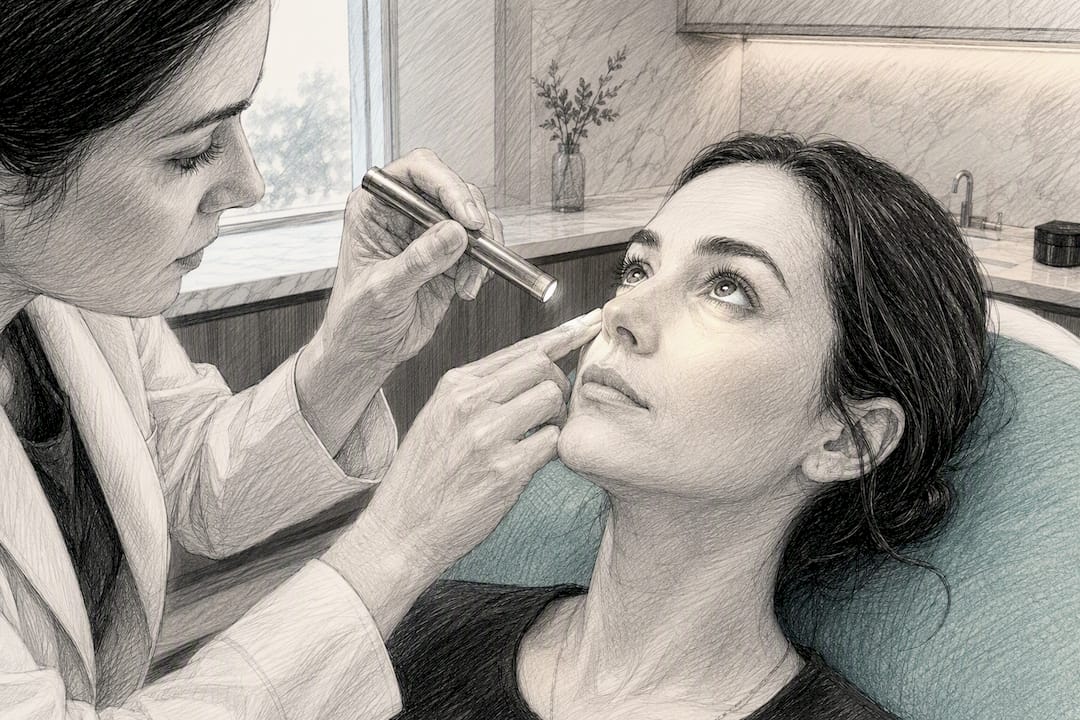
Start at 0.025%: Tretinoin Under the Eyes With Clinician Guidance
Tretinoin can be used under the eyes, but only with lower strengths, careful placement well away from the lid margin, and ideally clinician guidance. Expect improvements in fine lines and some pigment issues, alongside a real risk of dryness and irritation. Anyone pregnant or breastfeeding should avoid it entirely, and everyone else should build up gradually. The rest of this guide covers exactly how.
TL;DR:
- Tretinoin requires careful application and gradual increase in frequency to minimize irritation and reduce the risk of skin darkening caused by inflammation.
- Initiating treatment with a 0.025% cream and using a buffering moisturizer helps maintain skin comfort and enhances effectiveness over several months.
- Applying tretinoin a centimetre below the lash line and avoiding eyelids prevents excessive absorption and potential irritation of delicate eye skin.
- Supplementing with barrier-repair moisturizers, broad-spectrum sunscreen, and avoiding active stacking on application nights reduces side effects and protects the skin.
- Structural dark circles caused by hollowing or fat pads do not improve with topical retinoids and may require procedural treatments like fillers.
Table of Contents
- What benefits tretinoin can deliver for the under-eye area
- Risks, common side effects and when tretinoin can make the area look worse
- Practical application: how to use tretinoin safely around the eyes
- Choosing concentration, formulation and expected timeline
- Retinol, retinal and other gentler alternatives compared with tretinoin
- When to see a clinician, prescription access and safety checks
- Recommended moisturising and barrier-repair products to minimise irritation
- Specific precautions for sensitive skin types or pre-existing eye conditions
- How to handle and minimise peeling or flaking under the eyes due to tretinoin use
- Author perspective and clinic practice notes from The M-ethod Skin
- How Them-ethod supports safe tretinoin use under the eyes
- Sources
- FAQ
What benefits tretinoin can deliver for the under-eye area
Tretinoin works by accelerating skin cell turnover and stimulating collagen production in the dermis, the layer beneath the surface where structural support lives. That mechanism is why it remains one of the most studied treatments for photoaging anywhere on the face, including the delicate skin below the eyes.
A network meta-analysis covering 23 randomised controlled trials and 3,905 participants found tretinoin among the most effective topical agents for fine wrinkles and hyperpigmentation, with a reasonable safety profile when tolerability is managed properly. That is broad facial evidence, not eye-specific data, but the underlying biology carries over. Retinoids reduce melanin transfer between skin cells while smoothing surface texture, which is why they help with pigment as well as lines.
Statistic Callout: A 12-week open-label trial of a hydrating double-conjugated retinoid eye cream reported a 33% improvement in lines and wrinkles and a 41% improvement in under-eye darkness, with no related adverse events across the small cohort studied. That is a genuinely strong signal, though the study used a specialised, hydrating formulation rather than a standard tretinoin cream, and the sample size was small at 26 participants.
Not every dark circle responds the same way. Pigment-related darkening, caused by excess melanin, tends to respond best to retinoids over several months. Structural dark circles, caused by under-eye hollowing or visible fat pads casting a shadow, will not improve with any topical, however patiently it is used. Vascular dark circles, where thin skin reveals blood vessels beneath, may look marginally better as skin thickens slightly with sustained use, but they will not resolve completely. Knowing which category applies to your under-eye area saves months of misplaced expectation.
Risks, common side effects and when tretinoin can make the area look worse
The trade-off for that cell turnover is irritation, and the eye area feels it faster than almost anywhere else on the face. Expect some combination of the following in the early weeks of use:
- Dryness and tightness, often the first sign of overuse.
- Flaking or visible peeling, especially where the product has been applied too close to the lid.
- Redness and a mild stinging sensation on application.
- Temporary, irritation-related darkening of the skin, which can look like the exact problem you were trying to fix.
That last point catches people out. Retinoids reduce melanin transfer over time, but irritation itself triggers a short-term inflammatory response that can darken skin, particularly in medium to deep skin tones where post-inflammatory hyperpigmentation is more common. The mechanistic evidence on retinoid action explains why: the same pathway that eventually lightens pigment can briefly worsen it if the skin barrier is disrupted too aggressively.
The anatomy of this area explains why it reacts so strongly. Periorbital skin is thinner than skin almost anywhere else on the face, with fewer oil glands to buffer active ingredients and constant movement from blinking and expression that speeds up product spread and moisture loss. What a cheek can tolerate nightly, the eye area often cannot.
Pro Tip: If you notice flaking within the first week, that is not a sign to push through. Skip two nights, apply a thick moisturiser only, and resume at a lower frequency once the skin has settled.
Pregnancy and breastfeeding change the calculation entirely. The American Academy of Dermatology advises stopping tretinoin and other prescription retinoids if you are pregnant or planning to become pregnant, and recommends discussing breastfeeding plans with a clinician before resuming use. This applies to the under-eye area exactly as it does everywhere else tretinoin might be used.
Practical application: how to use tretinoin safely around the eyes
Technique matters more here than almost anywhere else you might apply a retinoid. Get the placement wrong and you risk irritation on skin that has little margin for error.
- Wait for your skin to dry completely after cleansing. Applying tretinoin to damp skin increases penetration and, with it, irritation risk.
- Apply a thin layer of moisturiser first across the under-eye area. This buffering step, sometimes called the “moisturiser sandwich,” blunts the initial strength of the retinoid without cancelling its effect.
- Use a pea-sized amount for the whole face and take only the smallest residue left on your fingertip for the under-eye area. You need far less than most people assume.
- Dot the product roughly one centimetre below the lash line, staying clear of the lid itself, the inner corner, and the lash line. Pat gently rather than rubbing it in.
- Never let tretinoin touch the eyelid or get near the lashes. The eyelid skin is even thinner than the under-eye area and absorbs actives far too readily.
- Start every two to three nights, not nightly. Give your skin at least 48 hours to recover between applications in the first month.
- Watch for flaking, tightness, or redness for 24 hours after each application before deciding whether to continue at that frequency.
- Progress slowly to every other night, and only move to nightly use once the skin at higher frequency shows no irritation for several consecutive weeks.
- Avoid combining tretinoin with AHAs, BHAs, or benzoyl peroxide on the same night. Alternate nights instead, since stacking actives compounds irritation rather than doubling benefit.
- Apply broad-spectrum sunscreen every morning without exception. Retinoid-treated skin is more reactive to UV, and under-eye skin burns and pigments easily.
A step-by-step guide to layering retinol safely covers buffering techniques that apply equally well to tretinoin, particularly for readers introducing actives to sensitive areas for the first time.
Pro Tip: Keep a small note on your phone tracking which nights you applied tretinoin and how your skin reacted the next morning. Patterns emerge within two weeks that are easy to miss otherwise.
If irritation appears despite following every step, pause completely for three to four nights, moisturise generously, and resume at a lower frequency once calm. There is no prize for pushing through redness.
Choosing concentration, formulation and expected timeline
Most dermatologists start patients on 0.025% tretinoin cream for the under-eye area, the lowest common prescription strength, precisely because higher concentrations like 0.05% or 0.1% carry a disproportionate irritation risk on skin this thin. Starting low and adjusting upward based on tolerance, rather than starting at a “standard” strength, is the safer default here.
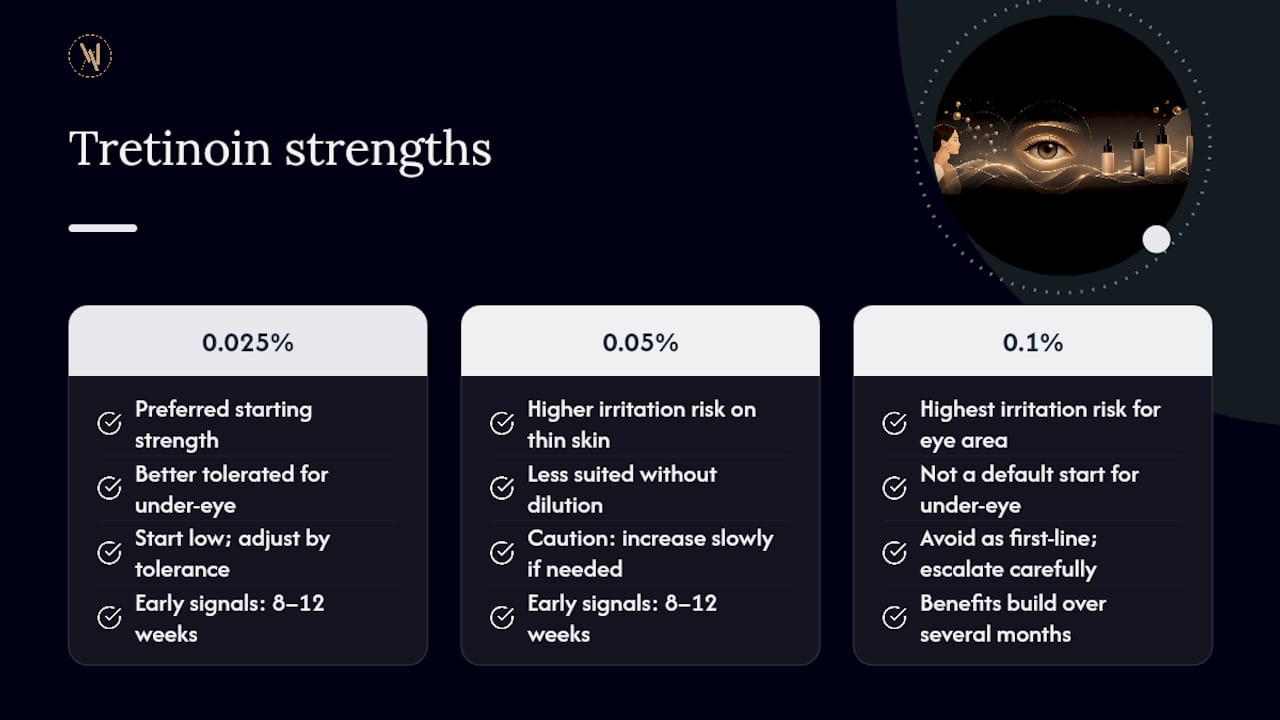
Formulation matters almost as much as concentration. Cream vehicles, which contain more emollient and hydrating ingredients, tend to suit the eye area better than gel or solution formats, which are typically designed for oilier skin elsewhere on the face and can feel drying around the eyes. A randomised, double-blind trial comparing tretinoin 0.025% against a retinol-based combination over 84 days found both improved photoaging, but the retinol combination was better tolerated, reinforcing that gentler vehicles and lower-potency actives can still deliver meaningful results with less friction.
Statistic Callout: Improvement with retinoids tends to be progressive rather than immediate. Reviews of long-term retinoid use show benefits accumulate over several months of consistent use, with early signals sometimes visible from around eight to twelve weeks, but full results building well beyond that. That same evidence shows discontinuation can partially reverse gains, which is why maintenance use matters as much as the initial ramp-up.
Worth repeating: the strongest published results for under-eye retinoids came from a specialised, hydrating eye cream formulation, not an off-the-shelf tretinoin cream intended for the whole face. Translate those results cautiously, and expect a standard prescription tretinoin to need more careful dilution and slower buildup to reach comparable comfort.
Retinol, retinal and other gentler alternatives compared with tretinoin
Tretinoin is retinoic acid itself, immediately active on skin cells the moment it is applied. Retinol and retinaldehyde (retinal) are precursors that skin must convert through several enzymatic steps before reaching that same active form, which blunts their potency but also their irritation potential.
That conversion delay is the entire reason retinol-based eye creams are often recommended as a first step for people with sensitive skin or no prior retinoid experience. A dedicated eye-specific retinol formulation, usually at lower percentages and blended with humectants, gives skin time to build tolerance before considering a prescription-strength jump.
A few supporting choices worth building into the same routine:
- Peptide serums, which support the skin’s structural proteins without the irritation profile of retinoids.
- Humectants like hyaluronic acid, which draw moisture into the skin and offset the dryness retinoids can cause.
- Daily SPF, non-negotiable regardless of which active you choose, since sun damage undoes retinoid gains and increases pigment risk.
None of these alternatives are irritation-free by default. A gentler active still needs the same conservative introduction, just with a shorter runway before you can expect comfortable daily use. And gentler options are, almost by definition, slower to deliver visible change than tretinoin itself.
When to see a clinician, prescription access and safety checks
Certain signs mean stop using any retinoid and get it looked at rather than pushing through:
- Persistent pain, swelling, or crusting around the eye, rather than ordinary flaking.
- Any change in vision, watering, or a sensation of grit in the eye.
- Dermatitis that spreads beyond the treated area or does not settle within a few days of stopping.
Structural under-eye concerns such as hollowing, prominent fat pads, or deep static wrinkles will not resolve with tretinoin no matter how consistently it is used. Those cases usually need procedural options such as dermal fillers, Profhilo, or a nonsurgical treatment like HIFU rather than a topical.
For anyone wanting a supervised start, a virtual consultation before initiating tretinoin allows a clinician to confirm the right strength, screen for pregnancy or breastfeeding status, and check for any pre-existing eye conditions that might make topical retinoids inappropriate. That screening step matters more around the eyes than almost anywhere else tretinoin gets applied.
Recommended moisturising and barrier-repair products to minimise irritation
A well-chosen moisturiser is not optional alongside tretinoin under the eyes, it is the single biggest lever you have over comfort. Look for formulations built around ceramides, which replace lipids the skin barrier loses during retinisation, and glycerin or hyaluronic acid, which pull water into the surface layers to offset dryness.
Richer, occlusive night creams tend to suit the under-eye area better than lightweight lotions during the adjustment period, since they slow water loss over the many hours skin spends recovering overnight. Layering a barrier-repair product both before tretinoin, as a buffer, and after, sealing in hydration, is one of the most effective ways to stay on a retinoid long enough to see results. Them-ethod’s medical-grade moisturiser and eye cream range includes formulations designed with exactly this kind of barrier support in mind, useful for anyone building a routine around a new retinoid.
Avoid anything fragranced or alcohol-heavy on nights you apply tretinoin, since both ingredients strip moisture the skin can least afford to lose right then. Simplicity works in your favour here: a single, well-formulated barrier cream applied generously will do more than three thinner products layered on top of each other.
Specific precautions for sensitive skin types or pre-existing eye conditions
People with rosacea, eczema, or a history of atopic dermatitis around the eyes should treat tretinoin with extra caution, since these conditions already compromise the skin barrier before any retinoid enters the picture. Starting at the lowest available frequency, and extending the gap between applications well beyond the standard two to three nights, gives barrier-impaired skin more room to adapt.
Anyone with a diagnosed eye condition, including blepharitis, dry eye disease, or a history of eyelid dermatitis, should raise tretinoin use with a clinician before starting rather than after a reaction appears. The proximity of the treated area to the eye itself means any accidental transfer carries more consequence than it would elsewhere on the face.
Darker skin tones warrant a particular note on technique rather than avoidance. Post-inflammatory hyperpigmentation risk is genuinely higher when irritation occurs, which makes the conservative building schedule described earlier more important, not less. Patch testing on a small area of the cheek before ever bringing tretinoin near the eyes is a sensible extra step for anyone with a history of reactive or easily inflamed skin, regardless of tone.
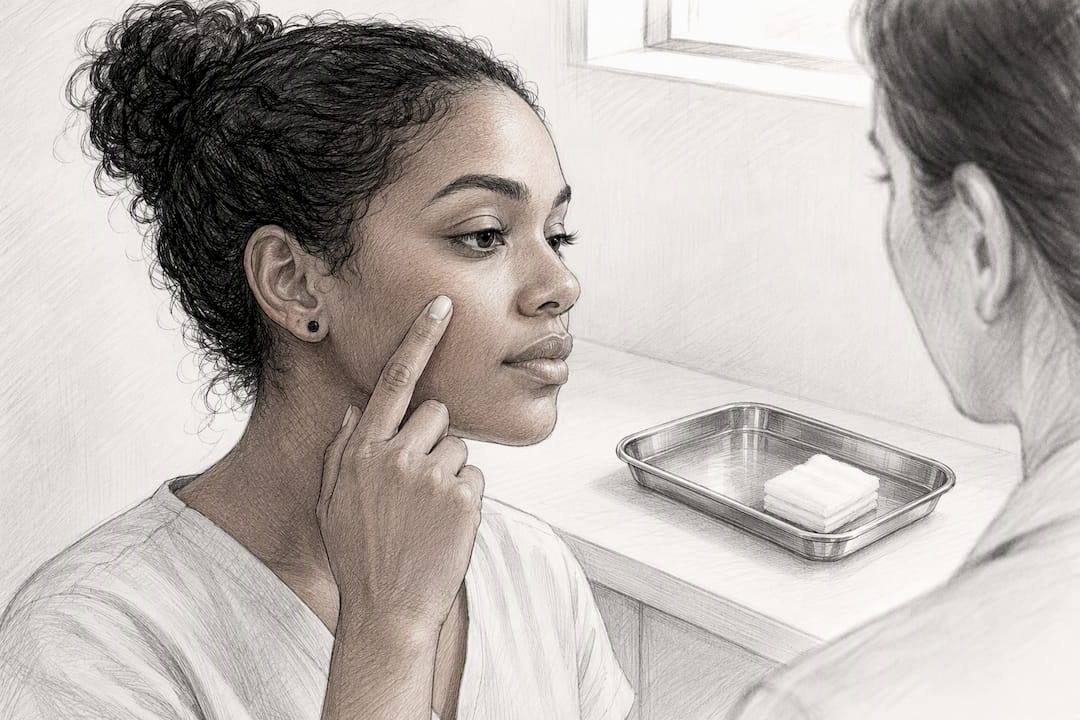
How to handle and minimise peeling or flaking under the eyes due to tretinoin use
Peeling is usually a sign the frequency has outpaced what the skin barrier can currently manage, not a sign the product is “working harder.” The fix is nearly always to slow down rather than push through.
If flaking appears, drop back to applying tretinoin every fourth or fifth night rather than stopping entirely, and increase moisturiser frequency to twice daily rather than once. Avoid picking or exfoliating flaking skin under the eyes, since both actions can tear already-thinned skin and invite the exact irritation-driven pigmentation discussed earlier.
A gentle, fragrance-free cleanser both morning and night reduces additional friction on skin that is already shedding faster than usual. Some readers find a short “retinoid holiday” of three to five nights, followed by resuming at half the previous frequency, resolves persistent flaking faster than trying to tough it out at the same pace. Once skin has been flake-free for two consecutive weeks, frequency can be nudged back upward in small increments.
Author perspective and clinic practice notes from The M-ethod Skin
The biggest misconception about tretinoin under the eyes is that it is either reckless or unnecessary, when the honest answer sits between those two extremes. The evidence for eye-specific retinoid formulations is real but comes largely from small, specialised trials, and treating those results as a guarantee for a standard tretinoin cream oversells what the data actually shows.
What tends to separate a good outcome from a bad one is not the concentration chosen but the patience applied to reaching it. Clinicians at The M-ethod Skin typically introduce under-eye retinoids at the lowest workable strength and frequency, then escalate only once skin has proven it can tolerate the previous step, moving to in-clinic alternatives like Profhilo or microneedling when a patient’s concern turns out to be structural rather than textural. That distinction, made early, saves months of misapplied effort on a topical that was never going to solve the underlying issue.
— Jess
How Them-ethod supports safe tretinoin use under the eyes
Getting tretinoin strength and technique right around the eyes is easier with a clinician checking your skin history first, rather than guessing your way through trial and error. Them-ethod’s online skin consultation connects you with an expert clinician who can assess your skin type, screen for pregnancy or breastfeeding status, and recommend a tailored starting strength before you apply anything near your eyes.
That supervision matters most in the first few weeks, when frequency and placement decisions shape whether your skin tolerates tretinoin long enough to see results. Alongside prescription guidance, Them-ethod’s barrier-repair moisturisers and eye creams help manage the dryness that comes with starting any retinoid in this area. Book a consultation to get a plan built around your own skin rather than a generic starting point.
This article is general information, not a substitute for advice from a qualified doctor. Consult a qualified healthcare professional about your own circumstances before acting on anything here.
Sources
- Efficacy and tolerability of a retinoid eye cream for fine to moderate wrinkles of the periorbital region
- Comparative efficacy of topical interventions for facial photoaging: a network meta-analysis
- Is any acne treatment safe to use during pregnancy?
- Review on topical retinoids and maintenance in photoaging
FAQ
Where should you not put tretinoin on your face?
Avoid the eyelid itself, the lash line, and the inner corners of the eyes, since skin there is thinner and absorbs actives too readily. Keep application roughly a centimetre below the lower lash line and never near the upper lid.
Is it safe to put retinol under your eyes?
Retinol is generally better tolerated under the eyes than tretinoin because it converts gradually to its active form, reducing initial irritation. It still requires the same cautious placement and gradual buildup in frequency as any retinoid in this area.
How long does it take for tretinoin to work under the eyes?
Early signals of improvement in fine lines and pigment can appear from around eight to twelve weeks of consistent use, with fuller results building over several months. Retinoid reviews show ongoing maintenance is needed since benefits can partially reverse after stopping.
Does tretinoin darken under eyes?
Tretinoin itself is more likely to lighten pigment-related darkness over time by reducing melanin transfer, but irritation from overuse can cause temporary darkening, particularly in medium to deep skin tones. Slowing the application frequency at the first sign of irritation usually resolves this within a few days.
Can tretinoin help with dark circles caused by hollowing rather than pigment?
No. Structural dark circles caused by volume loss or prominent under-eye fat pads will not respond to any topical retinoid, since the cause is anatomical rather than pigment or texture related. Procedural options such as dermal fillers or Profhilo are more appropriate for that specific concern.