




How to choose a cleanser: a skin-type guide
TL;DR:
- Choosing the right cleanser depends on your skin type and concerns, with fragrance-free formulations being the standard recommendation.
- A gentle, barrier-supporting cleanser is essential to maintain skin health, especially for sensitive or compromised skin.
Your cleanser choice comes down to one decision: match the formulation to your skin type and primary concern. If your skin is dry or sensitive, reach for a cream or milky formula with ceramides or glycerin. If it’s oily or congested, a gel or foam cleanser with salicylic acid or niacinamide will serve you better. Whatever your type, fragrance-free, non-stripping formulations are the baseline standard dermatologists consistently recommend.
Quick label scan — four things to check before you buy:
- pH-balanced — supports the acid mantle and reduces post-cleanse sensitivity
- Non-comedogenic — won’t block pores (relevant for oily, acne-prone, and combination skin)
- Fragrance-free — the single most reliable way to reduce unnecessary irritation
- Barrier-supporting actives — look for ceramides, glycerin, or hyaluronic acid in the first half of the ingredient list
The sections below walk through how to identify your skin type, which cleanser formats suit each type, which ingredients to seek out or avoid, and how to test a new product safely. If you’re dealing with persistent acne, post-procedure skin, or unexplained barrier loss, skip ahead to the clinical escalation section.
Table of Contents
- How to identify your skin type and main concern
- Which cleanser format suits your skin type?
- Which ingredients should you look for (and which to avoid)?
- How to test a new cleanser without damaging your skin
- How to use your cleanser correctly
- Common mistakes that undermine your cleanser choice
- When a medical-grade cleanser or clinician consultation makes sense
- Key takeaways
- The case for a barrier-first approach
- Them-ethod’s clinical cleanser options and consultations
- Further reading and trusted sources
How to identify your skin type and main concern
Skin type classification is the single most useful variable in cleanser selection. The American Academy of Dermatology recognises five categories: normal, oily, dry, combination, and sensitive. Most people sit clearly in one, though hormones, seasons, and active treatments can shift the picture.
A quick self-diagnosis — observe your skin one hour after cleansing, with no products applied:
- Oily: visible shine across the forehead, nose, and chin; enlarged pores; makeup slides off by midday
- Dry: tightness, flakiness, or a dull, rough texture; fine lines look more pronounced
- Combination: oily T-zone with normal or dry cheeks; patchy behaviour across the face
- Sensitive: redness, stinging, or flushing in response to products, temperature, or touch
- Acne-prone: recurring blackheads, whiteheads, or inflammatory spots regardless of sebum level
- Mature or ageing: skin feels thinner, drier, and less resilient; barrier function naturally declines with age
Skin type is not permanent. Cold weather, hormonal changes, new medications, and post-procedure recovery can all shift your skin into a different category temporarily. Treat your diagnosis as a current-state reading, not a lifetime label, and rotate your cleanser texture seasonally when needed.
Where two concerns compete, prioritise the gentler path. If your skin is both acne-prone and dry, a harsh stripping anti-acne wash will worsen the dryness and often trigger reactive breakouts. A gentle, acne-safe formula with salicylic acid at a low concentration is a better starting point than an aggressive one.

Pro Tip: If you’re unsure of your skin type, try the “bare-face test” on a day when you haven’t worn sunscreen or makeup. Cleanse gently in the morning, wait 60 minutes, then assess shine, tightness, and texture in natural light.
Which cleanser format suits your skin type?
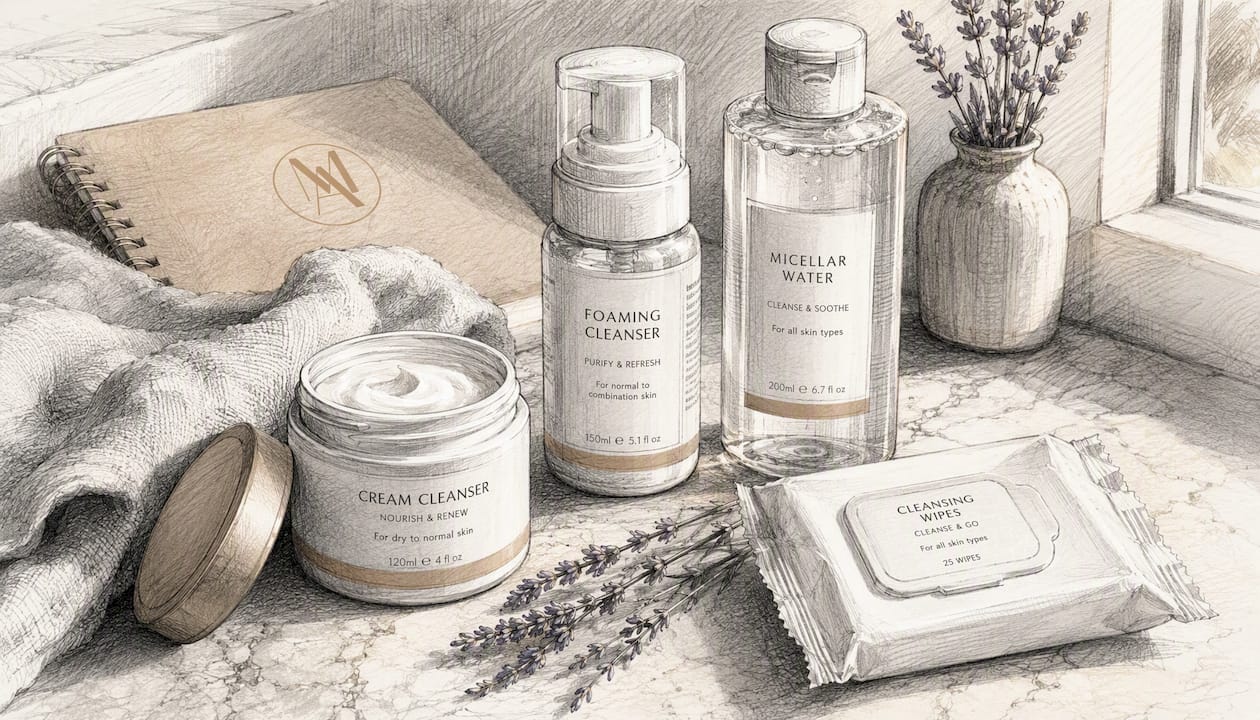
Cleanser texture is not just a sensory preference. It determines how the product interacts with sebum, the skin barrier, and any active ingredients it carries.
- Gel cleansers cut through excess oil without heavy emollients. They suit oily, acne-prone, and combination skin well. Some gel-to-foam formulas with niacinamide and glycerin are clinically shown to reduce pore appearance while supporting moisture.
- Foaming cleansers produce a lather that lifts debris and sebum effectively. Good for oily skin; can be drying for dry or sensitive types if the surfactant blend is too aggressive.
- Cream and milky cleansers are emollient-rich and rinse off without stripping lipids. The go-to for dry, mature, and sensitive skin. Clinically tested options such as the La Roche-Posay Toleriane range are formulated for normal-to-dry and sensitive skin and set a useful benchmark for tolerability.
- Oil cleansers dissolve sebum-based impurities, sunscreen, and makeup through the “like dissolves like” principle. Counterintuitively, they work well for dry and oily skin types when rinsed thoroughly.
- Balm cleansers are the richest format. Excellent for removing heavy or long-wear makeup and for dry or barrier-compromised skin. Always follow with a water-based second cleanse.
- Micellar water uses micelle technology to lift surface impurities without rinsing. Suitable for sensitive or very dry skin as a gentle first cleanse, though it is not sufficient as a standalone cleanser for heavy makeup or sunscreen.
- Bar cleansers (traditional soap) are generally a poor choice for facial skin. Traditional bar soaps are often high pH and disrupt the acid mantle, leading to sensitivity and barrier damage. Avoid unless the product is specifically formulated as a low-pH syndet bar.
Double cleansing — when it helps and how to do it correctly:
- Apply an oil or balm cleanser to dry skin and massage for 30–60 seconds to dissolve sunscreen and makeup.
- Rinse thoroughly with lukewarm water.
- Follow immediately with a water-based gel, foam, or cream cleanser suited to your skin type.
- Rinse again and pat dry. The second step must fully remove residue from the first; incomplete rinsing can cause build-up and congestion.
Double cleansing is most useful in the evening when you’ve worn sunscreen or makeup. A single gentle cleanse is usually sufficient in the morning.
Which ingredients should you look for (and which to avoid)?
Ingredients are where cleanser choice gets precise. The right actives can address a specific concern; the wrong ones can undermine the barrier you’re trying to protect.
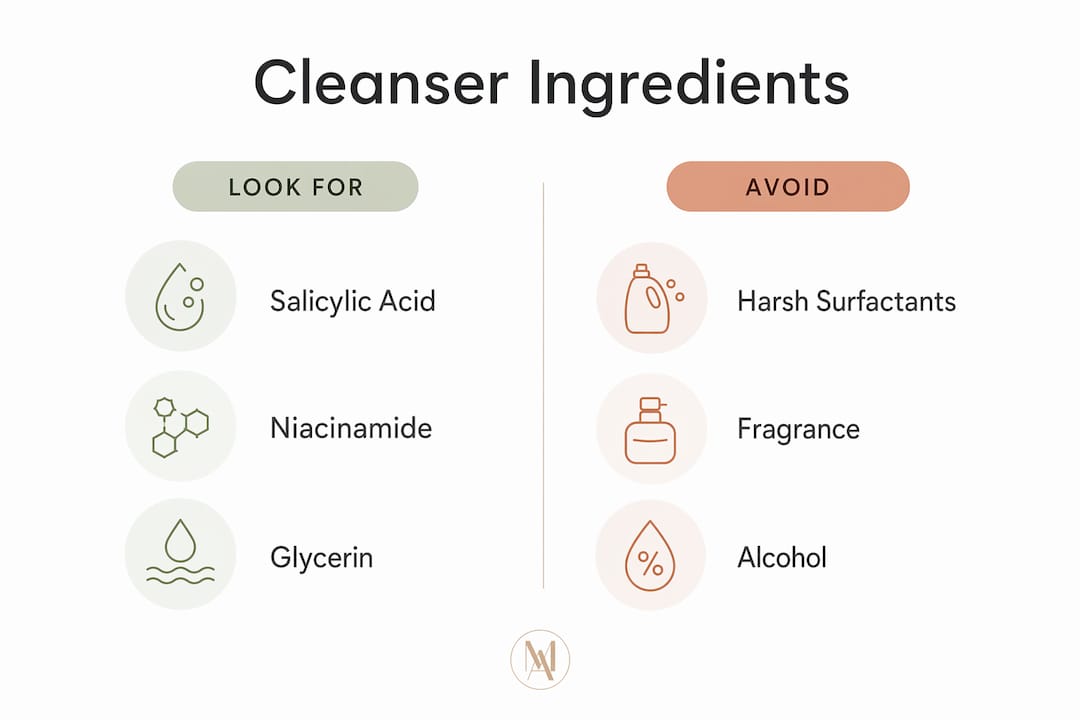
| Concern | Look for | Avoid |
|---|---|---|
| Oily / congested | Salicylic acid (BHA), niacinamide, glycerin | Harsh sulfates (SLS/SLES at high concentrations), heavy oils |
| Dry / dehydrated | Ceramides, hyaluronic acid, glycerin, squalane | Denatured alcohol, fragrance, strong acids |
| Sensitive / reactive | Ceramides, panthenol (B5), colloidal oat, allantoin | Fragrance, essential oils, high-concentration actives |
| Acne-prone | Salicylic acid, benzoyl peroxide (where appropriate), niacinamide | Comedogenic emollients, fragrance, heavy waxes |
| Ageing / mature | Glycerin, ceramides, hyaluronic acid, mild PHAs | Harsh surfactants, high-pH formulas, unnecessary fragrance |
Ceramides, hyaluronic acid, and glycerin are evidence-backed for barrier support and moisture retention. Salicylic acid, a beta-hydroxy acid (BHA), is oil-soluble and penetrates the pore lining, making it particularly effective for congestion and acne. For a detailed breakdown of barrier-supporting actives, the barrier repair ingredients guide at Them-ethod covers ceramide and hyaluronic acid selection in depth.
What label claims actually mean:
- Fragrance-free means no added fragrance compounds, including masking fragrances. “Unscented” does not mean the same thing.
- Non-comedogenic indicates the formula has been tested not to block pores, though testing standards vary between brands.
- Dermatologist tested confirms a dermatologist reviewed or assessed the product. It does not guarantee it will suit every skin type.
- pH-balanced suggests the formula is formulated close to the skin’s natural pH (roughly 4.5–5.5), which supports the acid mantle.
Retinoid-containing cleansers are rarely necessary. The contact time of a rinse-off product is too short for retinoids to deliver meaningful benefit, and the irritation risk is real. Save retinoids for leave-on treatments. For acne-focused cleanser selection, the acne cleanser guide at Them-ethod provides a more targeted breakdown.
How to test a new cleanser without damaging your skin
Patch testing is the standard clinician-recommended first step before committing to any new cleanser. It takes 48–72 hours and can prevent a full-face reaction.
- Apply a small amount of the cleanser to the skin behind your ear or on your inner forearm.
- Leave it for the contact time you would normally use on your face (30–60 seconds for a rinse-off product), then rinse.
- Repeat once daily for 48–72 hours and observe for redness, itching, swelling, or burning.
- If no reaction occurs, introduce the product on your face once daily for the first week.
- Observe for 2–4 weeks before judging overall suitability. Patch testing and a 2–4 week observation window are the practical clinician-recommended approach to establishing tolerability.
What to watch for:
- Immediate tightness or stinging after rinsing: the formula is likely too stripping or too high in pH. Stop use.
- Persistent redness or dryness after several days: the surfactant blend or an active ingredient is disrupting your barrier.
- Increased breakouts in weeks 1–2: this may be purging (a normal response to BHA or AHA actives clearing congestion) or a genuine reaction. Purging typically resolves within 4 weeks and is confined to areas where you already break out. New spots in unusual locations, or worsening inflammation, suggest a mismatch.
- Burning, swelling, or hives: stop immediately and seek medical advice.
If a cleanser causes barrier damage, the skin barrier repair guide at Them-ethod outlines the recovery steps.
How to use your cleanser correctly
Technique matters as much as formulation. A well-chosen cleanser used incorrectly can still compromise the barrier.
- Morning cleanse: use lukewarm water and a gentle, brief cleanse (30–60 seconds). Very dry or barrier-compromised skin may benefit from rinsing with water alone in the morning, reserving the cleanser for the evening.
- Evening cleanse: this is the most important cleanse of the day. Remove sunscreen, pollution, and makeup thoroughly. If you wore a water-resistant sunscreen or heavy makeup, double cleanse as described above.
- Water temperature: use lukewarm water. Hot water strips lipids from the barrier; cold water does not rinse surfactants effectively.
- Application: apply with clean fingertips using gentle, circular motions. Avoid scrubbing or using a rough cloth, particularly on sensitive or acne-inflamed skin.
- Rinse thoroughly: residue left on the skin, particularly from oil-based first cleansers, can contribute to congestion.
- Pat dry: use a clean, soft towel and pat rather than rub. Apply your next skincare step while the skin is still slightly damp to support hydration retention.
Pro Tip: If your skin feels tight, dry, or uncomfortable within 10 minutes of cleansing, the product is too stripping for your skin type regardless of what the label says. A well-matched cleanser should leave skin feeling clean, calm, and comfortable.
Common mistakes that undermine your cleanser choice
The most frequent error is choosing by marketing rather than by ingredients. A product labelled “deep cleansing” or “purifying” often contains harsh sulfates or fragrance that strip the barrier rather than support it.
Mistakes to avoid:
- Chasing “squeaky clean”: that sensation indicates overstripping of lipids. A squeaky-clean feeling typically signals a damaged barrier, not effective cleansing.
- Over-cleansing: twice daily is the maximum for most skin types. More frequent cleansing disrupts the acid mantle and triggers reactive sebum production in oily skin.
- Using active cleansers unnecessarily: salicylic acid or benzoyl peroxide cleansers are tools for specific concerns, not daily defaults for everyone.
- Ignoring fragrance: fragrance is one of the most common causes of contact dermatitis in skincare. “Natural” fragrance from essential oils carries the same risk.
- Not adjusting for seasons: a gel cleanser that works well in summer may be too drying in a cold, dry UK winter. Rotating to a richer cream formula in dry months is a practical adjustment many people overlook.
Red-flag symptoms that mean stop now: immediate burning or stinging on application, swelling, hives, or a sudden worsening of redness and breakouts. Simplify your routine to a single gentle cleanser and a fragrance-free moisturiser, and allow the barrier to recover before reintroducing anything new.
If you suspect barrier damage, the compromised skin barrier guide at Them-ethod provides a clinician-oriented recovery protocol. Before abandoning a product entirely, try reducing cleansing frequency to once daily for one week. Sometimes the formula is right but the frequency is wrong.
When a medical-grade cleanser or clinician consultation makes sense
Most people can find a suitable cleanser through the steps above. There are situations, however, where over-the-counter options are not enough and professional input is the right next step.
Clear indicators for clinical referral:
- Severe or cystic acne that has not responded to over-the-counter salicylic acid or benzoyl peroxide formulations
- Persistent dermatitis, eczema, or rosacea that worsens with every cleanser you try
- Post-procedure skin (after microneedling, laser, or chemical peels) that requires a clinician-approved protocol
- Unexplained barrier loss or repeated allergic reactions with no identifiable cause
- Skin lesions that need assessment before any active cleanser is introduced — a resource such as how to evaluate skin lesions can help you understand when to seek that assessment
What “medical-grade” actually means: medical-grade cleansers are formulated with higher concentrations of clinically validated actives, often in vehicles designed to maximise penetration or tolerability. They are typically available through clinicians or specialist retailers rather than general pharmacies, and their use is often guided by a professional assessment. This is not marketing language — it reflects a genuine difference in formulation rigour and the evidence base behind the product.
Medical-grade options are particularly relevant for post-surgical skin recovery and for skin that has been through intensive procedures. For readers navigating acne alongside sensitivity, the best cleansers for sensitive acne-prone skin guide at Them-ethod covers clinician-recommended options in that specific overlap. For a deeper explanation of what separates medical-grade from standard formulations, the medical-grade cleanser guide is a useful next read.
Key takeaways
Matching your cleanser to your skin type and primary concern is the single decision that determines whether your routine supports or undermines your barrier.
| Point | Details |
|---|---|
| Identify your skin type first | Observe skin one hour after cleansing to classify as oily, dry, combination, sensitive, or acne-prone. |
| Match format to skin type | Gel or foam for oily/acne-prone; cream or milky for dry/sensitive; oil or balm for heavy makeup removal. |
| Prioritise fragrance-free formulas | Fragrance is a leading cause of contact dermatitis; fragrance-free is the baseline for all skin types. |
| Test for 2–4 weeks | Patch test first, then observe for a full 2–4 weeks before judging suitability or switching products. |
| Them-ethod for medical-grade options | When over-the-counter cleansers fall short, Them-ethod offers clinician-led virtual consultations and curated medical-grade cleansers. |
The case for a barrier-first approach
The most common mistake we see is readers reaching for the most active cleanser available when their skin is struggling. The logic feels sound: if the skin is congested or reactive, something stronger should fix it. In practice, the opposite is usually true. A compromised barrier responds to aggression with more inflammation, more sensitivity, and often more breakouts.
Clinicians consistently prioritise barrier integrity before introducing any active ingredient. A gentle, fragrance-free cleanser that leaves skin calm and comfortable is doing its job correctly, even if it feels unremarkable. The actives belong in your serums and treatments, where contact time is long enough to matter. Your cleanser’s primary job is to remove debris without creating a new problem.
Skin type is also more fluid than most guides acknowledge. Hormonal shifts, travel, new medications, and the British climate all push skin between categories. The reader who found their perfect cleanser two years ago may need to reassess today. Treat your routine as a living protocol, not a fixed prescription.
For personalised guidance, Them-ethod’s virtual consultations connect you directly with expert clinicians who can assess your skin and recommend a regimen built around your current state, not a generalised skin type.
Them-ethod’s clinical cleanser options and consultations
For readers whose skin needs more than a standard over-the-counter formula, Them-ethod offers a direct route to clinician-led guidance and medical-grade products. The virtual skin consultation service connects you with expert clinicians who assess your skin type, concerns, and current routine before recommending specific products. This is particularly useful if you’ve cycled through multiple cleansers without resolution, or if your skin is post-procedure, acne-prone, or persistently reactive.
The curated product range includes clinically formulated options such as the NEOSTRATA gentle exfoliating cleansers and, for acne-prone skin, the PCA Skin ClearSkin treatment as a clinician-recommended follow-on step after cleansing. Both are available with expert guidance rather than guesswork. Book a virtual consultation at Them-ethod to receive a personalised cleanser recommendation matched to your skin’s current needs.
Further reading and trusted sources
- How to use cleanser properly, by an expert in skin science — The Conversation
- Which type of face wash is best for you? — Paula’s Choice
- How to choose a face cleanser for your skin type — CeraVe
- How to choose a cleanser by skin type — Sephora UK
- What is a cleanser? — The Ordinary
- Toleriane Hydrating Gentle Facial Cleanser — La Roche-Posay
- Skin care tips dermatologists use — American Academy of Dermatology