




Start Tretinoin at Night: Every 2 to 3 Nights, Then Build to Daily
Use tretinoin at night. Clinicians recommend evening application because the molecule is photolabile, meaning it breaks down when exposed to UV light, and it also heightens your skin’s sensitivity to the sun. The practical takeaway is simple: apply it to clean, dry skin before bed, then wear a broad-spectrum SPF 30+ every single morning without exception.
TL;DR:
- Applying tretinoin at night protects it from UV degradation and minimizes increased sun sensitivity during peak sunlight hours, making evening use crucial.
- Starting with every 2 to 3 nights and gradually increasing frequency allows the skin to build tolerance without causing excessive irritation or redness.
- Layering exfoliants or acids in the early treatment phase risks triggering severe redness and peeling, so separation or gradual introduction is essential.
- Consistent daily SPF 30+ is mandatory because tretinoin temporarily thins the skin barrier, increasing the risk of burn and pigmentation issues.
- Personalizing strength and frequency through clinician guidance ensures better tolerance, especially for sensitive or reactive skin, rather than relying solely on standard routines.
Table of Contents
- Tretinoin morning or night: the step-by-step evening routine
- Why night-time application actually matters
- How to build tolerance without wrecking your skin barrier
- Layering tretinoin with vitamin C, acids, and other actives
- Managing dryness, peeling, and the “tret uglies”
- What clinicians actually adjust for individual skin
- Our take: the timing question is settled, the technique question isn’t
- How The M-ethod Skin supports your tretinoin routine
- Sources
- FAQ
Tretinoin morning or night: the step-by-step evening routine
Once the verdict is settled, the technique matters just as much as the timing. Applying tretinoin badly, even at the right time of day, is one of the fastest routes to irritated, flaking skin and a reader who gives up within a fortnight.
Here’s the sequence we recommend to anyone starting out:
- Cleanse first. Use a gentle, non-foaming cleanser to remove make-up, sunscreen residue, and the day’s grime. Avoid anything with sulphates or heavy fragrance, as these strip the skin’s barrier before you’ve even applied the active.
- Wait until skin is completely dry. This is the step most people skip. Damp skin absorbs tretinoin faster and deeper, which sounds beneficial but actually increases irritation. Wait until your face is completely dry after cleansing, which may take some time.
- Measure a pea-sized amount. That’s the standard dose for the entire face, not per cheek or per zone. StatPearls’ clinical overview of tretinoin describes it as a thin layer applied once daily, with patients advised to keep it well clear of the eyes, lips, and nostrils.
- Spread gently, don’t rub. Dot small amounts across the forehead, cheeks, chin, and jaw, then smooth outward with your fingertips. Pressing or massaging it in doesn’t improve absorption. It just irritates the skin unnecessarily.
- Decide on your moisturiser strategy. Some people apply moisturiser before tretinoin to buffer sensitive areas; others apply it after, once the tretinoin has had a few minutes to settle. A middle path, sometimes called the sandwich method, involves moisturiser, then tretinoin, then a second thin layer of moisturiser on top. Which works best depends on how reactive your skin already is.
Pro Tip: If your skin stings within seconds of applying tretinoin, you’ve probably applied it to skin that wasn’t fully dry, or you’re using too much product. Cut the amount in half and extend your drying time before your next application.
Why night-time application actually matters
The reasoning here isn’t cosmetic tradition. It’s chemistry. Tretinoin is photolabile, which means UV exposure physically degrades the molecule and reduces how much active ingredient is left to do its job. Apply it in daylight, or even leave it on skin that then sees sun, and you’re diminishing the very treatment you just applied.
There’s a second, separate risk: tretinoin increases your skin’s sensitivity to sunlight. The FDA’s prescribing label for tretinoin flags photosensitivity explicitly and recommends night-time topical use for exactly this reason.
Tretinoin works by accelerating cell turnover in the stratum corneum, the skin’s outermost layer. That’s what drives its results for acne and photoageing, but it also temporarily thins the barrier that normally shields you from UV damage. A few effects worth understanding:
- Skin becomes more prone to sunburn during the adaptation period, sometimes for several weeks.
- Pigmentation issues can worsen if sun exposure isn’t controlled, undermining the very outcome many users are chasing.
- Barrier thinning means daily broad-spectrum SPF 30+ isn’t optional. It’s the single non-negotiable pairing with tretinoin use.
Applying at night sidesteps both problems: the medication isn’t sitting on your skin during peak UV hours, and it has several hours to work before you’re anywhere near daylight. Mayo Clinic’s patient guidance on tretinoin confirms it performs best when used in the evening, with irritation managed through frequency rather than avoidance.
How to build tolerance without wrecking your skin barrier
Jumping straight to nightly use is the single most common mistake among first-time tretinoin users. Skin needs weeks to adjust, and rushing the schedule almost always backfires into redness, peeling, and a reader convinced the product “doesn’t work for them.”
A sensible starting protocol looks like this:
- Weeks 1 to 2: every 2 to 3 nights. Apply, then skip a night or two before the next application. This gives your skin recovery time between doses.
- Weeks 3 to 4: every other night. If the initial phase produced only mild flaking or none at all, move to alternate nights.
- Week 5 onwards: nightly, if tolerated. Some people never need to progress beyond every other night, and that’s a perfectly legitimate long-term maintenance frequency rather than a failure to “graduate.”
MedlinePlus’s guidance on topical tretinoin recommends exactly this kind of gradual build, starting slowly and increasing only once the skin shows it can tolerate the current frequency without marked redness or peeling.
Applying more often than your skin tolerates doesn’t accelerate results. The Drugs is direct on this point: excessive application doesn’t improve outcomes, it just raises the risk of inflammatory reactions. If you’ve been on a stable nightly routine for months and your skin still looks consistently irritated rather than adapted, that’s worth raising with a clinician rather than pushing through.
Layering tretinoin with vitamin C, acids, and other actives
Tretinoin doesn’t exist in isolation on most people’s shelves, and how you sequence it against other actives determines whether your routine works with the medication or against it.
Mornings belong to protective actives, not treatment ones. Vitamin C serum followed by sunscreen is the standard daytime pairing, since vitamin C offers antioxidant support and sunscreen defends the thinned barrier tretinoin leaves behind. Save tretinoin itself exclusively for the evening slot.
Benzoyl peroxide is trickier. Some formulations can reduce tretinoin’s stability, so many clinicians suggest using benzoyl peroxide in the morning and tretinoin at night, or alternating nights between the two if your skin can’t tolerate a daily active on top of daily tretinoin.
Acids and physical exfoliants need the most caution during the adaptation phase. Layering an AHA or BHA on the same night as tretinoin, particularly in the first few weeks, is one of the fastest ways to trigger the intense redness and peeling sometimes nicknamed the “tret uglies.” Dermatology reviews on topical retinoid use consistently recommend separating or alternating strong exfoliants and retinoids rather than stacking them.
A few supportive ingredients genuinely help rather than compete:
- Niacinamide calms inflammation and supports barrier repair without interfering with tretinoin’s activity.
- Ceramides in a moisturiser help rebuild the lipid barrier that tretinoin temporarily disrupts.
- Hyaluronic acid can be layered underneath tretinoin on drier skin to add a hydration base without diluting the active.
If you’re building a routine around these principles, our guide on layering retinol safely covers sequencing logic that applies equally to prescription tretinoin.
Pro Tip: Introduce one new active at a time when you’re adjusting to tretinoin. Adding vitamin C, a new exfoliant, and tretinoin in the same week makes it almost impossible to work out which ingredient caused any irritation you see.
Managing dryness, peeling, and the “tret uglies”
Early irritation isn’t a sign that tretinoin is failing. It’s usually a sign that it’s working, though that’s little comfort when your skin is flaking across the cheeks. Understanding the pattern helps you ride it out rather than abandon treatment prematurely.
Dryness, mild redness, and visible peeling typically appear within the first one to four weeks and tend to ease as skin adapts, according to clinical evidence summaries on retinoid use. This phase is what the “tret uglies” nickname refers to, and for most people it settles within four to six weeks rather than persisting indefinitely.
When irritation shows up, the right response is almost always to pull back frequency or amount rather than push through:
- Drop to every third or fourth night until skin calms, then rebuild gradually.
- Halve the amount you’re applying rather than skipping nights entirely, if that suits your skin better.
- Increase moisturiser frequency, applying a barrier-repair formula both morning and night during flare periods.
- Switch to a fragrance-free, ceramide-rich moisturiser if your usual one is contributing to sting or redness.
Some signs warrant stopping and getting professional input rather than waiting it out: marked swelling, signs of infection such as weeping or spreading heat, or irritation that hasn’t improved after several weeks of reduced frequency. Our guide on calming retinoid irritation quickly covers practical barrier-repair steps in more depth if you’re mid-flare right now.
What clinicians actually adjust for individual skin
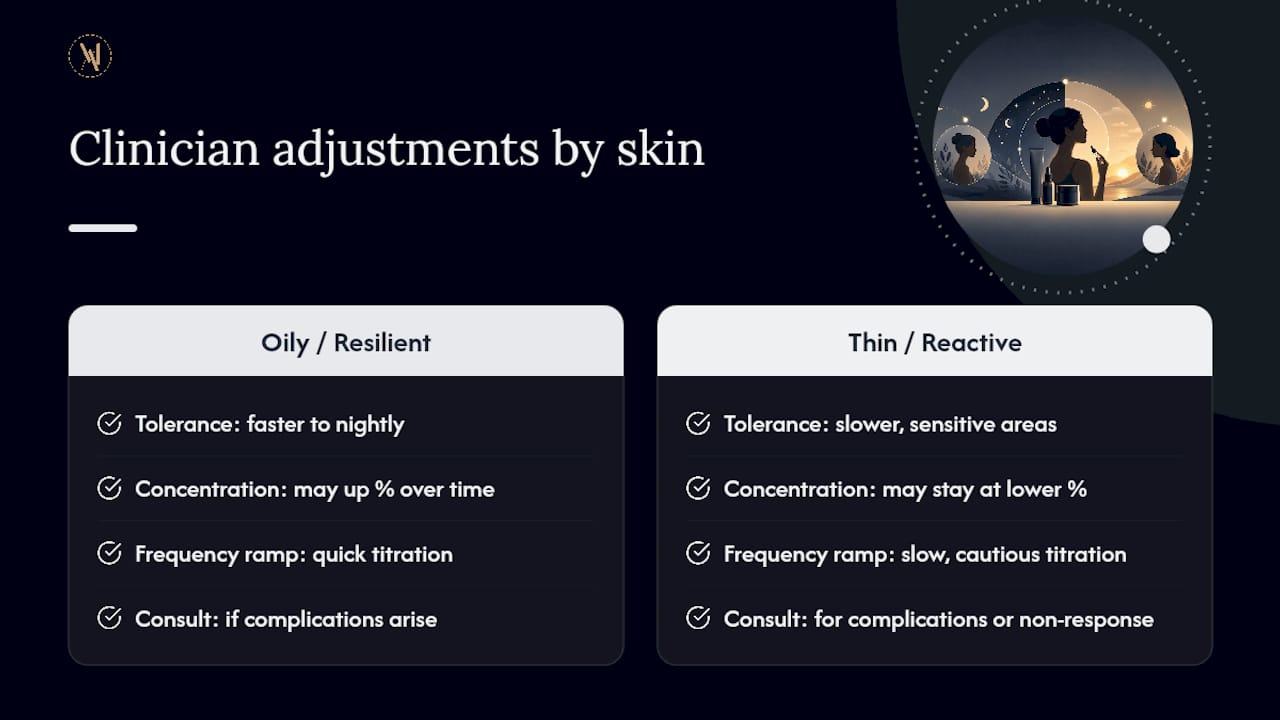
Standardised advice, every-other-night, pea-sized amount, night-time only, gets most people through the first month safely. But strength and frequency genuinely need personalising beyond that generic starting point, and this is where a proper consultation earns its place over guesswork.
Skin that’s naturally oilier and more resilient can often tolerate a faster climb to nightly use and, eventually, a higher percentage formulation. Thinner, more reactive skin, particularly around the eyes and mouth, may need a lower concentration indefinitely rather than as a temporary starting point.
A virtual consultation typically involves a clinician reviewing your skin type, current products, and history of sensitivity before recommending a specific strength and frequency, rather than a one-size-fits-all schedule. Complex cases, pregnancy, active infection, or skin that hasn’t responded to standard titration after several weeks, usually warrant that kind of tailored review rather than continued self-adjustment.
What a consultation adds over generic advice is context: someone reviewing your actual skin, your actual product shelf, and adjusting the plan around both. That’s a meaningfully different starting point from following a schedule designed for an average case.
Our take: the timing question is settled, the technique question isn’t
The morning-or-night debate gets far more attention than it deserves. Every credible clinical source lands in the same place: night, without meaningful dissent. Where the real value lies, and where most generic advice falls flat, is in the execution around that timing.
We think the conventional emphasis on “just apply it at night” undersells how much the surrounding routine determines success. Two people using identical tretinoin at identical strength can have wildly different outcomes based on drying time before application, moisturiser sequencing, and how ruthlessly they protect their skin with SPF the next morning. The medication is doing consistent work. The variable is everything around it.
Our honest priority order for anyone starting out: nail the sunscreen habit before you even open the tube, titrate slower than feels necessary, and treat the first month as an adjustment period rather than a results period. Chase strength or frequency too early and you’ll spend more time recovering from irritation than actually treating your skin.
— Jess
How The M-ethod Skin supports your tretinoin routine
Getting the timing right is only half the equation. Getting the right strength, the right supporting products, and honest advice when your skin isn’t cooperating is where most self-directed routines fall short. Them-ethod exists precisely for that gap, offering virtual skin consultations with clinicians who can assess your skin type, history, and tolerance before recommending a personalised strength and frequency, rather than leaving you to guess your way through titration.
Alongside consultations, Them-ethod stocks medical-grade support products suited to the tretinoin journey, including the PCA Clearskin acne treatment serum for those managing breakouts alongside retinisation, and the NEOSTRATA collection for clinically backed daytime moisturisers and barrier support. If your skin is complex, you’re pregnant, or irritation has become severe, a clinician assessment is genuinely worth booking before continuing self-directed use. Book a virtual consultation to get a routine built around your actual skin, not an average one.
Sources
The clinical claims in this guide draw on established prescribing and patient-education sources rather than anecdotal skincare advice:
For post-treatment barrier support, our partner’s guidance on regenerative creams after treatment offers useful context on rebuilding skin resilience.
This article is general information, not a substitute for advice from a qualified doctor. Consult a qualified healthcare professional about your own circumstances before acting on anything here.
FAQ
What is the 1/2/3 rule for retinol?
It’s an informal titration approach where users apply retinoid products once weekly for two weeks, then twice weekly for two weeks, then three times weekly, before building toward daily use. It’s not a clinically standardised rule, and for prescription tretinoin, the every-2-to-3-nights starting schedule recommended by MedlinePlus is the more reliable framework to follow.
When do tretinoin uglies go away?
Most people see the dryness, redness, and peeling associated with the “tret uglies” ease within four to six weeks as the skin adapts, though full therapeutic benefit for acne or photoageing often takes 8 to 12 weeks or longer to become fully evident.
Is 40 too late to start tretinoin?
No. Tretinoin remains one of the better-studied options for photoageing regardless of age, and the same starting protocol, low frequency building to nightly, applies whether you begin in your twenties or your fifties. A clinician consultation can help account for any age-related sensitivity or concurrent medications.
What not to do after applying tretinoin?
Avoid layering strong exfoliants, acids, or benzoyl peroxide on the same night, especially during the first few weeks, and never skip sunscreen the following morning. Also avoid applying tretinoin to damp or freshly washed skin that hasn’t fully dried, since this increases irritation without adding benefit.
Should I apply tretinoin before or after moisturiser?
Both approaches are used clinically: applying moisturiser first can buffer sensitive skin, while applying it after suits those with moderate dryness. The sandwich method, moisturiser, then tretinoin, then a second thin moisturiser layer, is a practical middle ground for reactive skin.