




Clinician Approved Pregnancy Skincare: Azelaic, Niacinamide, Daily SPF
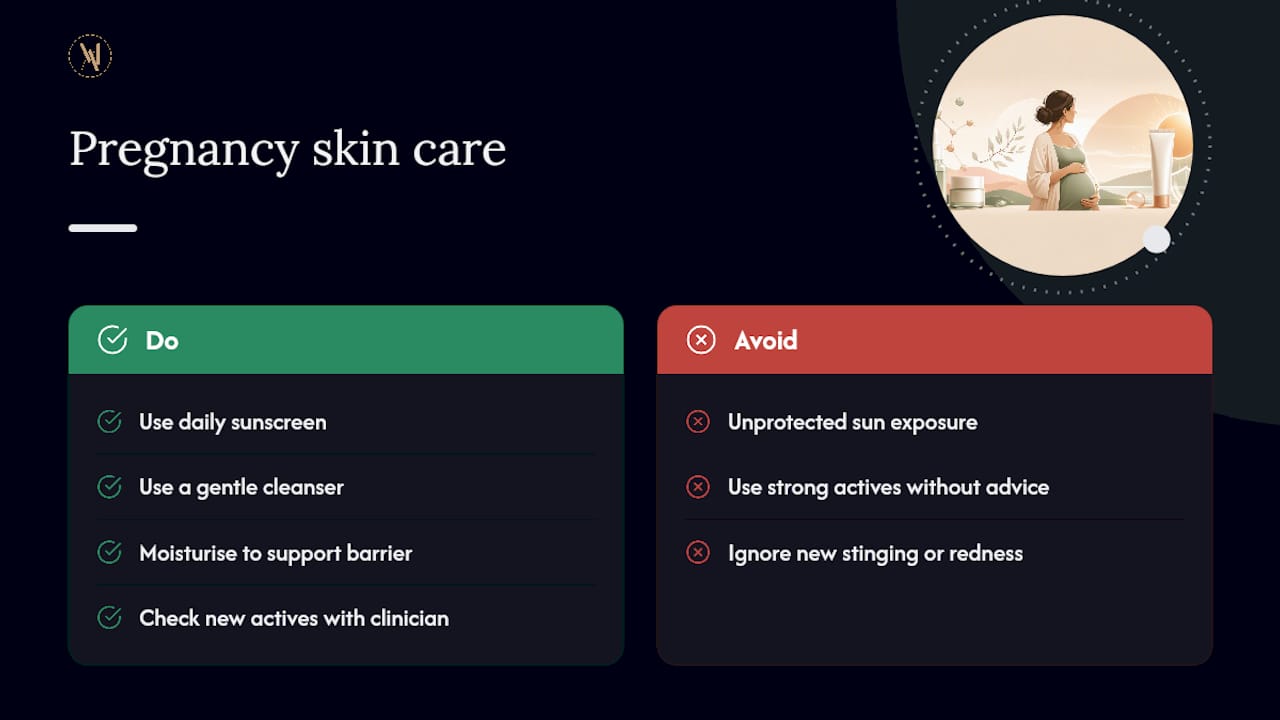
Stop using topical and oral retinoids, hydroquinone, and high-strength salicylic acid peels for the duration of pregnancy. Keep the fundamentals: a gentle cleanser, a barrier-supporting moisturiser, and a daily broad-spectrum sunscreen, built around clinician-approved actives like azelaic acid and niacinamide. Anything prescription-strength, including retinoid gels or spironolactone, needs a conversation with your obstetrician or a board-certified dermatologist before it goes anywhere near your skin.
TL;DR:
- Most pregnancy-safe skincare routines should focus on gentle cleansing, barrier strengthening, and daily broad-spectrum SPF 30 or higher, avoiding known harmful ingredients.
- Topical retinoids, hydroquinone, high-strength salicylic acid peels, and hormone-affecting medications like spironolactone must be paused during pregnancy due to potential risks.
- Azelaic acid, niacinamide, vitamin C, and low-concentration AHAs are effective, well-tolerated alternatives for managing acne and pigmentation safely.
- Physical sunscreens containing zinc oxide or titanium dioxide are preferred, with reapplication every two hours when outdoors, covering exposed areas including the décolleté and arms.
- Consulting with a dermatologist before introducing new treatments or products is recommended, especially for prescription or in-clinic procedures during pregnancy.
Table of Contents
- How pregnancy typically changes your skin
- Ingredients and treatments to avoid during pregnancy
- Safe ingredients and pregnancy safe retinol alternatives
- Sunscreen, melasma prevention and how to actually apply it
- A simple pregnancy skincare routine, morning and evening
- When to consult a dermatologist or your obstetrician
- How clinicians approach pregnancy safe skincare consultations
- A pragmatic, evidence-led view on pregnancy skincare
- Get a personalised pregnancy skincare check
- Sources
- FAQ
How pregnancy typically changes your skin
Around half of pregnant women develop melasma, the patchy brown pigmentation across the cheeks, forehead, and upper lip driven by rising oestrogen and progesterone stimulating melanin production. It’s one of the most visible and frustrating skin changes of pregnancy, and it doesn’t always fade neatly after delivery.
Hormonal shifts also swing oil production in either direction. Some women see a return of teenage-style acne, particularly in the first and third trimesters, while others find their skin turns drier and more reactive than usual. Increased blood flow and shifting hydration levels can leave the skin barrier more sensitive, meaning products you tolerated for years might suddenly cause stinging or redness.
These changes are exactly why sunscreen and gentle barrier care sit at the centre of any pregnancy-safe skincare routine. Melasma responds directly to UV exposure, so unprotected sun time can turn a mild pigment shift into a stubborn one. A compromised barrier, meanwhile, makes skin more prone to irritation from active ingredients that were previously fine. The American Academy of Dermatology recommends exactly this combination: gentle cleansing, moisturising, and daily sunscreen, checking any additional product against a clinician’s advice.
Ingredients and treatments to avoid during pregnancy
Some ingredients carry enough theoretical or documented risk that dermatologists and obstetricians consistently advise pausing them until after pregnancy and breastfeeding. The FDA’s consumer guidance on cosmetics and pregnancy notes that safety data for many topical ingredients in pregnant populations remains limited, which is part of why the dermatology community leans conservative here rather than waiting for definitive answers.
The ingredients to avoid outright include:
- Topical retinoids (tretinoin, adapalene, retinaldehyde) and all oral retinoids (isotretinoin), linked to birth defects at higher doses and avoided even in low-dose topical form as a precaution.
- Hydroquinone, the gold-standard pigment-lightener, which has notably high systemic absorption compared with most other topicals, prompting most dermatologists to pause it during pregnancy.
- Tetracycline-class antibiotics (doxycycline, minocycline), sometimes prescribed for acne, which can affect fetal bone and teeth development.
- Finasteride and spironolactone, both hormone-affecting oral medications used off-label for acne or hair loss, which carry documented reproductive risks.
- 5-fluorouracil, a chemotherapy-derived topical sometimes used for precancerous skin lesions.
High-strength salicylic acid peels and aggressive chemical peels (deep glycolic, TCA, or phenol peels) also go on the pause list, largely because of higher systemic absorption when a strong acid sits on the skin for an extended, occluded period. In-clinic treatments like Profhilo, microneedling, and injectables are typically deferred until after delivery and breastfeeding, though timing varies by treatment and individual health history. Discuss any planned procedure with your clinician before booking it.
Safe ingredients and pregnancy safe retinol alternatives
The good news: several highly effective actives have strong safety track records in pregnancy, and most double as genuinely good retinol substitutes rather than compromises.
Azelaic acid sits at the top of most dermatologists’ lists for treating both acne and pigmentation during pregnancy. Topical absorption is reported at roughly 4 to 8 percent, and clinicians often prescribe it at moderate strengths with routine monitoring. It calms breakouts, fades post-inflammatory marks, and works gently on melasma without the irritation retinoids can cause.
Pro Tip: If you’re switching from a retinoid to azelaic acid for acne, give it six to eight weeks before judging results. It works more slowly but tends to be far kinder to sensitised pregnancy skin.
Other reliable options include:
- Glycolic and lactic acids in low concentrations, ideally in rinse-off cleansers rather than leave-on serums, always paired with sunscreen the next morning.
- Niacinamide, hyaluronic acid, and peptides, which support the skin barrier, calm oil production, and hydrate without raising safety flags in pregnancy guidance summaries, according to Healthline’s pregnancy skincare overview.
- Vitamin C as a morning antioxidant, useful for brightening and adding a layer of environmental protection under sunscreen.
- Bakuchiol, marketed widely as a plant-derived retinol alternative, though clinical pregnancy trials are still lacking. It’s a theoretically lower-risk option, but worth flagging to your clinician rather than assuming it’s automatically safe, and crude essential oils or unrefined botanical extracts should be avoided regardless of their “natural” labelling.
Benzoyl peroxide and low-dose salicylic acid cleansers occupy a middle ground worth understanding properly. A rinse-off salicylic cleanser carries far lower systemic exposure than a high-strength, occluded leave-on peel, so the blanket “avoid all salicylic acid” advice you’ll see online oversimplifies things. Frequency and format matter as much as the ingredient itself.
Sunscreen, melasma prevention and how to actually apply it
Daily broad-spectrum SPF 30 or higher is the single highest-leverage step in preventing melasma from worsening during pregnancy. Reapply every two hours if you’re outdoors, and back it up with physical measures: a wide-brimmed hat, seeking shade during peak UV hours, and sunglasses to protect the delicate skin around the eyes.
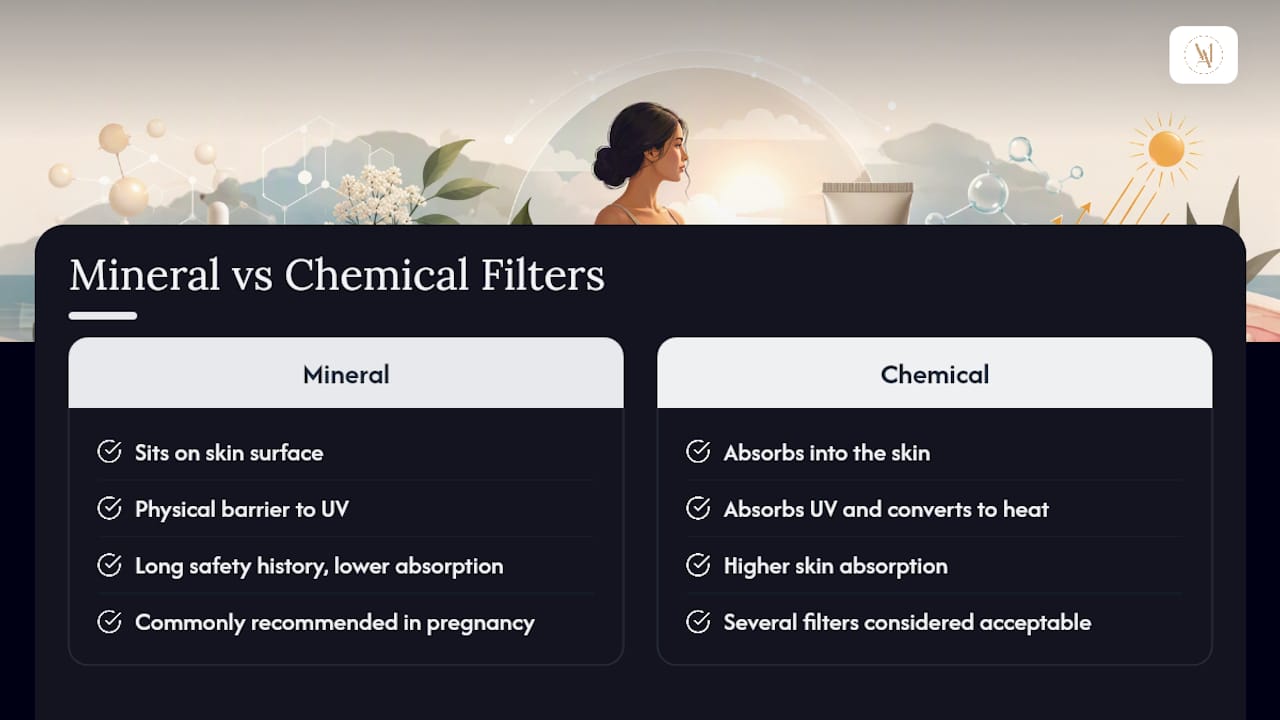
Mineral filters (zinc oxide and titanium dioxide) sit physically on the skin’s surface and are the filters most commonly recommended in pregnancy, largely due to their long safety history and lower absorption profile. Chemical filters absorb into the skin to convert UV rays into heat, and while several are considered acceptable, mineral formulas remain the more conservative default.
That said, consistency beats filter type. A sunscreen you’ll actually reapply every single day protects you more than a “perfect” mineral formula sitting unused in a drawer. Don’t stop at your face, either. Melasma frequently extends to the décolleté and forearms, so cover any skin that sees regular sun exposure, not just the areas you’d normally think of as “face skincare.”
A simple pregnancy skincare routine, morning and evening
Simplicity works in your favour here, both for your skin and your sanity during a period when your routine is already changing shape.
Morning:
- Cleanse with a gentle, fragrance-free cleanser.
- Apply a vitamin C serum for antioxidant support and brightening.
- Layer on a barrier-supporting moisturiser.
- Finish with broad-spectrum SPF 30 or higher, non-negotiable, even indoors on grey days.
Evening:
- Cleanse to remove makeup, sunscreen, and the day’s grime.
- Apply your targeted active, azelaic acid for acne or pigmentation, or a low-strength AHA a few nights a week, never a retinoid.
- Seal with a moisturiser or hydrating serum suited to your current skin texture.
When introducing anything new, patch test on your inner forearm for 48 hours first, then start twice weekly on the face before building up frequency if your skin tolerates it well. Pregnancy skin can react differently to products you’ve used for years, so treat every new bottle as an unknown quantity until proven otherwise.
For acne, start with a gentle cleanser and azelaic acid before reaching for anything stronger. For pigmentation, pair a brightening active with strict sun protection first. If either concern isn’t improving within eight to ten weeks, that’s your signal to escalate to a dermatologist rather than layering on more products.
When to consult a dermatologist or your obstetrician
Book a consultation if you need a prescription-strength product reviewed, you’re dealing with acne severe enough to cause scarring or distress, or your pigmentation is changing rapidly rather than gradually. Bring your full medication list, photos tracking any changes over a few weeks, and the ingredient lists of anything you’re currently using or considering.
A good dermatologist will coordinate directly with your obstetrician on anything that touches medication safety. Virtual consultations have made this step considerably faster, letting you get a clinical opinion on a specific product without waiting weeks for an in-person slot.
How clinicians approach pregnancy safe skincare consultations
A proper pregnancy skincare review starts with your medical history and current medications, then moves through a full ingredient audit of what’s already in your bathroom cabinet. From there, a clinician builds a stepwise plan: what to drop immediately, what to swap, and what can stay.
Virtual consultations are particularly useful here, giving you a fast, direct answer on a specific product rather than a generic internet search. It’s the kind of targeted, personalised check that pregnancy skin often needs, delivered without requiring an in-person appointment.
A pragmatic, evidence-led view on pregnancy skincare
Pregnancy skincare advice online tends to swing between two extremes: paranoid avoidance of anything with a chemical name, or breezy dismissal of any real risk at all. Neither serves you well. The evidence supports a middle path, keep your routine simple, lean on azelaic acid and niacinamide rather than reaching for stronger actives out of habit, and treat sunscreen as the one product you genuinely cannot skip.
Giving up a beloved retinoid or a strong peel for nine months, plus breastfeeding, feels like a real loss if it’s been central to your routine for years. That frustration is entirely normal, and it’s temporary. Your skin will tolerate the swap far better than your patience will.
— Jess
Get a personalised pregnancy skincare check
Working out which products are genuinely fine and which need shelving is easier with a second pair of trained eyes on your actual routine, not a generic list. Them-ethod’s online skin consultation gives you a clinician review of your current products, tailored swaps for anything flagged as unsuitable, and guidance on timing if you’re considering in-clinic treatments once you’ve finished breastfeeding. It’s a complementary service, entirely voluntary, and never a substitute for your obstetric care.
If you’d rather start with the products themselves, browse pregnancy-appropriate options across moisturisers, serums, and cleansers or explore the clinic’s treatment menu for when you’re ready to revisit stronger protocols. Book a consultation whenever you want a second opinion on a specific product before it goes on your face.
Sources
For further reading, see the FDA’s cosmetics and pregnancy guidance, the AAD’s pregnancy skincare recommendations, and peer-reviewed literature archived on PubMed Central.
This article is general information, not a substitute for advice from a qualified doctor. Consult a qualified healthcare professional about your own circumstances before acting on anything here.
- Retinol alternatives: Options for sensitive skin and pregnancy
- Safe skincare during pregnancy — AAD patient guidance
- Cosmetics and pregnancy — FDA
- Bakuchiol vs retinol and pregnancy safety — Cleveland Clinic
FAQ
What skincare should I avoid during pregnancy?
Avoid topical and oral retinoids, hydroquinone, tetracycline-class antibiotics, finasteride, spironolactone, and high-strength salicylic acid peels. Aggressive chemical peels and most in-clinic injectable treatments are typically deferred until after delivery and breastfeeding.
How do I know if my skincare is safe for pregnancy?
Check the full ingredient list against the known avoid list, particularly retinoids and hydroquinone, and favour products built around azelaic acid, niacinamide, hyaluronic acid, and vitamin C. If you’re unsure about a specific product, a dermatologist or online skin consultation can review it directly against your medical history.
Is vitamin C serum safe to use in pregnancy?
Yes, vitamin C has no meaningful pregnancy safety flags and works well as a morning antioxidant that also helps brighten pigmentation. Pair it with sunscreen, since it doesn’t replace UV protection on its own.
Is my current skincare routine safe during pregnancy?
It depends entirely on what’s in it. Retinoids, hydroquinone, and high-strength salicylic acid peels are the main ingredients to drop, while gentle cleansers, barrier-supporting moisturisers, and daily sunscreen can generally stay as they are; a full ingredient review resolves any doubt quickly.