



Clinician Backed AM/PM Routine for Copper Peptides and Vitamin C
Yes, you can use copper peptides with vitamin C, but not stacked into the same layer. The safest and most effective approach is to apply vitamin C in the morning under SPF and copper peptides at night, because mixing low-pH L-ascorbic acid directly with GHK-Cu can cause the two actives to degrade each other. Stabilised vitamin C derivatives are the exception worth knowing about.
TL;DR:
- Applying vitamin C in the morning and copper peptides at night is recommended due to pH incompatibility and potential degradation when layered together.
- Stabilized vitamin C derivatives are less risky to combine with copper peptides than pure L-ascorbic acid, which is highly unstable and best used separately.
- Formulation and delivery systems, like encapsulation or buffering, influence whether these actives can be used in the same routine without causing chemical reactions.
- Waiting 10 to 15 minutes between applications or using different vehicles can help avoid interaction and maintain the effectiveness of both ingredients.
- Sensitive skin or barrier issues require caution, with a need to patch test and avoid combining other actives like retinoids or acids in the same routine.
Table of Contents
- Copper peptides vs vitamin C: how they differ at a glance
- What are copper peptides (GHK-Cu) and what do they do in skin?
- What is vitamin C in skincare, and why does its form matter?
- The chemistry behind the copper and vitamin C conflict
- Can you use copper peptides with vitamin C? The practical verdict
- How to layer copper peptides and vitamin C in your routine
- Layering both in one session: order, vehicle and formulation tips
- Sensitivity, skin types and who should be cautious
- What a clinic-level protocol looks like in practice
- Your quick-reference checklist for combining the two
- Why the “just don’t combine them” advice misses the point
- Where to get expert guidance on building your routine
- Sources
Copper peptides vs vitamin C: how they differ at a glance
Both ingredients support collagen, but they get there by different routes and don’t always play well together in the same product. Here’s the shorthand version before we get into the chemistry:
- Vitamin C is best for brightening, photoprotection, and acting as an enzyme cofactor in collagen synthesis.
- Copper peptides are best for stimulating collagen gene expression, remodelling, and supporting wound repair.
- Mechanism: vitamin C works largely as a biochemical helper molecule; GHK-Cu works further upstream, switching on the genes that drive collagen and elastin production.
- Stability: vitamin C (as L-ascorbic acid) needs a low pH to penetrate skin; copper peptides prefer a more neutral environment and can destabilise under acidic conditions.
That pH mismatch is the reason most formulators keep the two apart rather than fighting it in one bottle.
What are copper peptides (GHK-Cu) and what do they do in skin?
Copper peptides are small copper-binding fragments, most commonly the tripeptide GHK-Cu, that occur naturally in the body and decline with age. In skincare, GHK-Cu is prized because it doesn’t just sit on the surface. It signals fibroblasts directly, switching on genes involved in collagen production while also regulating the enzymes that break old collagen down, a balance that matters for genuine skin remodelling rather than temporary plumping.
- Upregulates collagen and elastin gene expression
- Modulates matrix metalloproteinases (MMPs) and their inhibitors (TIMPs) for tissue remodelling
- Supports wound healing and has a long track record in post-procedure skincare
Statistic callout: Human topical trials on GHK-Cu remain smaller in scale than the major vitamin C RCTs, but the available studies consistently report measurable improvements in fine lines and skin density. Formulation and penetration also vary considerably between brands, so results depend heavily on how well a given product delivers the peptide into skin.
What is vitamin C in skincare, and why does its form matter?
“Vitamin C” on an ingredients list can mean several different molecules, and they don’t behave the same way. L-ascorbic acid is the gold-standard active form, backed by the deepest evidence base, but it’s notoriously unstable and needs a low pH to work. Derivatives like magnesium ascorbyl phosphate or ascorbyl glucoside are gentler and more stable, but they need to convert into active ascorbic acid once absorbed, and that conversion isn’t always efficient.
- L-ascorbic acid: potent, well-studied, unstable, requires low pH
- Derivatives (MAP, ascorbyl glucoside, tetrahexyldecyl ascorbate): more stable, gentler, but reliant on skin converting them to the active form
Statistic callout: Pinnell’s landmark research found that ascorbic acid achieves maximal skin saturation around pH 3.5, which is why most high-strength vitamin C serums are formulated deliberately acidic. Clinical trials using this form have shown genuine benefits for brightening and photoprotection against UV-induced damage, giving vitamin C one of the stronger evidence bases among common actives.
The chemistry behind the copper and vitamin C conflict
The core issue isn’t marketing folklore, it’s redox chemistry. Ascorbic acid is a reducing agent, and when it meets copper directly, it can reduce copper(II) to copper(I), triggering oxidative reactions that degrade both the vitamin C and the peptide. Neither ingredient does its job properly once that reaction starts.
Layer on the pH problem and you get a second layer of incompatibility:
- Vitamin C performs best around pH 3.5, an environment copper peptides don’t tolerate well
- Copper peptides prefer a closer-to-neutral pH, where ascorbic acid barely penetrates
- Combining both in one formula usually means compromising one, sometimes both
Practitioner guidance echoes the chemistry rather than contradicting it. Clinician-led commentary on the two actives concludes that a separated schedule is the practical workaround most formulators recommend, letting each ingredient work through its own pathway without cancelling the other out.
Can you use copper peptides with vitamin C? The practical verdict
The verdict holds: separate them, or choose formats specifically engineered to coexist. Straight L-ascorbic acid mixed with a copper peptide serum in your palm is the combination to avoid. But not every vitamin C or copper peptide product behaves the same way.
- Stabilised vitamin C derivatives (rather than pure L-ascorbic acid) are generally lower risk when paired with copper peptides
- Encapsulated or buffered copper peptide formats can reduce direct chemical contact
- Cream-based vehicles slow interaction compared with two watery serums mixed together
Because formulation matters more than the ingredient name on the label, check a product’s technical notes or ask the brand directly before assuming compatibility. When in doubt, patch test on the inner forearm for two to three days before introducing anything new to your face.
How to layer copper peptides and vitamin C in your routine
Building the routine is simpler than the chemistry behind it suggests. Here’s the sequence that avoids the conflict entirely:
- Morning: cleanse, apply vitamin C serum, follow with moisturiser, then finish with SPF to lock in antioxidant photoprotection for the day.
- Evening: cleanse, apply your copper peptide serum to clean, dry skin, then layer moisturiser over the top to support overnight repair.
- If you must use both in one session, wait 10 to 15 minutes between applications to let the first product absorb and its pH normalise on skin before the second goes on.
- Introduce gradually: start copper peptides gradually before nightly use, watching for redness or tightness.
Pro Tip: If your skin runs sensitive, trial each active on its own for two weeks before combining them at all. You’ll know exactly which product is responsible if irritation shows up, rather than guessing.
This AM/PM split isn’t just a workaround, it’s arguably the better strategy anyway: vitamin C’s antioxidant defence matters most during daylight UV exposure, while copper peptides’ remodelling work aligns with skin’s natural overnight repair cycle.
Layering both in one session: order, vehicle and formulation tips
When timing forces your hand, apply the low-pH vitamin C first and let it fully absorb before anything else touches your skin. Reversing the order risks the copper peptide sitting on an acidic surface before it’s had any chance to work.
- Choose water-based vitamin C under a cream-based copper peptide, not two serums mixed in the palm
- Never combine actives in your hand before application. Apply, wait, then apply the second
- Look for “encapsulated,” “buffered,” or “stabilised” on copper peptide labels. Products like Copper PCA Peptides™ by Medik8 are formulated with this compatibility in mind
- For vitamin C, a derivative form is a safer same-session partner than pure L-ascorbic acid
Sensitivity, skin types and who should be cautious
Sensitive and barrier-compromised skin carries the highest risk of irritation from either ingredient, let alone both. Redness, stinging, or a compromised moisture barrier are signs to slow down, not push through.
- Avoid layering AHAs, BHAs, or retinoids with copper peptides on the same night without spacing, since dermatology guidance warns this combination can increase irritation or blunt efficacy
- If you’re using a retinoid-based routine, reserve copper peptides for a separate night rather than adding a third active into the mix
- Stop and consult a clinician if you notice persistent redness, peeling, or burning that doesn’t settle within a few days of stopping the product
What a clinic-level protocol looks like in practice
At The M-ethod, the routine clinicians recommend clients follow mirrors the chemistry rather than fighting it: vitamin C and SPF every morning, copper peptides at night, with several hours of natural separation built into the day rather than a rushed ten-minute gap.
- Morning: antioxidant serum, moisturiser, broad-spectrum SPF
- Evening: cleanse, copper peptide serum, moisturiser, nothing acidic layered on top
- Patch test any new active for a week before folding it into a full routine, a step our guide to daily peptide use covers in more depth
Jess notes that clients chasing visible pigmentation or deeper collagen loss often see faster, more predictable results with a virtual consultation and a prescription-strength plan rather than self-directed layering of over-the-counter actives alone.
Your quick-reference checklist for combining the two
Keep it simple and the chemistry stays on your side:
- Vitamin C in the morning, followed by moisturiser and SPF
- Copper peptides at night, on clean, dry skin
- Patch test any new product for several days before daily use
- Never mix low-pH L-ascorbic acid directly with copper peptides in one application
- Check product labels for stabilised or encapsulated formats if you want more flexibility
- See a clinician if irritation persists beyond a few days
The single sentence to remember: separate by time of day, not by giving up on either ingredient.
Why the “just don’t combine them” advice misses the point
Most advice on this topic stops at “don’t mix them,” which is true but incomplete, and it leaves readers thinking these two ingredients are somehow rivals. They’re not. Vitamin C and GHK-Cu support collagen through genuinely different biological routes, one as an enzymatic helper, one as a gene-level signal, and that complementary relationship is the actual reason to use both, just not simultaneously.
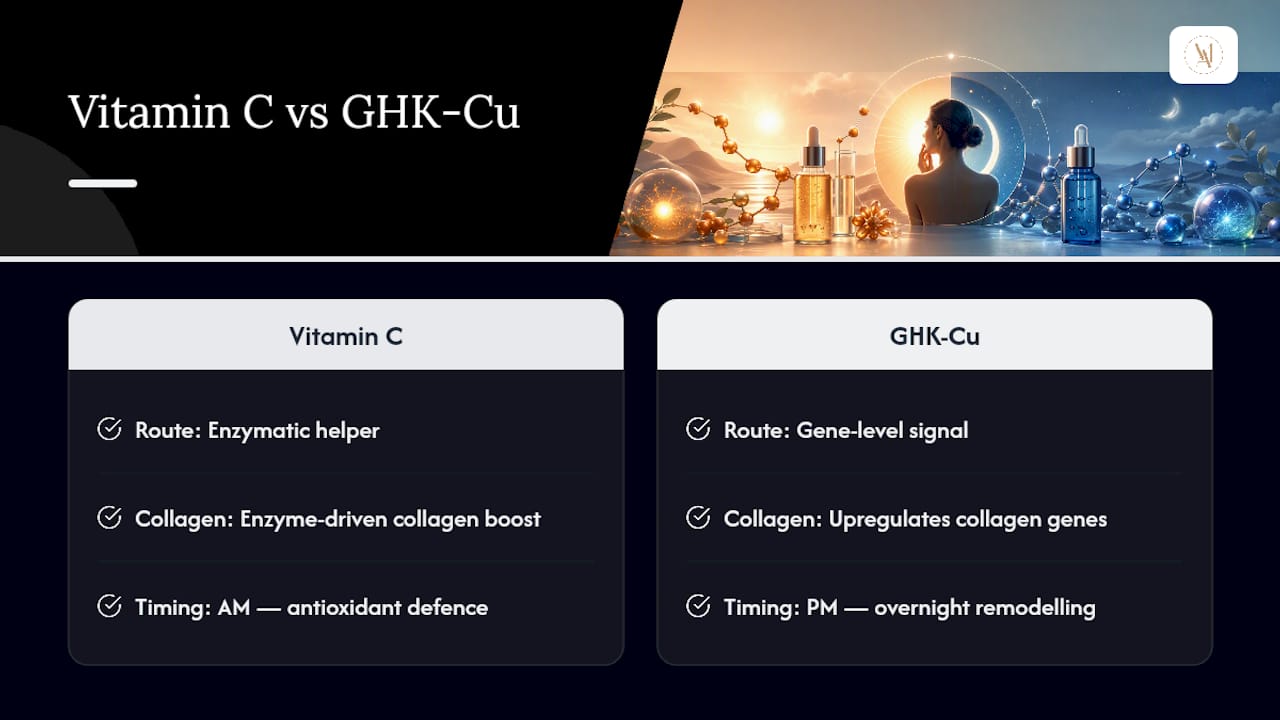
What gets underestimated is how much the fix depends on formulation chemistry, not brand loyalty or ingredient purity. A stabilised vitamin C derivative paired with an encapsulated copper peptide can behave very differently from two raw actives mixed in your palm. Readers fixated on “clean” ingredient lists sometimes overlook that the delivery system matters as much as what’s inside it.
If you take one thing from the chemistry, it’s this: the AM/PM split isn’t a compromise, it’s arguably the smarter strategy on its own merits, since it matches each active to the skin process it’s best suited to support. Start there before worrying about anything more advanced.
— Jess
Where to get expert guidance on building your routine
Working out which vitamin C derivative or copper peptide formulation actually suits your skin shouldn’t mean trawling ingredient lists alone. Them-ethod gives you direct access to virtual consultations with clinicians who can review your current products, flag conflicts before they cause irritation, and recommend medical-grade alternatives, including options from the NEOSTRATA collection when chemical exfoliation is part of your routine too. This suits anyone who has read this far and still isn’t confident which format of either active belongs in their bathroom cabinet. If you want a plan built around your skin rather than a general rule of thumb, book a virtual skin consultation with Them-ethod and get a routine that accounts for every active you’re already using.
Sources
- Copper Peptides vs Vitamin C: Which Actually Wins for Skin? | FormBlends
- Vitamin C v. Copper Peptides, A Scientific Perspective
- Copper Peptides & Vitamin C Guide | Combo, Dosage & Benefits – Neurogan Health
- Copper peptides for skin: a complete guide | Byrdie