




Match Vehicle, Not Percentage: Clinician Picks Azelaic Acid Strength
Percentage alone does not tell the whole story: formulation and skin condition shape how well each strength performs. Most people notice early improvement by 4 weeks, with fuller results by 8 to 12 weeks of consistent use.
TL;DR:
- Prescription strengths at 15% and 20% are approved for rosacea and acne respectively, with specific indications and labeled conditions.
- The vehicle type (gel, foam, cream) significantly influences how the active ingredient penetrates and how tolerated the treatment feels on various skin types.
- Effective treatment typically shows early improvement within four weeks, with clearer results appearing by 8 to 12 weeks, depending on severity and skin response.
- Using the correct strength and formulation, guided by a clinician, is key because lower percentages with advanced delivery systems can perform similarly to higher concentrations.
- Self-diagnosis with OTC formulas carries risks of misapplication, and persistent or worsening symptoms should prompt professional consultation for proper diagnosis and treatment adjustment.
Table of Contents
- Understanding the common azelaic acid strength bands
- Prescription versus over-the-counter: what actually differs
- How to choose the right azelaic acid strength
- Applying azelaic acid correctly from day one
- Why the formulation matters as much as the percentage
- Managing irritation and side effects
- What the clinical evidence actually shows
- When to see a clinician about azelaic acid
- How clinician oversight changes the strength decision
- The maximum concentration debate and regional rules
- Azelaic acid versus other actives for the same concerns
- Combining azelaic acid with retinoids and other actives
- Why clinicians look past the percentage on the label
- Get a tailored azelaic acid plan
- FAQ
- Sources
Understanding the common azelaic acid strength bands
Azelaic acid is sold in three recognisable bands, and each one has a distinct clinical purpose rather than simply offering “more” or “less” active ingredient.
These formulas are designed for everyday use on mild redness, uneven tone and occasional breakouts. They tend to suit people who want a gentle introduction to the ingredient or who are managing early signs of post-inflammatory hyperpigmentation rather than active inflammatory disease.
Prescription strengths step up from there. Finacea, at 15%, is FDA-labelled for the topical treatment of inflammatory papules and pustules associated with mild-to-moderate rosacea, with labelling that sets out dosing, vehicle and tolerability data from its clinical trials, as the Finacea label confirms. Azelex, at 20%, is labelled for mild-to-moderate inflammatory acne, and its label trials recorded improvement in inflammatory lesions within around 4 weeks of twice-daily use, according to the Azelex cream label.

FDA labelling draws a clear line between indications. Finacea 15% is approved for rosacea, Azelex 20% for acne, and that distinction shapes which one a clinician reaches for first.
Availability also differs by strength:
- OTC formulas (around 10% to 12%) are widely available without a prescription for general tone and texture concerns.
- Prescription 15% gel or foam is dispensed for diagnosed rosacea with inflammatory lesions.
- Prescription 20% cream is dispensed for diagnosed inflammatory acne.
- Generic versions of both prescription strengths exist and follow the same labelled indications as the branded originals.
It means the two sit in different regulatory categories, tested against different conditions, which matters more than the number on the tube.
Prescription versus over-the-counter: what actually differs
The gap between prescription and over-the-counter azelaic acid is not just a few percentage points. It is approval, vehicle, access and oversight, and each of those affects what you should expect from treatment.
Approved indications differ by product. Finacea 15% carries its rosacea indication specifically for inflammatory papules and pustules, while Azelex 20% is approved for inflammatory acne lesions. A clinician may still prescribe either off-label for another concern, but the label itself only speaks to what was studied.
Vehicle matters almost as much as concentration. Gels tend to suit oilier, acne-prone skin, foams spread easily over larger or hairier areas, and creams often sit better on drier, more reactive skin. The same percentage in a different vehicle can feel entirely different on the skin.
- Prescription products involve a clinician’s diagnosis, which reduces the risk of treating the wrong condition.
- OTC products are accessible immediately but rely on self-diagnosis, which is less reliable for rosacea versus acne versus pigmentation.
- Cost and access pathways vary: prescriptions usually require a consultation, while OTC formulas are purchased directly.
- Monitoring differs too, since a prescriber can track response and adjust strength or vehicle if irritation or poor response appears.
Clinicians typically escalate from OTC to prescription strength when an adequate trial of the lower concentration has not produced enough improvement, or when the diagnosis itself calls for a specific labelled product, a pattern Mayo Clinic’s dosing guidance reflects in its emphasis on prescriber direction. A guide to azelaic acid for rosacea covers this escalation path in more depth for readers managing persistent redness.
How to choose the right azelaic acid strength
Choosing a strength starts with naming the problem you are actually treating, since rosacea, acne and pigmentation respond differently even to the same ingredient.
- Identify your primary concern: persistent facial redness and bumps point toward rosacea-pattern treatment, while breakouts and blackheads point toward acne-pattern treatment.
- Rate the severity: occasional mild flare-ups often respond to a 10% OTC formula, while widespread or persistent lesions usually need prescription strength.
- Consider your skin’s sensitivity history: if retinoids or acids have caused reactions before, start at the lower end regardless of the condition.
- Factor in prior active use: skin already accustomed to exfoliants or acids may tolerate a higher strength sooner than untreated, reactive skin.
- Match the vehicle to your skin type: gels for oily or acne-prone skin, creams for dry or easily irritated skin.
Before any consultation, it helps to note how long you have had the concern, what you have already tried, and how your skin reacted. That turns a vague complaint into a useful clinical picture.
Pro Tip: Bring a list of every active ingredient you currently use, including occasional exfoliants, since a clinician needs the full picture to avoid stacking irritants.
Certain signs point toward needing prescription-strength azelaic acid rather than persisting with an OTC product: widespread inflammatory acne lesions, rosacea symptoms that have not responded to gentler measures, or pigmentation that has resisted several months of consistent OTC use. A comparison of azelaic acid and benzoyl peroxide can be a useful next step if acne is the primary concern.
Applying azelaic acid correctly from day one
Getting the application right matters as much as choosing the correct percentage.
Label-aligned dosing for prescription products calls for a thin film applied to clean, dry skin twice daily, washing hands afterwards and avoiding the eye area. OTC formulas often follow a similar twice-daily pattern, though some are designed for once-daily use, so checking the specific product’s instructions matters.
- Patch test on a small area before full-face application, particularly with prescription strengths.
- Start at a lower frequency, such as once daily, for the first one to two weeks before moving to twice daily if tolerated.
- Apply a fragrance-free moisturiser after azelaic acid to buffer dryness and reduce stinging.
- Always apply sunscreen the following morning, since any exfoliating or renewing active increases the value of daily protection.
Most people notice early improvement by around 4 weeks, with clearer benefit typically building by 8 to 12 weeks, in line with the timeline described in the Azelex label. If there is no change by that point, it is worth reassessing strength or formulation with a clinician rather than extending the trial indefinitely.
Pro Tip: Introduce azelaic acid on its own for the first two weeks before layering in any other active, so you know exactly what your skin is reacting to.
For a fuller walkthrough, our practical application guide breaks down the stepwise introduction process in more detail.

Why the formulation matters as much as the percentage
Vehicle governs how much azelaic acid actually penetrates and how the skin tolerates it.
Gels tend to feel lighter and absorb faster, which often suits oily or acne-prone skin, while creams sit heavier and can feel more comfortable on dry or sensitised skin. Foams spread thinly across larger areas and are popular for rosacea affecting the broader face. Newer delivery systems, including hydrogels, change how the active ingredient is released into the skin.
- A randomised trial found a 10% nanocrystal hydrogel reduced acne lesions as effectively as a 20% cream over 8 weeks, with a low rate of adverse events, according to research published in PMC.
- Vehicle and delivery technology affect how much active ingredient reaches the skin, which explains why a lower percentage can sometimes match a higher one.
- Matching vehicle to skin type and application site often does more for comfort and results than chasing the highest available percentage.
This is the core argument for formulation-aware prescribing rather than percentage-first thinking.
Managing irritation and side effects
Local irritation is the most common issue with azelaic acid, and it tends to appear early in treatment before the skin adjusts.
Burning, stinging, itching and dryness are the adverse reactions most frequently recorded on product labels, and rare cases of hypopigmentation have also been reported. These effects are usually mild and settle within the first couple of weeks.
- Reduce application frequency to every other day until irritation eases, then build back up gradually.
- Layer a bland, fragrance-free moisturiser both before and after application to create a buffer.
- Pause any other exfoliating actives, including retinoids or acids, until your skin has adjusted.
- Stop treatment and contact a clinician if irritation is severe, persistent or accompanied by swelling.
Pro Tip: If stinging lasts more than a few minutes after application, your skin barrier may need a few extra days of recovery before you resume.
Contact a clinician promptly if you notice signs of infection, unexpected pigmentation changes or irritation that does not improve despite reducing frequency. Our partners at The Holistic Science Co. outline complementary, soothing approaches for calming reactive skin between active treatments.
What the clinical evidence actually shows
Neither label claims superiority over the other, because they were never tested head to head for the same indication.
A double-blind trial found a 10% nanocrystal hydrogel achieved a 36.51% treatment success rate at 8 weeks, compared with 30.37% for a 20% cream, with mostly mild adverse events, as reported in the PMC-published RCT. That single trial does not prove lower strengths universally outperform higher ones, since formulation technology, sample size and study design all shape outcomes.
- Both 15% and 20% azelaic acid have FDA-labelled evidence of efficacy for their respective indications.
- Formulation innovation can allow lower percentages to perform comparably to higher ones.
- The clinical takeaway is that effective treatment depends on matching strength and vehicle to the diagnosis, not on maximising concentration.
When to see a clinician about azelaic acid
Self-treating with an OTC formula works well for many people, but certain situations call for professional input rather than guesswork.
- Persistent or worsening rosacea symptoms despite consistent OTC use.
- Widespread inflammatory acne that has not responded to several weeks of treatment.
- Stubborn post-inflammatory hyperpigmentation that has not faded with standard care.
- Uncertainty about whether your symptoms are rosacea, acne or another condition entirely.
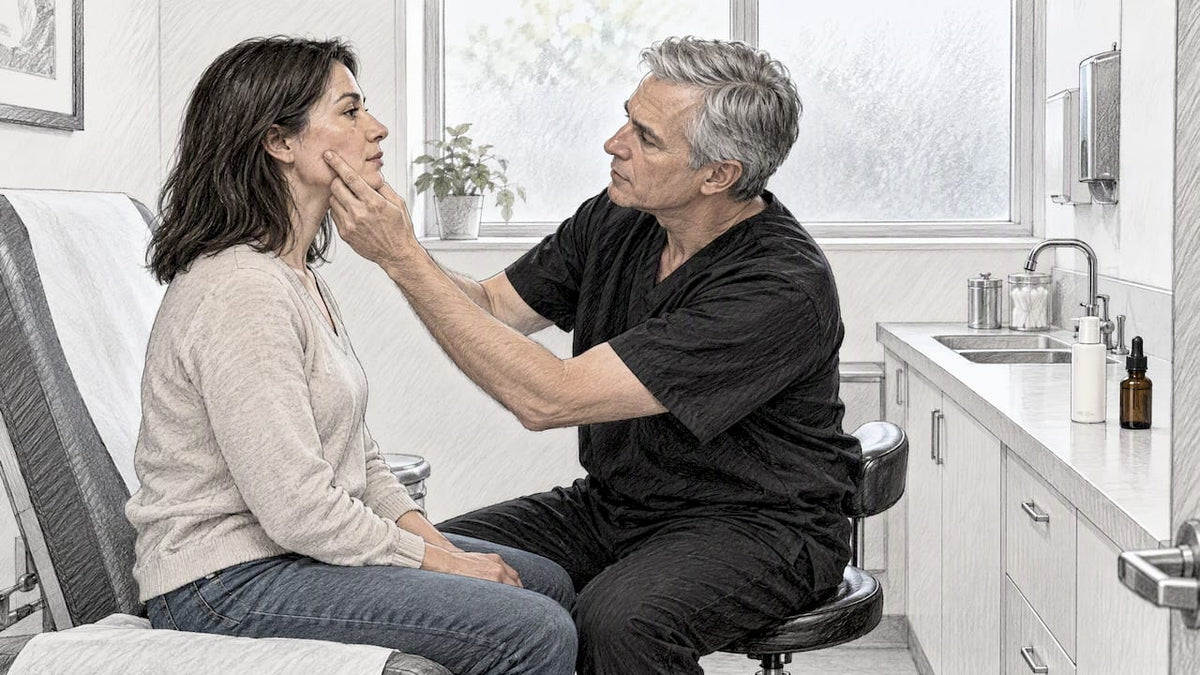
A clinician will typically confirm the diagnosis, prescribe the appropriate strength and vehicle, and monitor your response, adjusting the plan if irritation or poor progress appears. A virtual consultation is a practical way to access this assessment, and bringing a record of your symptoms, duration and prior treatments helps the clinician reach a plan faster. For readers who prefer an in-person pathway, telehealth-style acne services such as AM Rx illustrate how remote prescribing for acne typically works.
How clinician oversight changes the strength decision
Virtual consultations can provide clinician-supervised access to prescription-strength azelaic acid rather than leaving the choice to trial and error. An author associated with the brand has covered azelaic acid’s role in managing redness and pigmentation in detail. A personalised assessment weighs your diagnosis, skin sensitivity and prior treatments before recommending a specific strength and vehicle, which is a more reliable route than guessing from a shelf.
The maximum concentration debate and regional rules
Azelaic acid’s upper concentration limit is set by regulatory approval rather than by any known ceiling on safety at higher percentages. Products marketed above these levels outside regulated prescribing fall outside labelled, tested use.
Regulatory frameworks differ by region. Some markets permit azelaic acid in cosmetic formulations at lower percentages without a prescription, while reserving higher percentages for pharmacy or prescription-only sale. This means the same percentage can sit in different access categories depending on where it is sold, and a product freely available in one country may require a prescription elsewhere.
For readers outside the regulatory frameworks already discussed, the safest approach is to check the labelled indication and approval status for the specific product and market, rather than assuming a given percentage is automatically permitted or appropriate. Where concentration or access rules are unclear, a pharmacist or prescriber can confirm what is approved locally, which matters more than chasing the highest number available online.
Azelaic acid versus other actives for the same concerns
Azelaic acid is one of several options clinicians consider for acne, rosacea and pigmentation, and it is rarely the only one on the table.
For acne, benzoyl peroxide works through a different mechanism and is available in a range of strengths, though it can be more drying and bleaches fabric, which azelaic acid does not. Salicylic acid targets clogged pores and tends to suit oilier skin, while retinoids address both breakouts and texture but often come with a longer adjustment period for irritation.
For rosacea, topical metronidazole and ivermectin are alternative prescription options, each with different side-effect profiles and application schedules compared with azelaic acid’s twice-daily gel or foam.
For post-inflammatory hyperpigmentation, hydroquinone remains a common comparison point. It works through a different mechanism and carries its own regulatory restrictions in several markets, which is why some clinicians favour azelaic acid for patients who want a gentler long-term option. A comparison of azelaic acid and hydroquinone covers this trade-off in more detail.
None of these alternatives is strictly better across the board. The right choice depends on the specific diagnosis, skin sensitivity and how a person’s skin has responded to actives in the past.
Combining azelaic acid with retinoids and other actives
Azelaic acid combines reasonably well with other skincare actives, provided the introduction is staggered and irritation is monitored closely.
Pairing azelaic acid with a retinoid can improve results for acne and pigmentation, since the two work through different mechanisms, but combining them from day one often overwhelms the skin barrier. Introducing them on alternating nights, or using azelaic acid in the morning and a retinoid at night, tends to be better tolerated.
Combining azelaic acid with benzoyl peroxide is generally considered compatible, since neither destabilises the other, though using both at full strength simultaneously can increase dryness for some people. Starting with one in the morning and the other in the evening reduces that risk.
Layering azelaic acid under a moisturiser, and always finishing the morning routine with sunscreen, reduces the irritation that comes from combining multiple actives. Anyone introducing azelaic acid alongside an existing retinoid or benzoyl peroxide routine should slow down the pace of introduction and watch for cumulative dryness rather than treating each product as independent. A guide to choosing between benzoyl peroxide and azelaic acid is a useful reference when deciding how to sequence an acne routine.
Why clinicians look past the percentage on the label
Clinicians weigh tolerability, trial evidence and the specific diagnosis before settling on a strength, because the number alone does not predict how skin will respond. Talk to a clinician before escalating strength on your own.
— Jess
Get a tailored azelaic acid plan
An online skin consultation offers clinician oversight to confirm diagnosis and access the strength and vehicle suited to skin, with prescription options available where appropriate. If irritation is a concern while adjusting, a range of moisturisers and gentle cleansers can help support skin through the process. Book a consultation to get a plan built around your actual skin, not a guess.
This article is general information, not a substitute for advice from a qualified doctor. Consult a qualified healthcare professional about your own circumstances before acting on anything here.
FAQ
Is 20% azelaic acid effective?
Yes, 20% azelaic acid cream is FDA-labelled for mild-to-moderate inflammatory acne, with label trials showing lesion improvement within around 4 weeks of twice-daily use, as set out in the Azelex label. It is not automatically more effective than lower strengths for every condition, since formulation and indication also shape results.
Can azelaic acid be used to treat acne?
Lower strengths, including a 10% nanocrystal hydrogel studied in a randomised trial, have also shown comparable lesion reduction to 20% cream over 8 weeks, according to research in PMC.
What is the difference between 15% and 20% azelaic acid?
The difference lies mainly in the approved condition and vehicle rather than one strength simply being stronger than the other.
How long does azelaic acid take to work?
Many people notice early improvement by around 4 weeks of consistent, twice-daily use, with clearer results typically building by 8 to 12 weeks. This timeline is consistent with the trial data behind the Azelex label.
Do I need a prescription for azelaic acid?
Strengths of 15% and 20% require a prescription, since they are labelled specifically for rosacea and acne and involve clinician diagnosis and monitoring.
Sources
- AZELEX (azelaic acid) cream 20% label — DailyMed
- Azelaic acid topical — Mayo Clinic
- Efficacy and Safety of Azelaic Acid Nanocrystal-Loaded In Situ Hydrogel in the Treatment of Acne Vulgaris — PMC
- Finacea (azelaic acid) 15% label — FDA (PDF)