




What is skin barrier function, and why it matters so much
The skin barrier is the outermost layer of your skin, and its job is to hold water in while keeping everything else, from bacteria to pollution, out. It lives mainly in the stratum corneum, the thin, tough top layer of the epidermis, and it works around the clock whether you notice it or not.
Three things happen when this barrier is working properly:
- It controls water loss. A healthy barrier keeps transepidermal water loss (TEWL) low, so skin stays plump and hydrated rather than dehydrated and tight.
- It blocks external threats. Irritants, allergens, and microbes are kept out before they can trigger inflammation or infection.
- It supports immune balance. The barrier houses antimicrobial peptides and a resident microbiome that help regulate your skin’s defences, using natural moisturising factor (NMF) to keep the whole system hydrated and cohesive.
Key Takeaways
Skin barrier function depends on balanced stratum corneum lipids, an acidic surface pH, and consistent gentle care, and repair follows a predictable multi-week sequence once damaging habits stop.
| Point | Details |
|---|---|
| Barrier lives in the stratum corneum | Corneocytes and lamellar lipids form the bricks-and-mortar structure that controls TEWL. |
| pH drives enzyme activity | An acidic surface (4.5 to 5.5) keeps lipid-producing enzymes functioning; alkaline products slow repair. |
| Repair follows a timeline | Expect initial lipid release within hours, synthesis increases within days, and visible change within one to three weeks. |
| Balanced lipids beat single ingredients | Ceramides, cholesterol, and fatty acids together outperform any one used alone. |
| Persistent symptoms need assessment | See a dermatologist if self-care fails after two to three weeks or infection signs appear. |
Table of Contents
- What is skin barrier function made of at a structural level?
- What are the core functions of the skin barrier?
- How does the structure actually create barrier function?
- What causes barrier damage in everyday life?
- What are the signs of an impaired skin barrier?
- How long does it take the skin barrier to repair itself?
- Which routines and ingredients actually rebuild the barrier?
- What do dermatology reviews say actually matters clinically?
- When should you see a dermatologist about your skin barrier?
- What is skin barrier function — how it protects skin and how to fix it
- Frequently asked questions
- Sources
What is skin barrier function made of at a structural level?
Dermatologists often describe the stratum corneum using a “bricks and mortar” model, and it holds up well under scrutiny. The corneocytes, flattened, dead skin cells packed with keratin, are the bricks. The lipids surrounding them, arranged in precise layers, are the mortar. Neither works without the other.
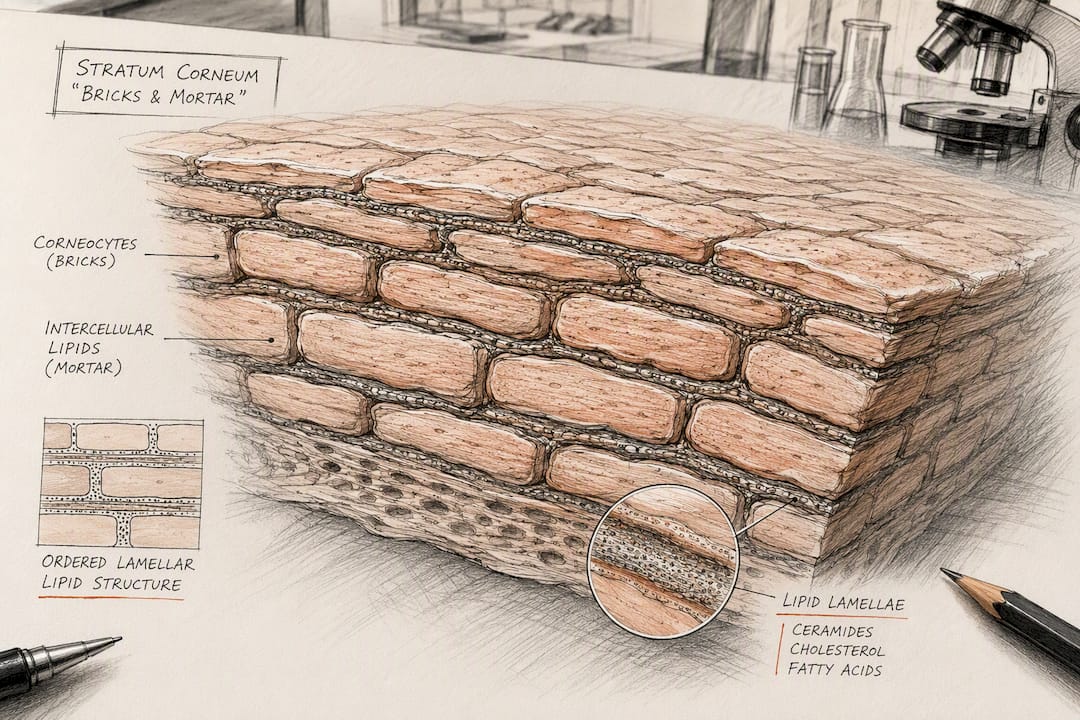
Corneocytes are held together by structures called corneodesmosomes, which act like molecular rivets, and each cell is wrapped in a tough cornified envelope that adds mechanical resilience. Between the cells sit lamellar lipids, principally ceramides, cholesterol, and free fatty acids, arranged in tightly stacked sheets. Get that lipid ratio wrong and water slips through the gaps.
Deeper in the epidermis, tight junctions provide a secondary seal, regulating what passes between living skin cells before it even reaches the stratum corneum. Meanwhile, a protein called filaggrin breaks down into natural moisturising factor, or NMF, a blend of amino acids, lactate, and urea that pulls water into the corneocytes and keeps the whole structure supple.
| Component | Principal role |
|---|---|
| Corneocytes | Provide structural “bricks”; mechanical resilience |
| Corneodesmosomes | Bind corneocytes together; regulate shedding |
| Lamellar lipids (ceramides, cholesterol, fatty acids) | Form the “mortar”; control permeability |
| Filaggrin / NMF | Hydrate corneocytes; support desquamation |
| Tight junctions | Secondary seal in deeper epidermis |
- Each component has a distinct job, but they only function as a barrier together.
- Weakness in any single part, low ceramides, filaggrin mutations, damaged corneodesmosomes, undermines the whole system.
What are the core functions of the skin barrier?
The permeability barrier is the function most people mean when they ask what the skin barrier actually does. It governs TEWL, the rate at which water evaporates from your skin’s surface. Low TEWL means well-hydrated, resilient skin. High TEWL is the mechanistic signature behind that tight, flaky feeling after a harsh cleanse or a long, hot shower.
But permeability control is only one job among several. The barrier also provides physical protection against friction and minor trauma, maintains an acidic surface pH, the so-called acid mantle, that keeps enzyme activity and antimicrobial defence running smoothly, and hosts immune components including antimicrobial peptides that help regulate the skin’s microbiome.
- Permeability control determines whether skin feels hydrated or perpetually dry.
- Physical protection reduces susceptibility to micro-tears and abrasion.
- Acid mantle function keeps pH in the 4.5 to 5.5 range, which matters more than most skincare marketing suggests.
- Immune and antimicrobial defence lowers the risk of opportunistic infection when the surface is compromised.
How does the structure actually create barrier function?
The lipid lamellae aren’t just present, they’re organised into a specific liquid-crystalline structure that only works when ceramides, cholesterol, and free fatty acids sit in roughly the right proportions. Disrupt that balance and the lamellae become disordered, opening microscopic gaps that water and irritants exploit.
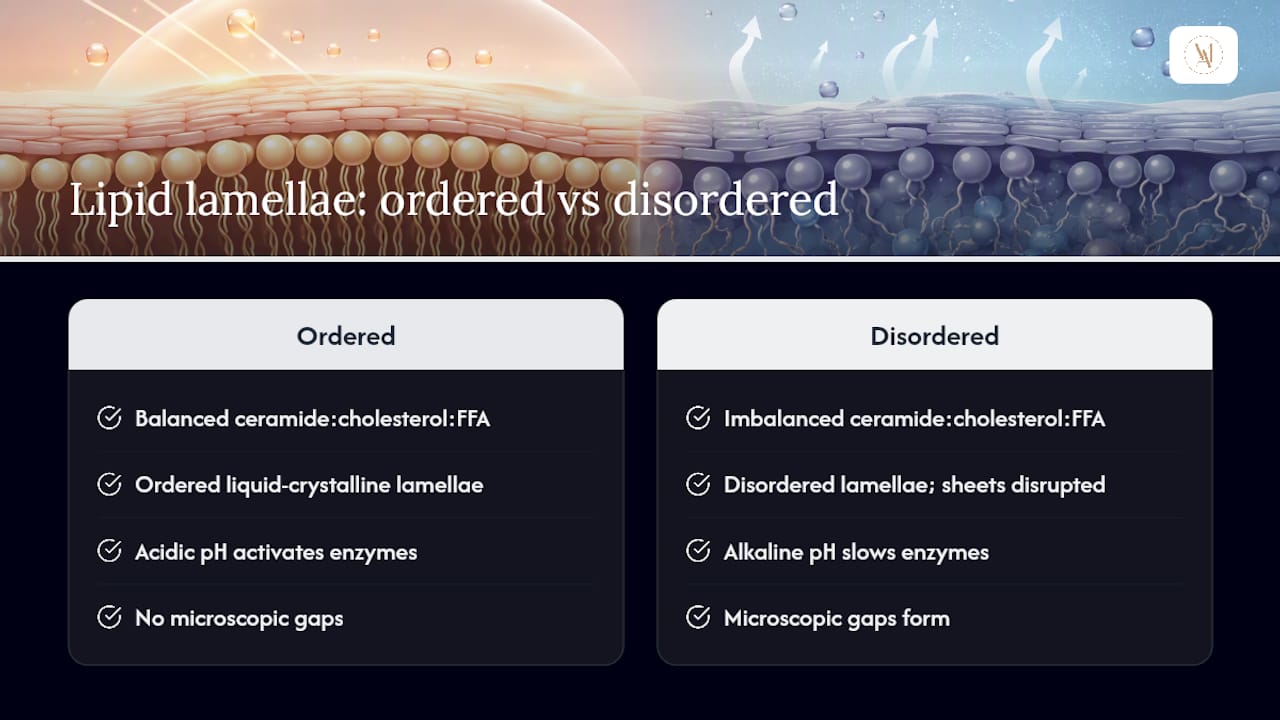
Much of this depends on pH. The enzymes responsible for both lipid synthesis and the shedding of old corneocytes are pH-dependent, and they function best in the skin’s naturally acidic environment. Push the surface toward alkaline, which is exactly what a harsh, high-pH cleanser does, and those enzymes slow down. Lipid production drops. Desquamation becomes erratic. The barrier weakens from the inside out.
When damage does occur, the skin doesn’t wait for you to intervene. Lamellar bodies, small storage organelles in the upper epidermis, release stored lipids within hours. Lipid synthesis ramps up over the following days. Cytokine signalling can even trigger transient thickening of the stratum corneum as a protective response.
Picture the bricks-and-mortar diagram again: bricks (corneocytes) stacked in overlapping rows, mortar (lipid lamellae) filling every gap in ordered sheets, and a thin acidic film coating the whole structure. That acidic film is doing more biochemical work than its thinness suggests.
Pro Tip: Check your cleanser’s pH before anything else in your routine. Many foaming cleansers sit above pH 7, which can suppress the very enzymes responsible for rebuilding your barrier overnight.
What causes barrier damage in everyday life?
Barrier damage is rarely caused by one dramatic event. It’s usually the accumulation of small, repeated exposures that overwhelm the skin’s self-repair capacity.
- Harsh surfactants and foaming cleansers strip lipids faster than they can be replaced; switch to a gentle, low-pH cleanser.
- Frequent hand-washing and alcohol sanitisers dehydrate the surface repeatedly; follow every wash with a barrier-supporting hand cream.
- Over-exfoliation removes corneocytes faster than they regenerate; limit chemical exfoliants to two or three uses a week.
- Hot showers accelerate lipid loss; turn the temperature down and shorten shower time.
- UV exposure degrades barrier lipids and accelerates ageing; wear a broad-spectrum sunscreen daily.
- Low ambient humidity increases TEWL passively; a humidifier in dry months helps more than most people expect.
- Irritants and allergens in fragranced or poorly formulated products provoke chronic low-grade inflammation; patch-test anything new.
Internally, ageing slows lipid synthesis and filaggrin production, inflammatory skin diseases disrupt the barrier from within, and nutrient insufficiencies, particularly in essential fatty acids, can leave the mortar chemically incomplete.
What are the signs of an impaired skin barrier?
Your skin usually tells you before things get serious. Persistent tightness after cleansing, unexplained redness, flaking that no moisturiser seems to fix, stinging when you apply products that never used to sting, these are the classic early markers of barrier dysfunction.
- Dryness that doesn’t respond to standard moisturisers
- Tightness or a “stretched” sensation, especially after washing
- Redness or a flushed appearance without an obvious trigger
- Flaking or visible scaling
- Stinging or burning with previously well-tolerated products
- Increased frequency of minor skin infections
There’s a genuine mechanistic link between barrier dysfunction and several diagnosed conditions. Atopic dermatitis is strongly associated with filaggrin gene mutations, which reduce NMF production and leave the stratum corneum chronically under-hydrated and permeable. Psoriasis and contact dermatitis both involve barrier compromise as part of their pathology, even though the underlying triggers differ. The National Eczema Association notes that this barrier weakness is central to why eczema-prone skin reacts so readily to everyday irritants.
If symptoms persist beyond two to three weeks of consistent gentle care, or worsen despite it, that’s a signal worth acting on rather than waiting out.
How long does it take the skin barrier to repair itself?
Repair follows a fairly predictable sequence, which is genuinely useful to know if you’re mid-way through fixing a compromised barrier and wondering whether anything is actually happening.
- Within hours: lamellar bodies release stored lipids to patch the most urgent gaps in the lipid matrix.
- 24 to 72 hours: lipid synthesis accelerates and cytokine signalling can trigger mild, protective thickening of the stratum corneum.
- One to three weeks: NMF levels rise, corneocyte cohesion improves, and visible symptoms, tightness, flaking, redness, typically start to resolve.
Pro Tip: Stop the inciting habit before adding new products. If a harsh cleanser or over-exfoliation caused the damage, no serum will out-perform simply removing the cause. Repair accelerates dramatically once the trigger is gone.
Which routines and ingredients actually rebuild the barrier?
Barrier repair isn’t about chasing a single hero ingredient. It’s about restocking the same materials your skin already uses. Ceramides, cholesterol, and fatty acids replenish the lipid mortar directly. Humectants such as glycerin and hyaluronic acid draw water into the stratum corneum. Occlusives, think petrolatum or squalane, seal that water in and dramatically reduce TEWL, though they add no hydration on their own, which is why layering order matters.
Formulators sometimes reference a balanced ratio of ceramides to cholesterol to fatty acids that roughly matches skin’s own composition, though most product labels never state their exact ratios. In practice, that means favouring formulas that list multiple skin-identical lipids together rather than a single isolated one, since balanced blends consistently outperform single-ingredient approaches for barrier repair.
Dry or compromised skin, morning: gentle cleanse with lukewarm water only, ceramide-rich moisturiser, mineral sunscreen. Dry or compromised skin, evening: low-pH cleanser, ceramide and cholesterol moisturiser, occlusive layer over damp skin if very dry.
Sensitive or reactive skin, morning: fragrance-free gentle cleanser, hyaluronic acid serum, ceramide moisturiser, sunscreen. Sensitive or reactive skin, evening: water-only or micellar cleanse, barrier-repair moisturiser, no actives until symptoms settle.
Oily skin with barrier damage, morning: gentle low-pH cleanser, lightweight humectant serum, oil-free ceramide lotion, sunscreen. Oily skin with barrier damage, evening: gentle cleanse, ceramide serum, lightweight occlusive such as squalane.
When choosing products, run through a short checklist:
- pH close to skin’s natural 4.5 to 5.5 range
- Fragrance-free formulation
- Minimal known irritants (avoid high alcohol content, sulphates)
- Dermatologist-tested claims backed by ingredient transparency, not just marketing language
Pro Tip: Reintroduce actives like retinoids, AHAs, or vitamin C only after visible symptoms have resolved, typically at the two to three week mark. Start with one active, every third night, and hold off adding a second until your skin tolerates the first without stinging. For layering sequences once your barrier has stabilised, how to layer active skincare correctly walks through the order that minimises irritation risk. If you’re building your product shortlist from scratch, Barrier repair ingredients guide that works breaks each ingredient category down further. Anyone integrating LED masks or microcurrent devices into a barrier-repair routine should also see this skincare device layering guide before combining actives with device use.
What do dermatology reviews say actually matters clinically?
Peer-reviewed literature consistently returns to the same handful of priorities: stratum corneum integrity, acid mantle maintenance, balanced lipid composition, and immune signalling working in concert rather than isolation. None of it supports the idea that a single ingredient can substitute for that balance.
Clinicians frequently point out that what patients describe as “naturally sensitive” or “just dry” skin often reflects underlying barrier dysfunction rather than an unchangeable skin type, which shifts the emphasis toward rebuilding barrier function rather than only masking surface symptoms.
The evidence is unambiguous on one point: balanced lipid replenishment consistently outperforms single-ingredient marketing claims. Restoring acid mantle pH isn’t a cosmetic detail, it’s a functional lever that reduces proinflammatory signalling in barrier-associated skin conditions. Over-treating with strong actives before the barrier has stabilised tends to prolong the very problem it’s meant to solve.
When should you see a dermatologist about your skin barrier?
Most barrier disruption responds to two to three weeks of consistent gentle care. Some signs warrant professional input sooner rather than later.
- Severe or widespread rash
- Cracking, bleeding, or fissured skin
- Signs of infection, including pus or spreading warmth
- Itching severe enough to disrupt sleep
- No improvement after two to three weeks of self-care
Contact your GP or a dermatologist, and consider a teledermatology consultation for initial triage. Bring a symptom timeline, photos if possible, and a list of any current topical prescriptions or steroid use.
What is skin barrier function — how it protects skin and how to fix it
Most skincare advice treats the barrier as an afterthought, something you address only once it’s visibly broken. That’s backwards. The research is clear that barrier maintenance is the foundation everything else sits on, not a rescue mission you launch after damage appears.
The conventional advice, “just moisturise more”, misses the mechanism entirely. Slathering on a heavy cream without addressing pH, lipid balance, or the habit that caused the damage in the first place is treating a symptom while ignoring the cause. What the evidence actually supports is unglamorous: stop the irritating behaviour, use a low-pH cleanser, replenish lipids in balanced ratios, and give it three weeks before judging results.
If there’s one thing worth prioritising above all else, it’s restraint. Fewer, better-formulated products applied consistently will out-perform an aggressive routine stacked with actives every time the barrier is compromised.
Frequently asked questions
What is skin barrier function in simple terms? It’s the skin’s ability to retain water and block external threats, carried out mainly by the stratum corneum’s structure of corneocytes and lipid layers.
How do I know if my skin barrier is damaged? Look for persistent dryness, tightness, redness, flaking, or stinging with products that previously felt fine. Symptoms lasting beyond two to three weeks warrant medical assessment.
Can a damaged skin barrier repair itself? Yes. The skin has natural repair mechanisms, including rapid lipid release and increased NMF production, that typically show visible improvement within one to three weeks once irritating habits stop.
What ingredients help repair the skin barrier fastest? Balanced formulas containing ceramides, cholesterol, and fatty acids together, paired with a humectant and sealed with an occlusive, tend to outperform single-ingredient products.
Is skin barrier damage linked to conditions like eczema? Yes. Atopic dermatitis is strongly associated with filaggrin mutations that impair NMF production, and both psoriasis and contact dermatitis involve barrier compromise as part of their underlying pathology.
This article is general information, not a substitute for advice from a qualified doctor. Consult a qualified healthcare professional about your own circumstances before acting on anything here.
Sources
- Skin 101: Understanding the fundamentals of skin barrier physiology—why is this important for clinicians? - PMC
- Skin barrier function - DermNet
- Skin barrier function - ScienceDirect