


What is professional skincare mapping: a complete guide
TL;DR:
- Professional skincare mapping uses advanced imaging and expert review to assess skin health beyond visual inspection. It provides personalized treatment plans based on measurable data, including sub-surface damage and microbiome imbalances. The process incorporates the Skin Longevity Index to track five key skin health pillars over time.
Professional skincare mapping is defined as a clinical, technology-driven process that uses advanced imaging and expert analysis to assess skin health and design bespoke treatment plans. Known in dermatology as professional skin assessment or skin analysis, this process goes far beyond what a trained eye can see in a standard consultation. A typical session runs 30–60 minutes, combining multi-spectral imaging with clinical expert review to produce a detailed skin report. The result is a customised skincare plan built on measurable data rather than educated guesswork.
What is professional skincare mapping and how does it work?
Professional skincare mapping works by dividing the face into distinct zones and analysing each one using specialist imaging technology. The process captures data that standard visual assessment simply cannot detect, including sub-surface sun damage, vascular irregularities, and microbiome imbalances. That data then feeds into a clinical review, where a dermatologist or trained clinician translates the findings into a personalised treatment protocol.

The technology at the centre of this process is multi-spectral imaging. Systems such as VISIA, which is widely used in dermatology clinics and medical spas, use UV, polarised, and cross-polarised light to reveal concerns that sit beneath the skin’s surface. UV imaging, for example, shows sun damage years before it becomes visible as a dark spot. Polarised light captures texture and pore structure, while cross-polarised light highlights vascular concerns such as redness and broken capillaries.
AI-powered analysis adds another layer of precision. Deep learning models and facial landmark detection assess up to 10–15 skin concerns simultaneously, with results that correlate over 80% with professional physician evaluations. That level of consistency means the technology supports clinical decision-making rather than replacing it.
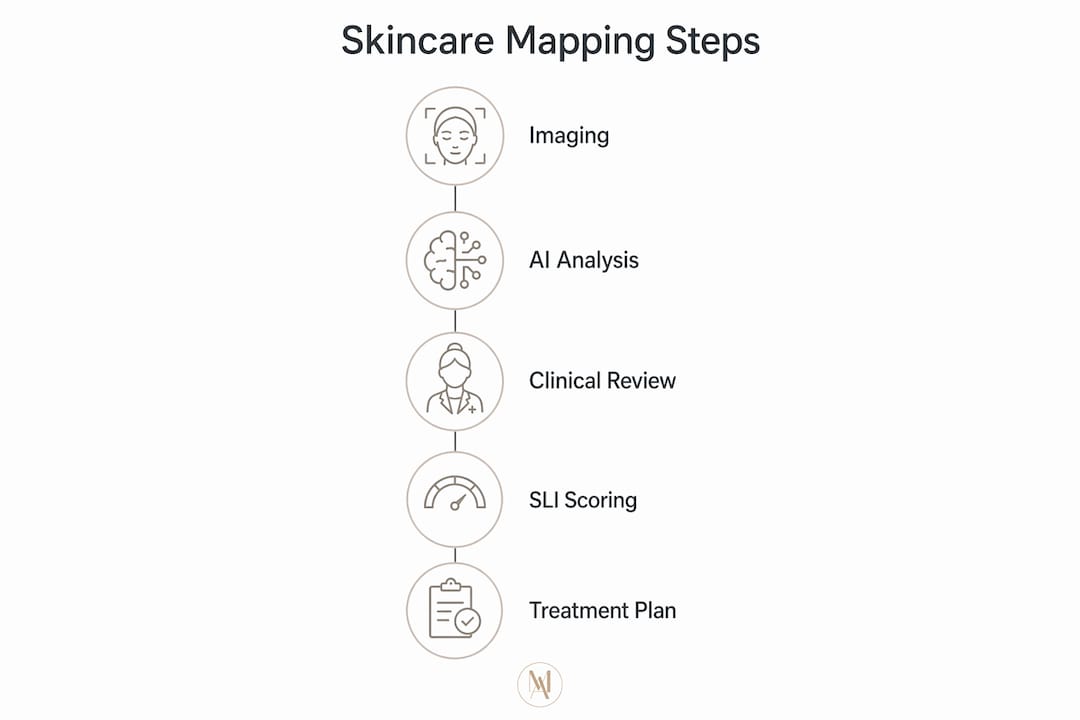
The typical skincare mapping process follows these steps:
- Skin preparation: The client cleanses the face to remove makeup, SPF, and surface oils before imaging begins.
- Multi-spectral imaging: The system captures the face from multiple angles using UV, polarised, and standard light.
- AI-powered analysis: The software identifies and scores concerns across zones including the forehead, cheeks, nose, and chin.
- Zone mapping: The clinician reviews the facial map, noting where specific concerns are concentrated and how severe they are.
- Metric scoring: Key indices such as the Skin Longevity Index are calculated from the imaging data.
- Clinical review: A dermatologist or trained clinician interprets the results in the context of the client’s skin biology, lifestyle, and goals.
- Report generation: A detailed skin report is produced, forming the basis of the personalised treatment plan.
- Follow-up scheduling: Reassessment appointments are typically planned every 3–6 months to track progress.
Pro Tip: When choosing a provider, ask specifically whether their imaging system is clinically validated and whether results are reviewed by a qualified clinician rather than generated by software alone.
What metrics and frameworks guide the analysis?
The most clinically rigorous framework used in professional skin assessment is the Skin Longevity Index (SLI). The SLI quantifies five pillars of skin health to measure how skin is changing over time, rather than capturing a single static snapshot.
| SLI pillar | What it measures | Weighting |
|---|---|---|
| Barrier function | Skin’s ability to retain moisture and resist irritants | 25% |
| Inflammation | Level of chronic or acute inflammatory activity | 20% |
| Elasticity | Collagen and elastin integrity, firmness, and bounce | 20% |
| Microbiome diversity | Balance of beneficial bacteria on the skin’s surface | 20% |
| Oxidative stress | Free radical damage affecting cellular health | 15% |
Barrier function carries the highest weighting because a compromised barrier undermines every other pillar. A client with excellent elasticity scores but poor barrier function will not respond well to active ingredients until the barrier is restored. The SLI makes that priority visible in the data, so the clinician can sequence treatments correctly.
Dermatological experts advocate for personalised skincare guided by validated metrics and continuous feedback cycles to genuinely influence skin longevity. The SLI provides exactly that: a repeatable, quantified measure that tracks whether a regimen is working over months and years.
Pro Tip: Ask your clinician to share your SLI scores at each follow-up appointment. Watching specific pillars improve over time gives you a far clearer picture of progress than relying on how your skin looks in the mirror.
What are the benefits of skincare mapping over a standard consultation?
A conventional skincare consultation relies on visual observation and the client’s self-reported concerns. That approach has real limitations. Clinicians can miss sub-surface pigmentation, early vascular damage, and microbiome disruption because none of these are visible to the naked eye. Professional skin mapping removes that blind spot entirely.
UV imaging detects sun damage long before it appears as a visible spot on the skin’s surface. That early detection changes the treatment conversation. Instead of addressing damage after it becomes visible, clinicians can intervene at the sub-surface stage with targeted actives such as vitamin C, niacinamide, or prescription retinoids.
The benefits of professional skin mapping compared to a standard consultation include:
- Objective data: Results are measurable and repeatable, removing subjectivity from the assessment.
- Hidden concern detection: UV and polarised imaging reveal pigmentation, vascular issues, and texture irregularities not visible in natural light.
- Personalised precision: Customised skincare plans are built on individual data rather than skin-type generalisations.
- Progress tracking: Repeat assessments every 3–6 months confirm whether treatments are working and where adjustments are needed.
- Faster clinical decisions: AI systems shorten consultation times and support more consistent clinical decision-making across appointments.
- Client confidence: Seeing objective data builds trust in the recommended regimen and improves adherence.
Professional systems also differ significantly from consumer AI apps. While consumer apps prioritise convenience, professional systems focus on clinical precision, HIPAA compliance, and integration with medical practice workflows. That distinction matters when the goal is a treatment plan that genuinely changes skin health rather than one that simply feels personalised.
How do you interpret results and build a treatment plan?
Interpreting professional skincare mapping results requires clinical expertise. The imaging data and SLI scores tell a clinician which concerns are present and how severe they are. The clinician then layers in the client’s skin biology, sensitivities, lifestyle factors such as diet, sleep, and sun exposure, and their treatment goals. That combination produces a protocol that is specific to one person, not a generic skin type.
Dermatologists use mapping analyses to select pharmaceutical-grade active ingredients at therapeutic concentrations suited to the individual. A client with high oxidative stress scores might receive a protocol centred on antioxidant serums and SPF optimisation. A client with compromised barrier function would start with ceramide-rich repair products before any active treatment is introduced. The sequencing is as important as the ingredient selection.
Follow-up assessments are where the real value of skin mapping compounds. Re-analysis at each appointment allows the clinician to confirm improvement, identify new concerns, and adjust the regimen accordingly. This is the measure, confirm, and optimise approach that replaces the “hope it works” mentality of conventional skincare.
When reviewing your mapping results with a clinician, ask these questions:
- Which of my SLI pillars scored lowest, and what does that mean for my regimen?
- Are there sub-surface concerns I should be addressing before they become visible?
- How long before I should expect to see measurable improvement in my scores?
- What lifestyle factors are most likely affecting my results?
- When should I return for a follow-up assessment?
Understanding the answers to these questions puts you in a far stronger position to follow your regimen consistently and adapt it intelligently over time. For a deeper look at how expert review follows imaging in practice, the step-by-step skin analysis guide from Them-ethod is worth reading alongside your results.
Key takeaways
Professional skincare mapping is the most clinically rigorous method available for building a customised skincare plan grounded in objective, measurable data.
| Point | Details |
|---|---|
| Defined by technology | Multi-spectral imaging using UV, polarised, and AI analysis reveals concerns invisible to the naked eye. |
| Guided by the SLI | The Skin Longevity Index scores five pillars, with barrier function carrying the highest weighting at 25%. |
| Surpasses standard consultations | Objective, repeatable data replaces guesswork and enables earlier detection of sub-surface damage. |
| Drives personalised protocols | Clinicians use imaging data alongside lifestyle and biology to select pharmaceutical-grade actives at therapeutic concentrations. |
| Requires ongoing monitoring | Reassessment every 3–6 months confirms progress and allows regimen adjustments based on measured change. |
Why I think most people underestimate what skin mapping actually tells you
Most clients arrive at a skin mapping consultation expecting confirmation of what they already know. They assume the technology will confirm their oily T-zone or their sensitivity to fragrance. What actually happens is often more surprising, and more useful.
I have seen clients with what appeared to be clear, healthy skin leave with UV imaging showing significant sub-surface sun damage across the cheeks and forehead. That damage was invisible in natural light and would not have been flagged in a standard consultation. Without the imaging, the clinician would have recommended a maintenance routine. With it, they prescribed a targeted vitamin C and retinoid protocol that addressed the damage before it became visible.
The mistake I see most often is treating mapping results as a one-time diagnosis rather than the start of an ongoing conversation. The SLI is only meaningful when you track it across multiple appointments. A single score tells you where you are. A series of scores tells you whether your regimen is actually working. That distinction is the difference between skincare that feels personalised and skincare that is measurably improving your skin health.
My advice: engage with the process actively. Ask your clinician to explain each metric. Request your scores in writing so you can compare them at your next appointment. And be honest about your lifestyle, because the imaging data and the SLI scores only make sense when the clinician understands the full picture. For guidance on personalising cosmetic treatment alongside your mapping results, it is worth reading how aesthetic specialists approach individual treatment design.
— Jess
Bespoke skincare at Them-ethod, informed by your skin data
Professional skin mapping identifies exactly what your skin needs. Them-ethod translates that precision into product recommendations drawn from clinically validated, pharmaceutical-grade ranges. Whether your mapping results flag acne-prone congestion, oxidative stress, or a compromised barrier, Them-ethod’s virtual skin consultation connects you with top clinicians who build your regimen around your data. For targeted acne treatment informed by professional assessment, the PCA Clearskin Acne Treatment Serum is a clinician-recommended option. For broader protocol support, the NeoStrata collection offers professional-grade formulations suited to a range of mapped skin concerns.
FAQ
What is professional skincare mapping?
Professional skincare mapping is a clinical process that uses multi-spectral imaging, UV and polarised light, and AI-powered analysis to assess skin health across facial zones. The results inform bespoke treatment plans tailored to the individual’s specific skin biology and concerns.
How long does a professional skin mapping session take?
A typical session runs 30–60 minutes, covering imaging, AI analysis, and clinical review. Follow-up reassessments are recommended every 3–6 months to track progress.
What is the Skin Longevity Index in skincare mapping?
The Skin Longevity Index (SLI) is a quantified framework that scores five pillars of skin health: barrier function, inflammation, elasticity, microbiome diversity, and oxidative stress. It measures how skin health changes over time rather than capturing a single static assessment.
How accurate is AI skin analysis in professional mapping?
AI-powered professional systems detect 10–15 skin concerns and correlate over 80% with physician evaluations. Professional systems are clinically validated and integrated with medical workflows, making them significantly more precise than consumer-grade apps.
What is the difference between a skincare consultation and skin mapping?
A standard skincare consultation relies on visual observation and self-reported concerns. Professional skin mapping uses imaging technology to reveal sub-surface damage, vascular issues, and microbiome imbalances that a visual assessment cannot detect, producing objective, measurable data for treatment planning.