

Melasma vs Hyperpigmentation: Why Tinted SPF50 Trumps Lasers
All melasma is hyperpigmentation, but melasma is a specific, usually hormone-driven form that behaves differently to a sun spot or a lingering acne mark. It tends to be chronic, symmetrical, and prone to relapse, which is exactly why the treatment path diverges. Getting the distinction right at the start shapes every decision that follows, from which active you reach for to how aggressively a clinic should treat your skin.
TL;DR:
- Melasma involves dermal and vascular changes that make it more resistant to typical brightening treatments and prone to relapse.
- It commonly appears as symmetrical, map-like patches on the mid-face, especially on the cheeks, forehead, and upper lip, mainly affecting women of darker skin tones.
- Sun protection for melasma requires tinted mineral sunscreens with iron oxides and habits like frequent reapplication and physical barriers due to visible light and heat contribution.
- Topical treatments such as hydroquinone, tranexamic acid, and retinoids are effective, but procedural options like lasers and peels carry higher risks of worsening pigmentation if not carefully managed.
- Ongoing management emphasizes maintenance and cautious treatment, with expert consultation recommended for persistent or atypical cases to prevent rebound and monitor systemic causes.
Table of Contents
- Hyperpigmentation: what it is and where it comes from
- Melasma: the pattern, the people it affects, and why it is stubborn
- Telling melasma and hyperpigmentation apart: history, pattern, and clinical tests
- Treating melasma and other hyperpigmentation: where the approaches split
- Protecting your skin from UV, visible light, and heat
- When to see a dermatologist about pigmentation
- Living with pigmentation: relapse risk and realistic goals
- How Them-ethod supports diagnosis and long-term maintenance
- The take that gets missed in most melasma advice
- Sources
Hyperpigmentation: what it is and where it comes from
Hyperpigmentation is the umbrella term for any patch of skin that has gone darker than the skin around it because of excess melanin. It is a description of an effect, not a single diagnosis, and melasma sits underneath it as one specific subtype among several, according to Cleveland Clinic. That is a useful distinction to hold onto: asking “is melasma a form of hyperpigmentation” is really asking whether a square counts as a rectangle. It does, but not every rectangle is a square.
The most common forms you will encounter are:
- Post-inflammatory hyperpigmentation (PIH): dark marks left behind after acne, eczema flares, or skin injury, usually appearing exactly where the damage was.
- Solar lentigines (sun spots): flat brown spots that build up on the hands, chest, and face from cumulative UV exposure over years.
- Lentigines: small, well-defined pigmented spots that can appear at any age, sometimes unrelated to sun exposure.
- Drug-induced pigmentation: darkening triggered by certain medications, including some antibiotics, chemotherapy agents, and anti-malarials.
- Systemic causes: pigment changes linked to conditions such as adrenal disorders, though these are far less common than the others.
The main triggers behind most of these are UV exposure, local inflammation, and physical injury to the skin, with medication as an occasional but important factor to rule out, per the Merck Manual. Because most of this hyperpigmentation lives in the epidermis, it tends to respond fairly well to consistent brightening ingredients and sun protection, and simple over-the-counter measures often make a visible dent within a few months. Melasma, as you will see, plays by different rules.
Melasma: the pattern, the people it affects, and why it is stubborn
Melasma shows up as symmetric, map-like patches of brown or grey-brown pigment, almost always on the mid-face, upper lip, or forehead. That symmetry is the single biggest visual clue separating it from an isolated sun spot or a solitary acne mark, and it is one of the clearest answers to “melasma vs sun spots” you will find. Where a sun spot is a single, defined blotch, melasma spreads across both cheeks in a mirrored pattern, almost like a mask.
It is a common acquired disorder with a pathogenesis that is genuinely multifactorial, and it is often chronic and relapsing rather than a one-off event.
Melasma disproportionately affects certain groups:
- Women, far more often than men, particularly during reproductive years.
- Pregnant women, where it is common enough to have earned the nickname “the mask of pregnancy.”
- People using hormonal contraception or hormone replacement therapy.
- People with darker skin tones (Fitzpatrick types III to VI), who show a notably higher prevalence than those with lighter skin.
Why melasma resists treatment when other pigmentation doesn’t: melasma is not simply melanocytes working overtime. It involves dermal and vascular alterations too, which helps explain why it responds more slowly and unpredictably to treatments that clear ordinary sun spots in a matter of weeks. That vascular component also means blood vessel activity under the skin can feed the pigment problem, a detail conventional “just use a brightening serum” advice tends to skip entirely. Beyond the visible patches, melasma carries a real psychosocial weight. Because it sits on the face, is often visible without makeup, and can persist for years despite treatment, it affects confidence in a way that a fading sun spot on the back of the hand rarely does.
Telling melasma and hyperpigmentation apart: history, pattern, and clinical tests
Working through this logically, three questions do most of the diagnostic heavy lifting before any test is even needed.
- What came before the pigment appeared? A recent pregnancy, new contraceptive pill, or regular sauna and hot yoga sessions points toward melasma. A breakout, insect bite, or cut that healed and left a mark points toward PIH.
- What is the pattern? Bilateral, symmetrical, map-like patches on the cheeks and forehead favour melasma. A single, localised, well-defined spot favours PIH or a solitary lentigo.
- Does it fade with sun avoidance, or does it deepen? Melasma tends to darken noticeably with sun and heat exposure and lighten only partially in winter, while ordinary sun spots are more stable once formed.
Clinicians lean on two simple in-office tools to confirm what the history suggests. A Wood lamp assessment separates epidermal pigment from dermal pigment: epidermal pigment accentuates clearly under the lamp and tends to respond better to topical resurfacing, while dermal pigment shows less contrast and is notably less responsive to the same treatments. Dermoscopy adds a closer look at the pigment network and vascular pattern, which helps flag cases that need a biopsy or specialist referral, particularly when the pattern looks atypical.
Not every dark patch is melasma or PIH. Lichen planus pigmentosus, drug-induced pigmentation, and exogenous ochronosis (a rare complication of prolonged, unsupervised hydroquinone use) can all mimic melasma closely enough to fool an untrained eye.
Pro Tip: If your pigmentation appeared or worsened within weeks of starting a new pill, pregnancy, or a course of medication, mention that timeline explicitly at your consultation. It often points a clinician toward the right diagnosis faster than the patches themselves.
Treating melasma and other hyperpigmentation: where the approaches split
This is where the difference between melasma and hyperpigmentation stops being academic and starts changing what actually goes on your skin.
Topical agents form the first line for both conditions, but with different expectations attached:
- Hydroquinone, used under medical supervision, remains one of the most effective depigmenting agents for both melasma and PIH, though it needs monitoring.
- Azelaic acid offers a gentler option, useful for those who cannot tolerate hydroquinone or who have more reactive, easily irritated skin.
- Tranexamic acid, applied topically, targets the vascular contribution to melasma specifically, addressing a mechanism that ordinary brightening agents miss.
- Retinoids support cell turnover and improve penetration of other actives, useful across both conditions but often introduced more cautiously in melasma to avoid triggering inflammation.
- Combination or “triple therapy” formulas, typically pairing hydroquinone, a retinoid, and a mild steroid, are often considered for melasma that has not responded to single agents.
For moderate-to-severe melasma that resists topical treatment, oral tranexamic acid can be considered as an adjuvant in selected cases, though it comes with contraindications around clotting risk that require proper screening and monitoring, according to Medscape’s guideline summary.
Procedures are where the caution really matters. Chemical peels can help epidermal pigmentation, but must be selected carefully in skin of colour to avoid triggering new post-inflammatory darkening. Microneedling, lasers, and IPL carry a genuinely higher risk of worsening melasma, or of causing PIH, if settings are too aggressive, which is why specialist supervision matters more here than almost anywhere else in aesthetic dermatology.
Two safety notes deserve equal weight regardless of which condition you are treating. Long-term, unsupervised hydroquinone use carries a rare but serious risk of exogenous ochronosis, a form of skin darkening that can be difficult to reverse. And several topical actives, including retinoids and higher-strength agents, require adjustment or avoidance during pregnancy, a caveat that applies whether you are treating melasma or pregnancy-related PIH.
Protecting your skin from UV, visible light, and heat
Sun protection advice for melasma needs an upgrade beyond the standard SPF message, because visible light and heat play a bigger role here than in most other pigmentation.
Standard chemical sunscreens filter UV effectively but often let high-energy visible light through untouched, and that visible light is implicated in melasma flares in a way plain UV protection does not address. That is why tinted mineral sunscreens containing iron oxides, applied at SPF 50 or higher with broad-spectrum coverage, are specifically recommended for melasma rather than left as an optional upgrade.
Beyond the product itself, a few habits carry real weight:
- Reapply every two hours when outdoors, and more often around water or heavy sweating.
- Use physical barriers, wide-brimmed hats and UPF clothing, especially during peak UV hours.
- Limit prolonged heat exposure where practical, since heat from saunas, hot yoga, and even cooking over a stove can aggravate melasma independently of sunlight.
- Layer in antioxidants such as vitamin C to support the skin barrier without adding irritation.
Pro Tip: Reapplying sunscreen through a full workday is genuinely hard with makeup on. A pressed mineral powder with SPF, tapped over foundation, solves the reapplication problem most people quietly give up on.
When to see a dermatologist about pigmentation
Most pigmentation changes are worth a professional opinion rather than months of guesswork with over-the-counter products. Certain signs make that visit more urgent.
- Rapid spread or sudden onset of pigmentation across the face, which can suggest a drug reaction or hormonal shift worth investigating quickly.
- Mucosal pigmentation, meaning dark patches inside the mouth or on the lips, which warrants prompt medical review rather than a skincare fix.
- Pigmentation alongside other symptoms, such as fatigue or unexplained weight changes, that could point to a systemic cause.
A typical consultation includes a focused history, a Wood lamp assessment, dermoscopy, and, in atypical or treatment-resistant cases, a biopsy to rule out mimicking conditions. From there, care usually moves toward prescription topicals, cautious procedural options where appropriate, and a maintenance plan with scheduled follow-up. Improvement is measured in months, not weeks, and that timeline holds whether you are treating melasma or a stubborn patch of PIH.
Living with pigmentation: relapse risk and realistic goals
Melasma in particular has a habit of returning once treatment stops, which makes indefinite maintenance, not a finite course, the realistic goal. Guideline summaries increasingly frame melasma management as personalised and ongoing rather than something you finish and file away.
- Expect softening and better evenness of tone rather than a guaranteed, permanent clearing.
- Maintenance sunscreen and a light rotation of brightening actives typically continue long after the visible improvement plateaus.
- Colour-correcting makeup and tinted sunscreen offer useful cosmetic cover on harder days without adding irritation.
- Never stop a prescribed regimen abruptly or swap in unregulated “fade cream” products bought online, since some carry undeclared steroids or high-dose hydroquinone.
How Them-ethod supports diagnosis and long-term maintenance
Working out whether you are dealing with melasma, PIH, or ordinary sun spots is easier with a proper assessment rather than a guess based on a mirror and a search engine. Virtual skin consultations can help distinguish the condition and develop an appropriate maintenance plan, rather than a one-off fix.
Relevant options include:
- Virtual skin consultations with clinicians experienced in pigmentation, useful for an initial read on melasma versus other hyperpigmentation before committing to a routine.
- Prescription-strength topical options, including formulations built around the same actives discussed above, dispensed with proper guidance.
- In-clinic protocols, such as FDA-approved SkinPen microneedling, offered with the supervision that pigmentation-prone skin genuinely needs.
For readers wanting a structured starting point, Them-ethod’s melasma skincare routine guide and the BRIGHT SKY protocol for pigmentation and melasma both lay out clinic-aligned approaches to maintenance rather than a quick fix. If you already know which cosmeceutical ingredients your skin tolerates, the NEOSTRATA collection offers medical-grade formulations built around evidence-based pigmentation actives, worth discussing with a clinician before adding to your routine.
The take that gets missed in most melasma advice
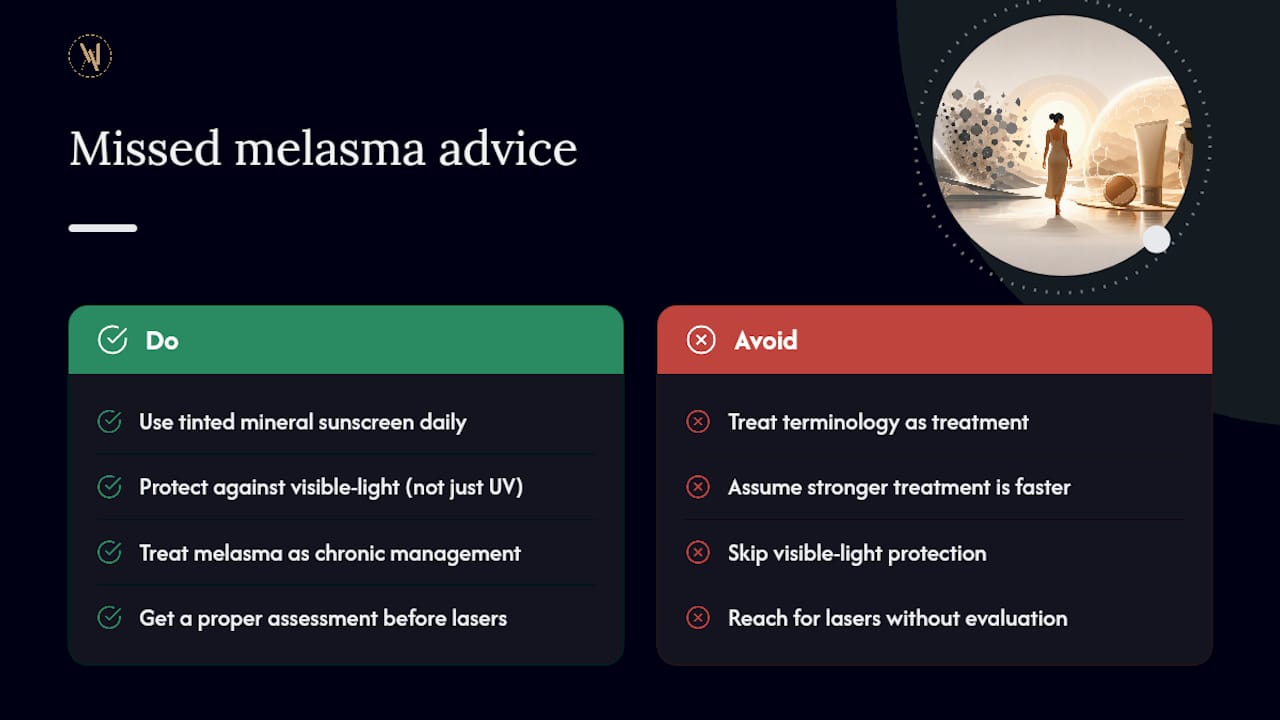
Most articles on this topic treat melasma and hyperpigmentation as a vocabulary problem, as if knowing the right term fixes the skin. It doesn’t. The real gap in conventional advice is the assumption that more aggressive treatment equals faster results. With melasma, that assumption backfires more often than it pays off, because the dermal and vascular components mean an overzealous laser session can trigger the exact rebound pigmentation you were trying to erase.
What actually moves the needle is unglamorous: visible-light protection most people skip because they think SPF alone covers them, and a willingness to treat this as management rather than a cure. If I had to pick one habit readers underrate, it’s the tinted mineral sunscreen. Plain SPF misses the visible light driving a real share of melasma flares, and most people never learn that distinction until years into frustrated treatment. Start there, get a proper assessment before reaching for a laser, and treat maintenance as the plan, not the fallback.
— Jess
This article is general information, not a substitute for advice from a qualified doctor. Consult a qualified healthcare professional about your own circumstances before acting on anything here.
Sources
For deeper technical detail, StatPearls on melasma covers pathophysiology and management in clinical depth. The Merck Manual’s hyperpigmentation entry explains diagnostic tools like the Wood lamp clearly. Medscape’s guideline summary lays out the current treatment algorithm, and the PMC review on melasma management covers procedural risk in more detail than most patient-facing sites attempt.
- Melasma - StatPearls (NCBI Bookshelf)
- Melanin hyperpigmentation disorders, management: guideline summary (Medscape) 2026
- Hyperpigmentation - Merck Manual Professional Edition
- Review article on management of melasma and pigmentation (PMC article)