



LED Light Therapy for Acne: What the Evidence Supports
LED light therapy can be a useful part of an acne routine. Blue light targets the bacteria involved in breakouts, red light calms inflammation, and a 2025 meta-analysis of at-home devices found clear improvement in inflamed spots after a few weeks of regular use. It works best when it sits alongside a routine matched to your skin type and acne pattern, and when you have checked it is safe for you. This guide covers how the light works, what the research shows, how often to use it and who should speak to a doctor first.
TL;DR
- A March 2025 JAMA Dermatology meta-analysis found at-home red and/or blue LED devices improved inflammatory acne lesions by 45.3% compared with control, with changes typically seen after 4 to 12 weeks.
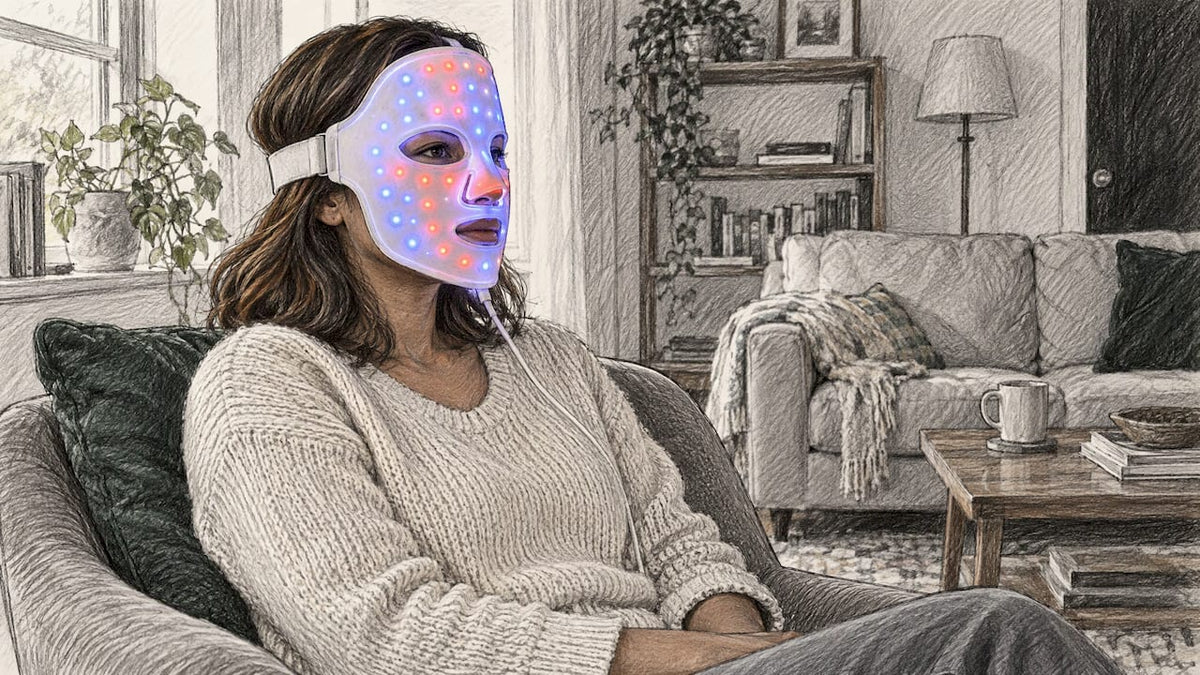
- Blue light is used for its antibacterial action and red light for calming inflammation. Combined masks use both.
- Consistency matters more than intensity: the studies use regular sessions over weeks, not occasional long ones.
- Light is aimed at inflamed pimples. It is not a treatment for blackheads, whiteheads or deep cysts.
- If you take light-sensitising medication, have a photosensitive condition or are pregnant, speak to a clinician before starting. We can review your skin in an online consultation.
Table of Contents
- How blue and red light act on acne
- What the research shows
- Which kinds of acne respond best
- Red light for skin and LED mask benefits beyond acne
- How often to use LED light for acne
- Safety: who should check first
- Home devices and in-clinic treatment
- Building a routine around light
- Our perspective
- Get a plan built for your skin
- FAQ
- Sources
How blue and red light act on acne
Acne develops when oil, dead skin cells and bacteria clog a pore and the surrounding skin becomes inflamed. The main bacterium involved is Cutibacterium acnes (C. acnes). It produces molecules called porphyrins, which absorb visible light. When blue light in the 400 to 445 nanometre range hits them, they generate reactive oxygen species, which damage the bacteria. This is the biological basis for blue light’s antimicrobial effect, according to a 2021 review of visible light and the skin.
Red light sits at a longer wavelength, roughly 625 to 700 nanometres, and travels deeper. A dermatologist quoted by Cosmopolitan describes red light as reaching around 6 mm into the skin against about 1 mm for blue. That is why red is associated with calming inflammation and supporting tissue repair, while blue works nearer the surface where the bacteria sit.
This pairing explains why many acne masks combine the two. Blue light addresses the cause at the surface, and red light addresses the redness and swelling that make a breakout look and feel worse.
What the research shows
The strongest recent evidence is for at-home devices. A 2025 JAMA Dermatology systematic review and meta-analysis by Ershadi and Barbieri pooled trials of red and/or blue LED devices used at home. Compared with control, they found:
| Measure | Improvement versus control |
|---|---|
| Inflammatory lesions | 45.3% greater change |
| Non-inflammatory lesions | 47.7% greater change |
| Investigator Global Assessment score | 45.7% greater change |
Improvement typically appeared after 4 to 12 weeks of use, and no severe adverse reactions were reported.
A 2024 systematic review of 35 studies covering 1,185 patients found that average total lesion counts improved by 43% at week 4. Blue light was used in about 64% of cases, and 95% of the blue-light patients showed partial clearance. The same review reported that minor side effects such as dryness, redness or irritation were the main thing patients noticed.
Individual device studies point the same way. In a 7-week open-label study of a wearable mask combining 415 nm blue and 633 nm red light, 30 people aged 14 to 45 used it four times a week at home. Both inflammatory and non-inflammatory lesion counts fell significantly, and 86% improved by at least one grade on the investigator’s global assessment. There were no device-related adverse events beyond mild, brief stinging (3%) and itching (7%) at the first visit.
A 2018 systematic review of light-emitting diodes in dermatology also summarised a trial in which 414 nm blue LED used every other day for 8 weeks cut lesion counts by 52% against no treatment, and a split-face red light trial showed 66% and 59% reductions in inflammatory and non-inflammatory lesions at 8 weeks.
What a realistic result looks like
A September 2026 review in the Journal of Drugs in Dermatology describes red light therapy as a safe adjunctive therapy with gradual, maintenance-based improvement. That matches how we frame it: expect steady, cumulative change over weeks, not a one-night reset. Your first fortnight is for building the habit. Judge results at around 8 weeks, which is where most trials measure.
Which kinds of acne respond best
The American Academy of Dermatology (AAD) is specific here. Its guidance says visible light treats pimples, meaning red, inflamed spots, and is not aimed at blackheads, whiteheads, acne cysts or nodules. The 2021 visible-light review likewise notes that inflammatory lesions may respond better than non-inflammatory ones.
In practice:
- Red, tender spots and pustules: the clearest fit for blue or combined blue and red light.
- Persistent redness after breakouts: red light is the wavelength associated with calming it.
- Blackheads and whiteheads: these usually call for an exfoliating or retinoid-based routine alongside any light.
- Deep, painful nodules or cystic acne: this needs a clinical assessment, and prescription treatment may be appropriate.
That last point is where a personalised plan matters. Light can sit next to prescription-strength skincare, but which ingredients and in what order depends on your skin. Our guide to the role of LED therapy in a regimen shows how it fits with serums and actives.
Red light for skin and LED mask benefits beyond acne
Many people search for red light because of general skin benefits, not just breakouts. Red and near-infrared wavelengths are widely used in cosmetic dermatology for skin rejuvenation, and the 2026 Journal of Drugs in Dermatology review recognises acne among the indications where red light is a reasonable adjunct. Combined masks are popular because one device offers a calming wavelength, an antibacterial wavelength and a routine that is easy to repeat.
Sensible expectations for a mask used regularly:
- Fewer new inflamed spots over several weeks.
- Less visible redness around active breakouts.
- A skincare step that is non-abrasive, so it sits comfortably alongside a gentle routine.
For a deeper look at the different device types, see how to select an LED mask and our piece on whether LED masks work for better skin.
How often to use LED light for acne
There is no single schedule, because devices differ in power. The published guidance gives a useful range.
- Follow your device’s instructions first. The AAD notes that at-home LED acne devices are generally used twice daily, and that some require 30 to 60 minutes per session for 4 to 5 weeks. Power varies a great deal between products.
- Reference ranges from trials. The 2018 systematic review suggests blue light at 6 to 40 mW/cm² or red light at 8 to 100 mW/cm², for 20 minutes, twice weekly for 4 to 8 weeks. The 2024 review’s combined blue and red group averaged 15-minute sessions twice a week over 8 weeks. The wearable mask study above used four sessions a week for 7 weeks.
- A dermatologist’s view. In Cosmopolitan, Dr Safaee recommends red light 2 to 3 times a week for 20 minutes, and blue light every other day for at least 8 weeks.
A sensible approach is to start at the low end of your device’s recommended schedule, use it on clean, dry skin, and keep a simple log. Take a photo in the same light once a week. Changes are easier to see in photographs than in the mirror.
Why skin can look worse at first
The question “why is my skin getting worse with red light therapy?” comes up often. In the 2024 review, 2% of patients using blue light (5 of 281 in the combined group) saw their lesions worsen, and minor side effects such as dryness, redness, rash, irritation or headaches occurred in 26%. If your skin feels tight, flaky or irritated, reduce the frequency and add a barrier-supporting moisturiser. If the reaction persists, stop and ask a clinician to review your routine.
Safety: who should check first
The AAD says red light appears safe in the short term, and that unlike ultraviolet light, research has not found it causes any type of cancer. The most common side effects are mild, temporary pain or irritated skin. It also advises seeing a board-certified dermatologist before use, because at-home red light can worsen an existing skin condition or interact with medicines that increase light sensitivity.
Speak to a doctor before starting if any of these apply:
- You use a medicine or topical that makes skin more sensitive to light. Your prescriber or pharmacist can confirm whether yours does.
- You have a photosensitising condition such as lupus or melasma. Dermatologist Amit Om, speaking to Axios, does not recommend red light therapy in these cases.
- You have darker skin and plan to use blue light regularly. Dr Safaee cautions about hyperpigmentation risk with blue light on deeper skin tones.
- You are pregnant. The 2018 review notes that LEDs may be especially suitable for pregnant people with acne, since retinoid treatments fall in pregnancy class C, but confirm your plan with your own doctor.
For a plain summary of the common skin reactions and precautions, read these red light therapy precautions.
Always protect your eyes with the goggles or eye cover supplied with your device, and never use a device that has been modified or damaged.
What FDA clearance tells you
In the United States, low-level light devices are cleared by the FDA, not approved. The AAD explains that clearance means the device poses a low risk, and it says nothing about how well the device works. Axios points out you can search the FDA database to confirm a clearance claim. Dr Safaee adds that clearance applies to a specific intended condition, and many products are labelled as cosmetic. When you choose a mask for acne specifically, look for one whose clearance covers acne. Our guide to the best LED mask for acne lists what to check, and is an LED mask worth it covers the value question.
Home devices and in-clinic treatment
At-home devices are less powerful than the ones used in a clinic. An AAD spokesperson told Axios that home devices will not match in-office laser results. The trade-off is convenience and safety: you can treat regularly, in short sessions, with very low risk.
Clinic-based light and energy treatments work differently, with fewer, stronger sessions. For people whose acne has left marks or texture, other professional options come into play. Microneedling is one: our guide to LED mask versus microneedling explains how each works and when they complement one another. The Dermalux phototherapy article from Dr Mandy Mak explains professional-grade LED in more detail.
Building a routine around light
LED light is one step. A routine that supports it might look like this:
- Cleanse with a gentle, non-stripping cleanser so the light reaches the skin, not a film of oil or make-up.
- Use light for the time and frequency your device specifies.
- Apply treatment actives as directed by your clinician, such as a prescribed retinoid or other prescription-strength product. Introduce one change at a time.
- Moisturise to protect the barrier.
- Wear sunscreen every morning. Post-acne marks darken with sun exposure.
We stock medical-grade cleansers, serums, moisturisers and sunscreens, so the whole routine can come from one place, chosen around your skin rather than around a trend. Our overview of clinically proven skincare devices and devices that deliver visible results explain where devices sit in a plan.
Our perspective
We see LED light as a supportive step, and the people who get the most from it are the ones who treat it as part of a plan. The research is encouraging: regular use over 4 to 12 weeks is associated with fewer inflamed spots, and the safety profile is gentle.
What shapes results is the plan around the light. Acne comes in different forms, and the right order of cleanser, active and light depends on your skin type, your tone, and any medicines you take. That is why we start with a conversation. Dr Mandy Mak is a UK-trained doctor, and our approach pairs prescription-strength, dermatologist-recommended products with one-to-one guidance, so the light fits your skin and not the other way round.
If you are travelling to London or Athens, or ordering from abroad, the same principle applies. A clear plan, set before you buy, makes it far easier to stay consistent for the eight weeks that the evidence says matter.
Jess
Get a plan built for your skin
If you are not sure whether blue, red or a combined approach suits your acne, or whether prescription skincare such as tretinoin should come first, our online skin consultation with Dr Mandy is the place to begin. It is available to international clients. You can also browse our medical-grade skincare range, or look at in-clinic options in London and Athens through The M-ethod Skin Clinic, including SkinPen microneedling.
FAQ
Does LED light therapy really work for acne?
A 2025 JAMA Dermatology meta-analysis found at-home red and/or blue LED devices improved inflammatory lesions by 45.3% compared with control. Results usually appear after 4 to 12 weeks of regular use. It is best seen as a supportive step within a wider routine.
How often should I use red light for acne?
Follow your device’s instructions, since power varies. Trials have used sessions of about 15 to 20 minutes, two to four times a week, for 4 to 8 weeks. The AAD notes that some at-home acne devices are used twice daily for 4 to 5 weeks.
What are the benefits of a blue light mask?
Blue light targets the C. acnes bacteria involved in breakouts, so it is used for inflamed spots. Combined masks add red light, which is associated with calming redness and supporting repair. Visible light is aimed at pimples, not blackheads, whiteheads or cysts.
Is LED light therapy safe for all skin types?
The AAD describes red light as safe in the short term, with mild, temporary irritation as the most common side effect. People on light-sensitising medicines, with photosensitive conditions, or with deeper skin tones using blue light should speak to a clinician first. Pregnant readers should also confirm with their own doctor.
Can I use LED light with prescription skincare?
Often yes, but it depends on the product and your skin. Some medicines increase light sensitivity, so ask a clinician before combining them. A consultation can set out the order and timing.
Sources
- At-Home LED Devices for the Treatment of Acne Vulgaris, JAMA Dermatology, 2025
- Visible Light in the Treatment of Acne Vulgaris, 2024 systematic review
- Visible Light Part I: Properties and Cutaneous Effects, 2021
- A 7-Week, Open-Label Study of a wearable LED mask, JCAD
- Light-emitting diodes in dermatology: a systematic review, 2018
- Red Light Therapy in Cosmetic Dermatology, Journal of Drugs in Dermatology, 2026
- Lasers and lights: How well do they treat acne? American Academy of Dermatology
- Is red light therapy right for your skin? American Academy of Dermatology
- Red light therapy masks: What doctors say, Axios, 2024
- Red Light vs. Blue Light Therapy, According to an Expert, Cosmopolitan
- Red light therapy precautions